"If the goal is 'complete virus eradication,' it is difficult to achieve... It was never the original goal"
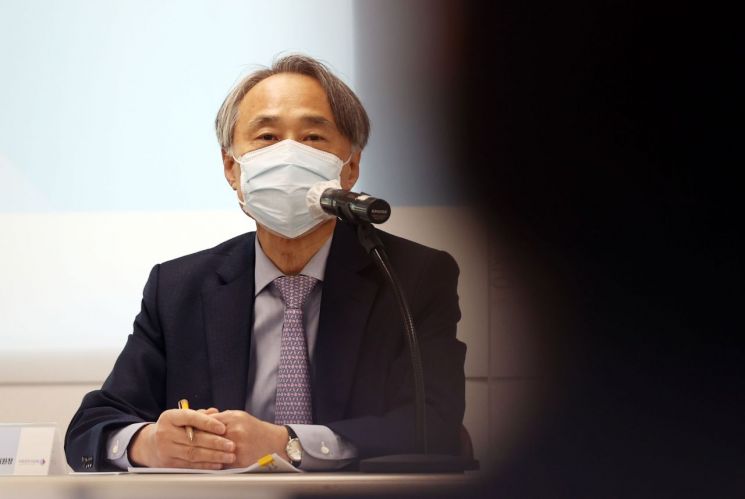
[Asia Economy Reporter Kim Ji-hee] Experts have expressed doubts about the government’s goal of achieving “herd immunity by November,” which has been promoted since the end of last year. In response, health authorities explained, “If the goal of herd immunity is the complete eradication of the COVID-19 virus, it may be difficult to achieve, but our goal is the restoration of daily life.”
Yoon Tae-ho, head of the Central Disaster and Safety Countermeasures Headquarters’ quarantine team, stated at a back briefing on the 4th, “The issue of achieving herd immunity should be approached by considering what the goal of herd immunity is,” adding, “It depends on whether the goal of herd immunity is virus eradication or the recovery of daily life.”
Yoon said, “Smallpox is almost the only disease eradicated through vaccines. In the case of COVID-19, there are many variants and the virus continues to evolve, so we never initially aimed to eradicate the virus through herd immunity,” and added, “Achieving COVID-19 herd immunity ultimately means the recovery of daily life, but it does not mean that simply getting vaccinated allows people to live exactly as before without any measures.” He further explained, “We are approaching this with the goal that once immunity is formed in a certain portion of the population without quarantine measures such as gathering bans, we can manage it at a level similar to seasonal influenza and live daily life.”
Earlier, Oh Myung-dong, chairman of the Central Clinical Committee on Emerging Infectious Diseases, attracted attention by stating at a press briefing the day before, “Even if 70% of the population is vaccinated, achieving herd immunity is difficult, and the COVID-19 virus will become endemic and coexist with us.” He pointed out, “Reaching a 70% vaccination rate does not automatically mean COVID-19 will disappear and social distancing will end,” and criticized, “The government’s definition of herd immunity focuses on a 70% vaccination rate, but there was no specific explanation of how people’s lives would change accordingly.”
As evidence for the difficulty of herd immunity, Chairman Oh cited the low “secondary infection prevention effect” of vaccines. He emphasized, “The 95% effectiveness of the Pfizer vaccine in preventing COVID-19 means it prevents illness in the vaccinated individual, not transmission to others,” and added, “There is currently no COVID-19 vaccine with over 95% effectiveness in preventing infection.”
According to Chairman Oh, even assuming an 80% vaccine transmission blocking effect, if 90% of the 85% of the population eligible for vaccination excluding children and middle and high school students who cannot be vaccinated receive the vaccine, the overall transmission blocking effect is only 60.8%. A recent study in the UK of over 360,000 households found that the transmission reduction effect of individuals who received one vaccine dose was between 38% and 49%.
Accordingly, Chairman Oh argued, “COVID-19 will become endemic like influenza,” and insisted that the COVID-19 response strategy should focus on “minimizing harm” by reducing severe cases and deaths.
© The Asia Business Daily(www.asiae.co.kr). All rights reserved.
![Clutching a Stolen Dior Bag, Saying "I Hate Being Poor but Real"... The Grotesque Con of a "Human Knockoff" [Slate]](https://cwcontent.asiae.co.kr/asiaresize/183/2026021902243444107_1771435474.jpg)











