Renault Group Accelerates Global Restructuring... Labor-Management Conflict 'Negative Factor'
"Union Strike Participation Rate 25%... 79% Normal Attendance Today"
[Asia Economy Reporter Yu Je-hoon] Renault Group is closely monitoring the escalating labor-management conflict at Renault Samsung Motors. As Renault Group is preparing a global-level plant restructuring plan, the labor and management at Renault Samsung Motors, who were negotiating the 2020 wage and collective bargaining agreement, are now in confrontation through a full strike and partial plant closure. Industry insiders express concerns that the labor dispute and resulting production instability could negatively impact Renault Samsung's medium- to long-term survival.
According to industry sources on the 4th, Renault Samsung implemented a partial plant closure starting at 7 a.m. that day. This was a response to the union's decision to carry out an 8-hour full strike, which was expected to cause production disruptions. Typically, a plant closure is the highest level of dispute action used by employers to enforce their position, but Renault Samsung chose a partial closure, opening the plant only to employees not participating in the strike. This is a desperate measure to maintain production amid successive strikes.
The extreme confrontation between labor and management continues because the 2020 wage and collective bargaining agreement has yet to be finalized. The union demands a 70,000 KRW increase in base pay and a 7 million KRW bonus, while the management, citing last year's operating loss of 79.6 billion KRW, proposes freezing base pay and paying a 5 million KRW bonus, resulting in a stalemate.
The problem is that this conflict could threaten Renault Samsung's survival. According to the industry, Renault Group is expected to announce a restructuring plan, including production volume allocation for its global plants, as early as this month. This means comparing and analyzing production costs at each plant to assess overall competitiveness, which is inevitably burdensome for Renault Samsung. Although Renault Samsung has implemented a restructuring plan called the ‘Survival Plan’ as a profitability enhancement strategy since the beginning of the year, production instability due to labor disputes continues.
In fact, in Renault Group's comprehensive production competitiveness (QCTP) ranking?which evaluates quality (Q), cost (C), time (T), and productivity (P) across its 19 plants?Renault Samsung fell from 1st place in 2018 to 10th place last year. Particularly, in the cost category, including factory manufacturing cost (VTU), it ranked 17th, below average. Given the labor disputes that have flared up since the beginning of this year, the ranking is likely to decline further.
A ‘warning signal’ has already been sounded at the headquarters level. Jose Vicente de los Mozos, Vice Chairman of Manufacturing and Supply at Renault Group, visited the Busan plant earlier this year and said regarding the XM3 production allocation, "If the promise of improving competitiveness is not kept, we will look for new ways." This can be interpreted as a warning that if the worst-case scenario continues, options such as volume reduction or even withdrawal could be considered. Renault Samsung’s partial plant closure in response to the union strike on this day is also against this backdrop.
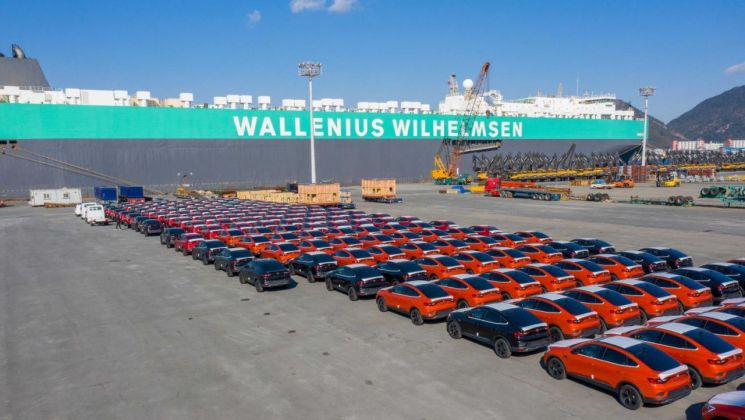
Among Renault Samsung employees, there are also many skeptical views about the strike. According to the company, about 79% of employees participated in production normally on that day. A Renault Samsung official said, "If production instability continues, it will inevitably affect future volume allocation as well as new car assignments," adding, "Right now, producing even one more New Arkana (the European export name for XM3) is the way Renault Samsung can survive."
© The Asia Business Daily(www.asiae.co.kr). All rights reserved.

















