Post-COVID Remote Work
Smart Work Expansion
KT Leads Domestic Service Commercialization
SKB Succeeds in Dedicated Terminal Development
Financial and Public Sector Services
Focus on Growing Demand for Network Separation
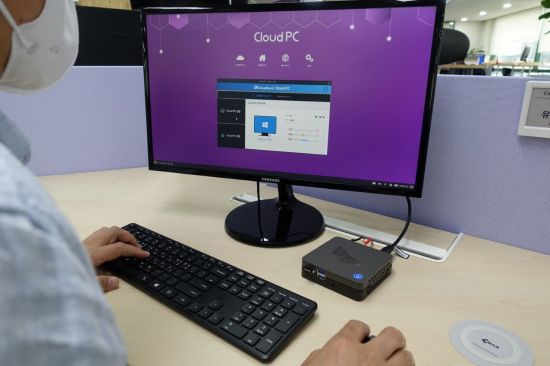
[Asia Economy Reporter Cha Min-young] Even after COVID-19, as smart work continues to expand, the three major telecommunications companies are engaged in a covert battle over the cloud PC market. This is because demand from the financial sector and public sector has significantly increased due to the spread of remote work and smart work, as well as the implementation of the Digital New Deal policy. In a situation where network separation is mandatory due to security issues, cloud PCs are regarded as new technology that enhances work efficiency.
Three Major Telecom Companies, Service-Type and On-Premise Domestic Solutions
According to the industry on the 4th, the three major telecom companies have entered fierce competition over the domestic cloud PC market. Cloud PCs are broadly divided into two types: service-type DaaS and on-premise VDI. The difference lies in that DaaS is provided by cloud service providers, while VDI is hosted and maintained by data centers, with DaaS being a more technologically advanced form.
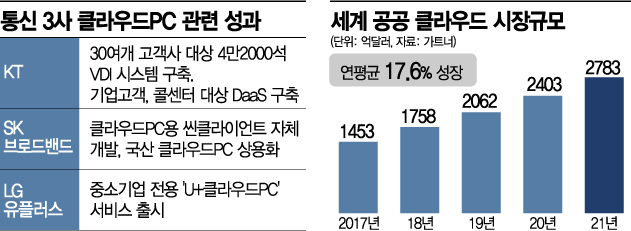
The most proactive is KT, the number one company in the related domestic field. KT is leading the localization of foreign DaaS such as Amazon Web Services (AWS). In December last year, it formed a partnership with Namu Technology and Citrix, and plans to launch an enterprise DaaS service this month that supports multiple corporate clients with a single software. Earlier in April this year, KT provided a service that replaced the computer room at the National Public Health Center to enable online practice, and is currently discussing services for call center agents with several call center outsourcing companies.
SK Broadband completed the development of its own thin client last month. Based on its existing Btv set-top box manufacturing capabilities, it succeeded in developing a dedicated terminal for cloud PCs. A thin client is a cloud PC access-only terminal equipped with minimal essential hardware and a lightweight OS, available in standard set-top box size, monitor-integrated, and laptop types. Even old desktop computers can improve the PC usage environment simply by installing a thin client, reducing terminal replacement costs.
LG Uplus launched the ‘U+ Cloud PC’ service for small and medium-sized enterprises with a monthly fee in the 30,000 KRW range in June last year and has been operating it for over a year. It offers both service-type and on-premise options, and users can access the cloud PC by logging in with an issued account on the U+ Cloud PC website.
Increasing Demand for Network Separation in Public and Financial Sectors
The sector attracting attention in the telecommunications industry is the demand for service-type network separation in the public and financial sectors. The domestic network separation market is estimated to grow to about 400 billion KRW in 2023. According to the government’s ‘Digital Government Innovation Promotion Plan’ announced in October 2019, the Ministry of the Interior and Safety, the Ministry of Science and ICT, and others are leading the application of internet network separation DaaS by this year. In November last year, the Ministry of Science and ICT and the Korea Internet & Security Agency (KISA) finalized the DaaS security certification system, laying the foundation for system transition.
Especially in places using shared PCs such as training centers, libraries, and government offices, using virtual computers is efficient not only for security but also for operational management. For example, when using thin clients, programs indiscriminately installed on shared PCs can be removed and restored without introducing a separate PC initialization solution. In-house IT staff can also remotely deploy software and perform batch updates using remote terminal management solutions.
Private companies are also actively considering the introduction of cloud PCs. They can be applied in various areas such as smart offices, remote work, smart schools, public institutions, and call centers. The importance of security for remote work terminals in public and financial institutions was emphasized due to the spread of remote work triggered by COVID-19. This phenomenon is observed globally as well. Market research firm Gartner analyzed that the global public cloud market has grown at an average annual rate of 17.6% from 2017 to this year.
Lee Bang-yeol, head of SK Broadband’s corporate division, said, "Following Ubuntu among open OSs, we plan to actively respond to the expansion of public DaaS led by government ministries by additionally applying Hancom’s Gureum OS."
© The Asia Business Daily(www.asiae.co.kr). All rights reserved.


















