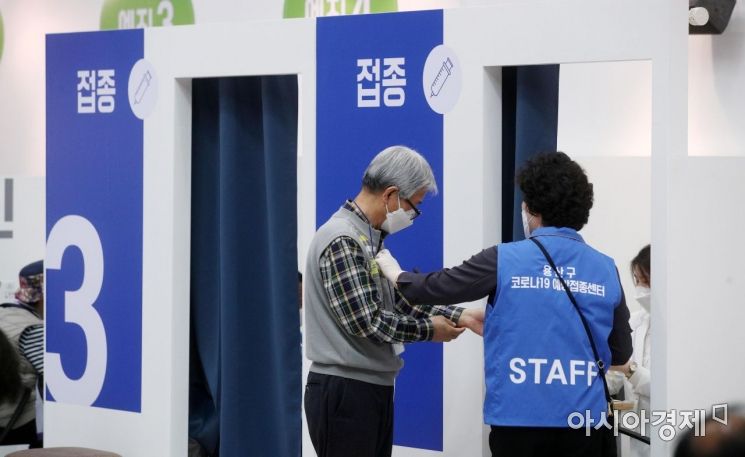
 On the 3rd, elderly and other vaccine recipients are entering the vaccination room at the vaccination center in Yongsan-gu, Seoul. Photo by Hyunmin Kim kimhyun81@
[Asia Economy Reporter Lee Seon-ae] The government plans to supply a total of 14.2 million doses of COVID-19 vaccines in May and June, aiming to vaccinate up to 13 million people in the first half of the year. The total volume introduced in the first half is 18.32 million doses, with an additional 230,000 doses of AstraZeneca (AZ) vaccine added to the original plan.
On the 3rd, the Ministry of Health and Welfare reported this plan titled 'COVID-19 Vaccine Supply Plan for May-June and Domestic Vaccine Development Support Measures' at the special COVID-19 response quarantine inspection meeting.
The vaccines secured by the government through individual pharmaceutical companies and the international project 'COVAX facility' total 192 million doses (enough for 99 million people).
Lee Ki-il, Director of Health and Medical Policy at the Ministry of Health and Welfare, stated in an online briefing that "This is 3.7 times our population," adding, "The United States secured 3.6 times (relative to population), and Japan about 2.5 times, so our government has secured a sufficient amount."
This figure is a simple division of vaccine doses by population. In the case of the United Kingdom, they secured 6.7 times their population in vaccine doses.
The government plans to import a total of 18.32 million doses of vaccines within the first half of the year.
Minister of Health and Welfare Kwon Deok-cheol said, "Originally, 18.09 million doses were scheduled to be supplied in the first half, but an additional 230,000 doses of AstraZeneca vaccine have been brought forward, making a total of 18.32 million doses supplied in the first half," adding, "The AstraZeneca vaccine was initially planned to be introduced at the end of May and June, but the schedule was advanced."
The Ministry of Health and Welfare explained that even excluding the additional 230,000 doses, the first dose can be administered to 13 million people, which is 1 million more than the original target of 12 million.
Among the vaccine doses supplied in the first half, 4.12 million doses have already been introduced, and about 3.33 million people have been vaccinated, while the remaining 14.2 million doses will arrive this month and next month.
Of the 14.2 million doses, 7.23 million doses of AstraZeneca vaccine will be sequentially supplied on a weekly basis from the 14th of this month until the first week of June. All 7.23 million doses are produced at SK Bioscience's Andong factory, with varying quantities supplied each week.
The government stated that based on confidentiality agreements, specific quantities are not disclosed but a significant portion will be supplied within this month.
A total of 5 million doses of Pfizer vaccine will be sequentially supplied in May and June.
Additionally, through COVAX, 1.67 million doses of AstraZeneca vaccine and 297,000 doses of Pfizer vaccine will be supplied within the first half of the year.
Separate from the 18.32 million doses planned for supply in the first half, the government is negotiating to introduce a total of 2.71 million doses of Novavax, Moderna, and Janssen vaccines contracted with each pharmaceutical company within the first half.
For Moderna vaccine, an initial quantity is expected to arrive within the first half.
The government also plans to support the introduction of a 'comparative clinical trial method' for pharmaceutical companies aiming to enter phase 3 clinical trials in the second half to secure domestic vaccines early. Comparative clinical trials are research methods to verify whether the efficacy of a vaccine under development is similar to that of a previously approved product. For example, France's Valneva is conducting comparative clinical trials between its vaccine under development and the AstraZeneca vaccine.
Specifically, the National Institute of Infectious Diseases and others plan to secure standard materials for comparative clinical trials and establish testing methods within the first half as much as possible, while expanding specimen analysis infrastructure.
To expedite trials, the government will conduct one-on-one reviews with pharmaceutical companies before the completion of phase 1 and 2 clinical trials this month, support the design of phase 3 clinical trials, and assist companies in recruiting clinical trial participants through the National Clinical Trial Support Foundation's pre-recruitment efforts.
Furthermore, the government will support pharmaceutical companies' clinical trials with a budget of 68.7 billion KRW this year and will pursue additional budget acquisition if necessary.
In addition, through inter-ministerial cooperation, the government will promote self-sufficiency of raw and subsidiary materials for overseas vaccine contract manufacturing companies.
© The Asia Business Daily(www.asiae.co.kr). All rights reserved.
![Clutching a Stolen Dior Bag, Saying "I Hate Being Poor but Real"... The Grotesque Con of a "Human Knockoff" [Slate]](https://cwcontent.asiae.co.kr/asiaresize/183/2026021902243444107_1771435474.jpg)
















