Real Estate Special Committee and Ruling Party Supreme Council Reach Consensus
Long-term Holding Special Deduction Rate for Capital Gains Tax
Expected to Discuss Full Revision or Abolition
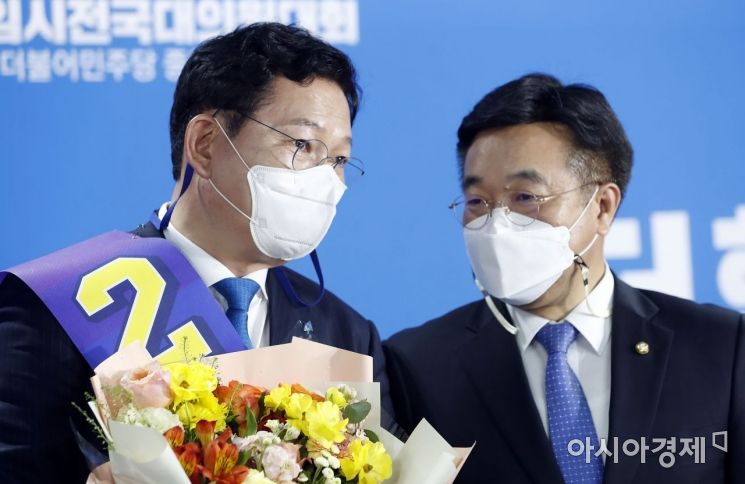 On the 2nd, Song Young-gil, who was elected as the new leader of the Democratic Party of Korea, is talking with floor leader Yoon Ho-jung. Photo by the National Assembly Press Photographers Group
[Asia Economy Reporter Koo Chae-eun] The first test for Song Young-gil, the newly appointed leader of the Democratic Party of Korea, who will handle real estate tax issues, is expected to be the 'reduction of capital gains tax benefits for rental business operators.' The scale and timing of the reduction of capital gains tax benefits for rental business operators (long-term holding special deduction rate of 70%) introduced by the August 2, 2017 measures, as well as whether to completely abolish them and retroactive legislation, are likely to become key agendas for the Democratic Party's future policies.
On the 3rd, a key official from the Democratic Party's Real Estate Special Committee said, "We will report the contents discussed in the special committee regarding the reduction of capital gains tax benefits for rental business operators to the new party leadership and continue related discussions," adding, "The withdrawal of capital gains tax benefits is the top priority issue being examined by the special committee." The official further explained, "At the time of the August 2 measures, the government strongly persuaded the party that registration was necessary to stabilize the rental market, and that incentives related to capital gains tax were needed for that purpose. There is now a consensus within the party that this was a policy failure."
Accordingly, full revision or abolition of the long-term holding special deduction rate for capital gains tax is expected to be actively discussed. According to Democratic Party real estate special committee officials, the government at the time failed to anticipate the rise in housing prices due to ultra-low interest rates, and the Ministry of Land, Infrastructure and Transport hastily established capital gains tax benefits for rental business operators through a 'Presidential Decree,' resulting in excessive privileges for rental business operators that distorted housing prices. Consequently, the intended effect of 'strengthening capital gains tax benefits for rental business operators → protecting tenants and revitalizing the rental market' did not materialize, and instead, many multi-homeowners registered as rental business operators to receive capital gains tax deductions and enjoy untaxed capital gains.
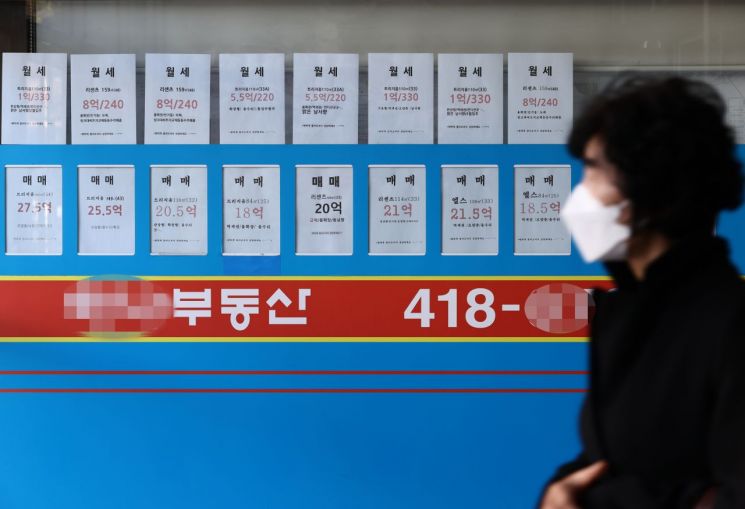
In fact, the top 20 real estate rental registration business operators hold more than 7,000 houses. Furthermore, with the recent rise in official land prices causing even single-homeowners to bear heavier property tax burdens, issues of fairness have been raised. Kang Byung-won, the newly appointed Supreme Council member, has also mentioned the 'abolition of rental business operator privileges.'
However, the backlash pointing to the erosion of policy credibility is expected to be significant. Three years after the August 2 measures, the government abolished the short-term (4-year) rental housing type and banned new registrations of rental apartments in the July 10 measures last year. This was in response to repeated criticisms that these were being exploited as loopholes to evade regulations on multi-homeowners. Woo Byung-tak, team leader of Shinhan Bank's Real Estate Investment Advisory Center, explained, "There are rental business operators who have not yet sold their properties and thus have not realized capital gains. This can be interpreted as an intention to revoke capital gains tax benefits in a form of 'quasi-retroactive' application." He added, "Since this could damage policy consistency, it is necessary to carefully review the detailed matters." Professor Shim Kyo-eon of Konkuk University's Department of Real Estate pointed out, "Regulations on rental business operators could reduce housing supply and cause greater harm to ordinary citizens."
© The Asia Business Daily(www.asiae.co.kr). All rights reserved.



















