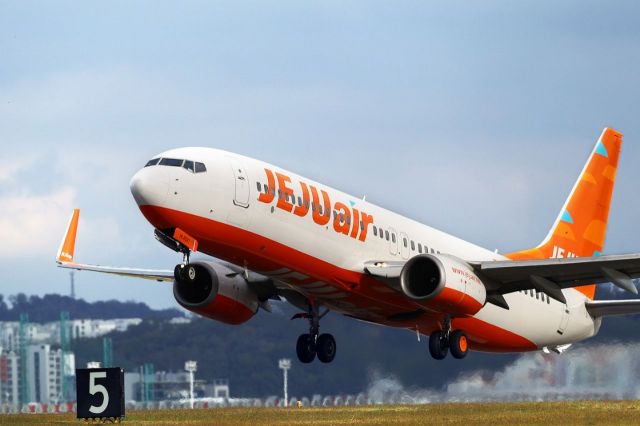
[Asia Economy Reporter Dongwoo Lee] Jeju Air ranked first in both passenger and cargo transport performance on a monthly basis last month. This achievement is attributed to the increase in spring tourists and the expansion of cargo routes.
According to the Ministry of Land, Infrastructure and Transport's Aviation Information Portal System on the 3rd, Jeju Air transported a total of 1,229,911 passengers from the 1st to the 30th of last month, including 1,225,504 domestic passengers and 4,407 international passengers. This is the first time in 1 year and 3 months since January last year (1,573,039 passengers), before the COVID-19 pandemic, that Jeju Air exceeded 1.2 million passengers.
Jeju Air attributed this to the increase in tourists visiting Jeju during the spring season and the growing travel demand from Jeju residents. In fact, on the 4th and 5th of last month, Jeju Air recorded a historic high of 101 daily domestic flights departing from Jeju, carrying about 17,000 passengers. During the same period, the international non-stop sightseeing flight occupancy rate also maintained an average of 90% following the previous month.
Following Jeju Air, the airlines with the highest passenger numbers were Jin Air (1,013,220), T'way Air (888,245), and Asiana Airlines (878,346), in that order.
In cargo transport performance, the company recorded 4,540 tons last month, ranking first among domestic LCCs. The company has shown a continuous upward trend for four consecutive months, transporting 1,671 tons in January, 3,273 tons in February, and 3,704 tons in March. Following Jeju Air were Jin Air (4,290 tons), T'way (3,993 tons), and Air Busan (3,649 tons).
Jeju Air's strategy to steadily expand its cargo transport business to minimize management losses caused by the prolonged COVID-19 pandemic is considered effective. Currently, the company operates cargo routes from Incheon to Haikou and Incheon to Taipei, and since March, it has added the Incheon to Ho Chi Minh route.
Earlier, Jeju Air CEO Kim I-bae announced at the beginning of this year that the company plans to explore new possibilities in business areas that were not core competencies, signaling an expansion of the cargo transport business as a COVID-19 exit strategy.
Meanwhile, the total number of passengers for domestic airlines last month was 5,973,862, a 13.0% increase compared to the previous month, while cargo transport totaled 228,866 tons, a 1.6% decrease during the same period.
© The Asia Business Daily(www.asiae.co.kr). All rights reserved.

















