Expansion of the 52-Hour Workweek System Two Months Away
Applied to 6.6 Million Workers...43% of All Employees
Worker Wage Compensation and 11-Hour Rest Period Regulations
"Regulatory Pressure on Companies Struggling Due to COVID-19"
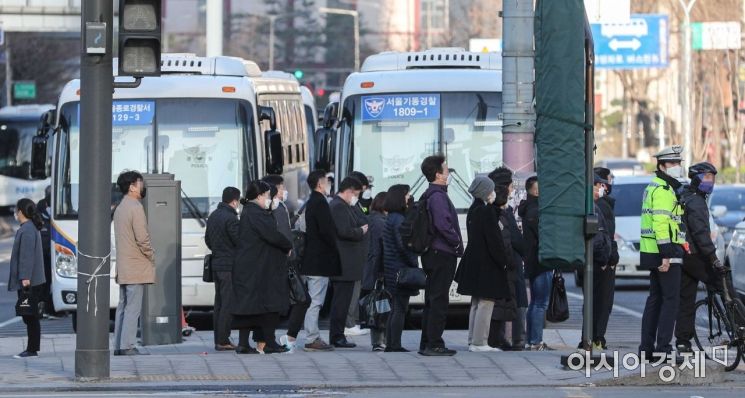
"The 52-hour workweek not only diminishes the competitiveness of startups but also dampens workers' motivation to work. While I understand the intent behind the regulation, I believe it is a system that is unfavorable to both companies and employees."
Park, the CEO of a subscription service startup, cautiously shared his thoughts on the 52-hour workweek system. His company has about 40 employees, and the 52-hour workweek will apply starting July 1 this year. Park said, "Startups are organizations where individuals invest more time and resources to achieve great results together." Since the employees joined fully understanding and choosing the high work intensity, it is difficult to confine them within the regulation of the 52-hour workweek. He added, "For technology-based venture companies, unlike the primary and secondary industries, simply adding more manpower does not directly lead to increased production," and "Hiring more people is not a viable solution, which is frustrating."
Flexible Work Systems Have Low Utilization in Small Businesses... "Different Grace Periods Needed"
Recently, the government expanded flexible work systems such as the flexible working hours system and selective working hours system (for new product and new technology R&D work), but it is not easy for small businesses to utilize them. Most places lack staff dedicated to administrative tasks, so the CEO must handle administrative procedures personally, which is challenging. To implement the system, employers must secure written agreements between labor and management, prepare wage compensation plans for workers, and provide 11 consecutive hours of rest, among other 'poison clauses' from the employer's perspective.
Certified labor attorney Park Sung-min said, "For subcontractors, where margins are almost non-existent, it will be difficult to reduce working hours while also maintaining wage compensation," adding, "This could be an obstacle to adopting flexible work systems." He further noted, "The wage compensation issue has not yet surfaced but has a high potential to become a controversy in the future."
The small and medium business sector insists that a grace period should be set to further postpone penalties for businesses with fewer than 50 employees. Yang Ok-seok, head of the Human Resources Policy Office at the Korea Federation of SMEs, stated, "Small businesses are not well informed about the 52-hour workweek system, so they have not been able to prepare countermeasures and are only growing anxious," and added, "Just as the law's application was deferred for companies with 50 or more employees, a grace period should also be given to businesses with fewer than 50 employees."
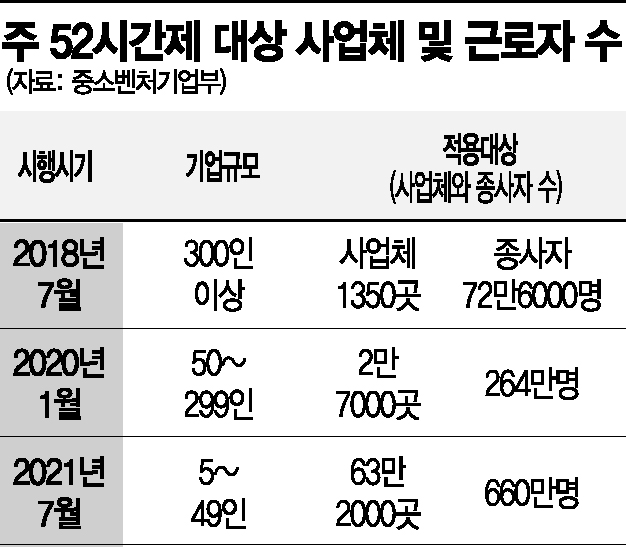
Applies to 6.6 Million Workers, 43% of All Employees
According to the Ministry of SMEs and Startups, from July this year, approximately 632,000 workplaces will newly become subject to the reduced working hours regulation, affecting about 6.6 million workers, which accounts for 43% of all employees. Compared to January 2020, when the 52-hour workweek was implemented for workplaces with 50 to 299 employees?covering 27,000 workplaces and 2.64 million workers?the scope of application is significantly expanding.
The manufacturing industry unanimously stated that chronic domestic labor shortages have been compounded by foreign labor shortages due to the COVID-19 pandemic, making it practically impossible to recruit workers. Shim, the CEO of a small business in the Seoul metropolitan area, said, "Nowadays, high school graduates tend to enter delivery jobs rather than manufacturing companies to learn skills," and appealed, "The government is pressuring companies with the 52-hour workweek without providing support measures for workforce development in manufacturing."
Signs of an 'exodus' of skilled employees have also begun to appear. In manufacturing sites, allowances such as overtime pay account for 30-40% of monthly wages beyond the base salary. Since additional work is no longer possible, monthly wages naturally decrease, and recently, severance pay?which is calculated based on salary?has also been cut, making some employees' departure inevitable. Lee Soo-kyun, director of the Busan-Gyeongnam Mold Industry Cooperative, said, "You can think of monthly wages dropping from 4 million won to 2.5 to 3 million won," adding, "Employees who have worked for 10 to 20 years face severance pay reductions of tens of millions of won, so they decide to quit or ask for early settlement of their severance pay."
© The Asia Business Daily(www.asiae.co.kr). All rights reserved.
![Clutching a Stolen Dior Bag, Saying "I Hate Being Poor but Real"... The Grotesque Con of a "Human Knockoff" [Slate]](https://cwcontent.asiae.co.kr/asiaresize/183/2026021902243444107_1771435474.jpg)

















