Price Gap Between Apartments Within 5 Years of Move-In and Over 10 Years Widens
Housing Environment and Amenities Influence... Demand Focused on New Apartments
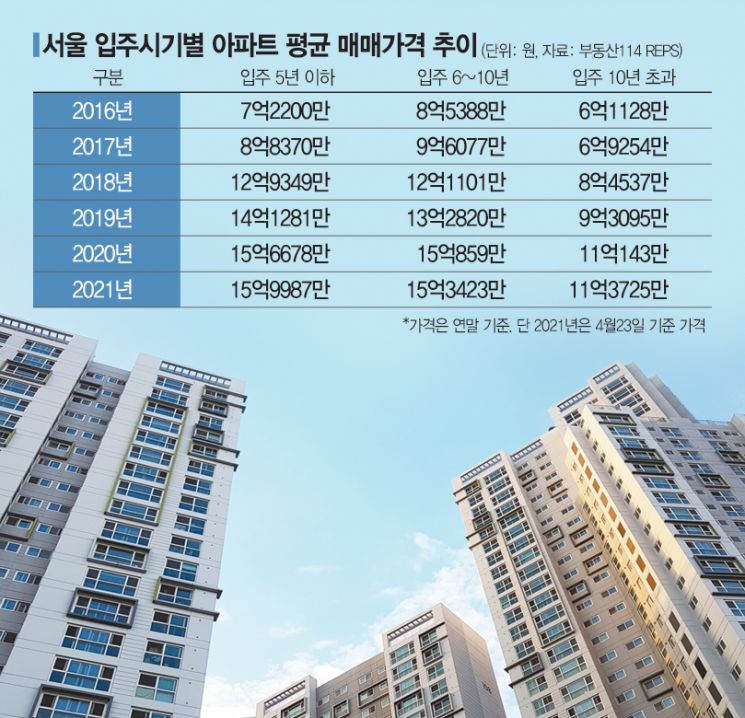
Average Price of New Apartments in Seoul Reaches 1.59987 Billion Won
Over 10 Years Old Average Price is 1.13725 Billion Won
[Asia Economy Reporter Ryu Tae-min] It has been revealed that the price gap between newly built apartments within 5 years of occupancy and old apartments over 10 years old is widening. Demand is concentrated on new apartments with differentiated floor plans, residential environments within the complex, and convenience facilities, and this gap appears to be reflected in market prices.
According to a survey by Real Estate 114 on the average sale price per household of Seoul apartments by age as of the 1st, the average price of newly built apartments within 5 years of occupancy reached 1,599.87 million KRW as of the 23rd. The prices of apartments occupied for 6 to 10 years and over 10 years were 1,534.23 million KRW and 1,137.25 million KRW, respectively.
As prices of new apartments rise sharply, the price gap with existing older apartments is expanding. The average sale price of new apartments increased by 877.87 million KRW (121.5%) since the end of 2016, while older apartments rose by only 525.97 million KRW (86%) during the same period. Accordingly, the price gap, which was 110.72 million KRW in 2016, has now widened to 462.62 million KRW.
The average price per household of new apartments was highest in Seocho-gu, where many new apartments were occupied through reconstruction in Banpo-dong and Jamwon-dong over the past 2 to 3 years, at 2,616.91 million KRW. This was followed by △ Gangnam-gu 2,499.82 million KRW △ Yongsan-gu 2,568.66 million KRW △ Songpa-gu 1,927.76 million KRW △ Jongno-gu 1,749.08 million KRW △ Seongdong-gu 1,709.57 million KRW △ Dongjak-gu 1,649.73 million KRW △ Gangdong-gu 1,523.68 million KRW △ Mapo-gu 1,483.36 million KRW. Yangcheon, Jung, Yeongdeungpo, Seodaemun, Gangseo, and Gwangjin-gu also had average sale prices of new apartments within 5 years exceeding 1 billion KRW.
Professor Seo Jin-hyung of Gyeongin Women's University (President of the Korean Real Estate Society) said, "Even if the initial sale price of new apartments is lower than the surrounding market price, they are so popular that a premium is added, leading to resale prices surpassing surrounding apartments and driving up housing prices."
As demand concentrates on new apartments, complexes that applied for subscription in the first half of this year recorded high competition rates exceeding three digits. ‘Jayang Haneulchae Ver’ in Jayang-dong, Gwangjin-gu, the first apartment for sale in Seoul this year, recorded a competition rate of 367 to 1, and ‘Godeok Gangil Jeil Punggyeongchae’ in Gangdong-gu closed its first subscription with a rate of 150 to 1.
The number of subscribers to the Housing Subscription Savings Account is also steadily increasing. According to the Korea Real Estate Board, as of the end of March, the number of subscribers nationwide exceeded 26.06 million, reaching 26,064,515. This is an increase of 62,108 subscribers compared to the previous month, meaning that one out of every two citizens holds a subscription account.
© The Asia Business Daily(www.asiae.co.kr). All rights reserved.
![Clutching a Stolen Dior Bag, Saying "I Hate Being Poor but Real"... The Grotesque Con of a "Human Knockoff" [Slate]](https://cwcontent.asiae.co.kr/asiaresize/183/2026021902243444107_1771435474.jpg)











