Analysis of Online Counseling by the Youth Counseling & Welfare Institute
Youth Reporting 'Depression and Withdrawal' Increased by 195.2% Compared to Last Year
Consultations Related to Obsession, Anxiety, and Suicide Doubled from the Previous Year
Parents' Consultations on 'Family Issues' Increased Since COVID-19
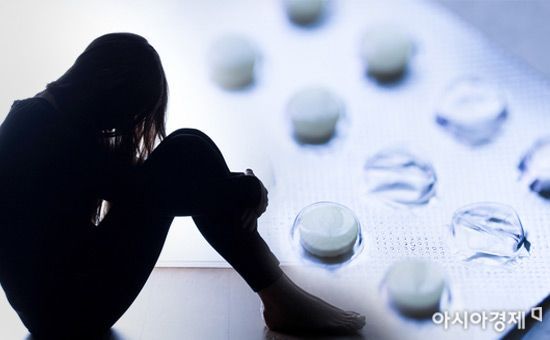
[Asia Economy Reporter Han Jinju] #A, a 20-year-old woman, repeatedly hospitalized and discharged due to self-harm and suicide attempts. After seeing her parents express disappointment over her depression caused by a celebrity's suicide, A felt increasingly useless and burdensome. Through online counseling, she learned appropriate ways to express her thoughts of 'wanting to die' and found ways to cope with conflicts with her parents.
It has been revealed that concerns about 'mental health' among adolescents have significantly increased since COVID-19.
On the 1st, the Korea Youth Counseling and Welfare Institute under the Ministry of Gender Equality and Family analyzed the results of online counseling in the first quarter of 2021. Mental health-related counseling (27,042 cases) accounted for 34.2% of the total, and the number of mental health counseling cases increased by 57.2% compared to the same period last year. The total number of online counseling cases in the first quarter was 79,132, a 28% increase compared to the same period last year.

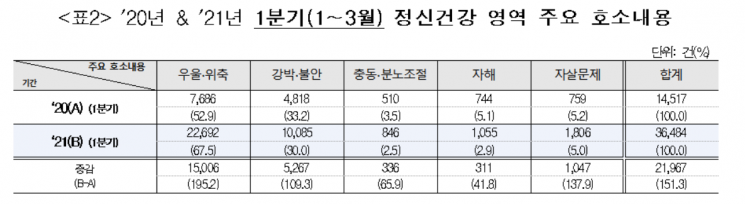
Among mental health-related counseling, the number of adolescents complaining of 'depression and withdrawal' increased by 195.2%. The number of counseling cases by content was ▲depression and withdrawal 22,692 cases (67.5%) ▲obsession and anxiety 10,085 cases (30.0%) ▲suicide issues 1,806 cases (5.0%) ▲self-harm 1,055 cases (2.9%) ▲impulse and anger control 846 cases (2.5%). Compared to the previous year, counseling for depression and withdrawal tripled, obsession and anxiety more than doubled, and counseling related to suicide issues also more than doubled.
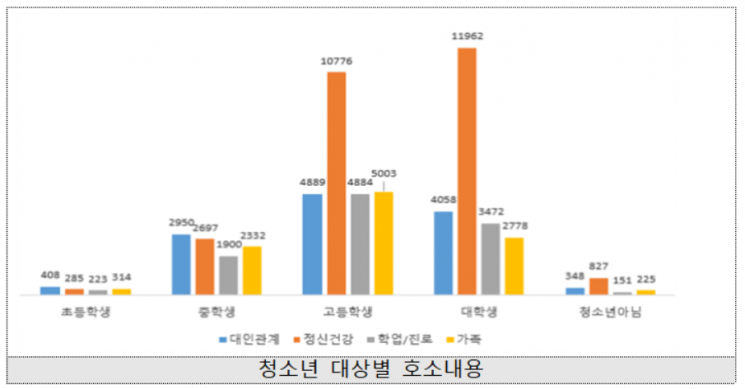
Besides mental health, there were many consultations about interpersonal relationships, family, and academic/career concerns. The proportion of counseling by cyber counseling content was ▲mental health (34.2%) ▲interpersonal relationships (16.8%) ▲family (14.1%) ▲academics and career (13.7%) ▲personality (4.4%) ▲sex (2.6%) ▲lifestyle habits and appearance (2.1%) in descending order. By age group, university and high school students mainly sought 'mental health' counseling, while elementary and middle school students had similar levels of counseling on interpersonal relationships and mental health.
Compared to 2-3 years before the outbreak of COVID-19, mental health counseling increased by 78.6 percentage points, family issues by 70.5 percentage points, academics and career by 20.5 percentage points, and interpersonal relationships by 5.8 percentage points.
Regarding mental health, the number of adolescents struggling with depression, withdrawal, obsession, and anxiety has increased, while concerns about friendships and school maladjustment due to reduced school attendance have decreased. On the other hand, anxiety about exams and academic stress related to academics and career have significantly increased.
A counselor at the Youth Cyber Counseling Center explained, "Before the COVID-19 outbreak, adolescents had places like schools and playgrounds to freely interact with friends, release energy, and relieve stress, but nowadays, it seems difficult to find psychological refuge in physical environments, which is a major problem."

There was a clear difference in concerns between adolescents and their parents. While family issues increased the most in parents' counseling content after COVID-19, adolescents had more concerns related to mental health.
A representative from the Youth Cyber Counseling Center explained, "Adolescents mainly express their emotional difficulties, which they cannot share with others or which close people cannot easily notice, through online counseling, while parents worry about their children's interpersonal problems or conflicts arising in their relationships with their children."
Adolescents experiencing everyday worries or psychological difficulties such as depression and anxiety can receive counseling through the 1388 Youth Hotline, chat counseling at the Cyber Counseling Center, or KakaoTalk.
© The Asia Business Daily(www.asiae.co.kr). All rights reserved.
![Clutching a Stolen Dior Bag, Saying "I Hate Being Poor but Real"... The Grotesque Con of a "Human Knockoff" [Slate]](https://cwcontent.asiae.co.kr/asiaresize/183/2026021902243444107_1771435474.jpg)


















