Possibility of Policy Shift Between First and Second Half of the Year
From Direct Cash Payments to Mid-to-Long-Term Investment and Tax Increase
Stock Market Uncertainty May Increase Reflecting Economic Recovery in Advance
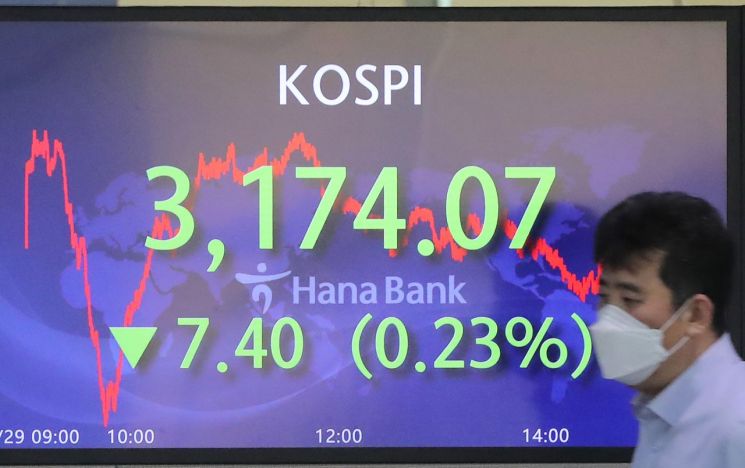 On the 29th, the KOSPI closed lower for the third consecutive day. The photo shows the dealing room at the Hana Bank headquarters in Jung-gu, Seoul, in the afternoon of the same day. [Image source=Yonhap News]
[Asia Economy Reporter Minwoo Lee] As the KOSPI has relinquished its previous upward momentum and remains trapped within a trading range, the U.S. stock market is also treading water. Although the Federal Open Market Committee (FOMC) and U.S. President Joe Biden's congressional speech proceeded as the market expected, uncertainties have not been fully resolved. Analysts emphasize the need to pay attention to changes brought about by U.S. fiscal policies, which differ in nature from those in the first half of the year.
On the 1st, IBK Investment & Securities stressed the importance of focusing on potential risks arising from changes in U.S. policies when forecasting the stock market. This is because both upside and downside risk factors have surfaced, including premature tapering (reduction in asset purchases), evaluations of an overheated stock market, and the formalization of Biden's additional stimulus package and tax increases.
Shaken Domestic and International Stock Markets... Increased Uncertainty
Recently, the KOSPI has failed to break out of its trading range. On the previous day, the KOSPI closed at 3,147.86, down 0.83% from the day before. Since first closing above the 3,200 mark on the 20th, it has fluctuated and gradually trended downward. The U.S. stock market is also sluggish. On the 30th of last month (local time), the Dow Jones Industrial Average closed at 33,874.85, down 0.54% from the previous day, at the New York Stock Exchange (NYSE). During the same period, the S&P 500 index fell 0.72% to 4,181.17, and the tech-heavy Nasdaq index dropped 0.85% to 13,962.68.
This week, caution seems to have been exercised due to U.S. policy issues such as the FOMC and President Biden's speech, as well as the partial resumption of short selling in the domestic stock market in May. Soeun Ahn, a researcher at IBK Investment & Securities, diagnosed, "Economic indicators and corporate earnings are showing a favorable trend, but expectations are already high, limiting the potential to lead a significant rise." Investor sentiment is similar. According to a survey by the American Association of Individual Investors on the stock market outlook for the next six months, expectations for both bullish and bearish markets have decreased, while neutral outlooks have increased.
The greatest concern is uncertainty regarding U.S. policies. Researcher Ahn explained, "Although the FOMC and President Biden's speech did not deviate from market expectations, they did not alleviate market uncertainty either. The Federal Reserve maintained a dovish stance but expressed concerns about an overheated stock market, and President Biden formalized an additional stimulus package worth $1.8 trillion (approximately 2,012 trillion KRW) along with tax increases on high-income earners and corporations."
Focus on Changes in U.S. Fiscal Policy... Different Nature in First and Second Halves of the Year
IBK Investment & Securities particularly emphasized caution regarding changes in fiscal policy. Researcher Ahn predicted, "Considering the U.S. employment situation, it is unlikely that the Fed will change its policy stance in the short term based on some asset overheating and imbalances. On the other hand, since tax increases are proposed as funding for the 'American Jobs Plan' and the 'American Families Plan,' concrete discussions and negotiations are likely to begin immediately." This means that the impact of U.S. fiscal policy may be reflected in the stock market sooner.
Above all, the policy focus differs between the first and second halves of the year. The American reconstruction policy proposed by President Biden consists of the 'American Rescue Plan' to overcome the COVID-19 crisis, the 'American Families Plan' to resolve polarization, and the 'American Jobs Plan' to drive medium- to long-term growth.
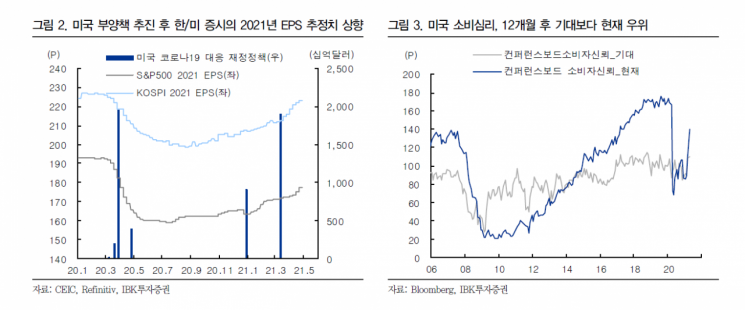
Until the first half of this year, since the COVID-19 shock has not been fully overcome, the focus is expected to be on rescue policies. The government directly supports weakened private demand by providing cash and subsidies. Researcher Ahn said, "In fact, short-term results are immediately visible in consumption indicators, raising expectations for economic growth and corporate profits. With the expansion of COVID-19 vaccinations and the easing of lockdown measures, deferred consumption will also contribute, sustaining a positive trend through the summer."
Infrastructure Investment Requires Time for Effect... Tax Increases Also Heighten Stock Market Anxiety
In the second half of the year, the other two policies, which differ in nature from the first half, are expected to be actively pursued. Regarding infrastructure investment, although the fiscal multiplier (effect of fiscal input) is large, it is likely to take time to generate private demand through increased employment. Welfare policies such as education and childcare support improve the quality of the economy but have a relatively small fiscal multiplier. In other words, unlike the immediate demand creation measures such as cash and subsidies in the first half, there are limitations to immediate demand stimulation.
Researcher Ahn analyzed, "Considering that the proportion of transfer income in personal income has increased since COVID-19, if there are no additional government subsidies, most individuals may experience effects similar to tax increases. Furthermore, if tax increases on high-income earners and corporations become a reality, it will inevitably act as a burden in terms of high-income earners realizing stock gains and some sectors experiencing profit hits."
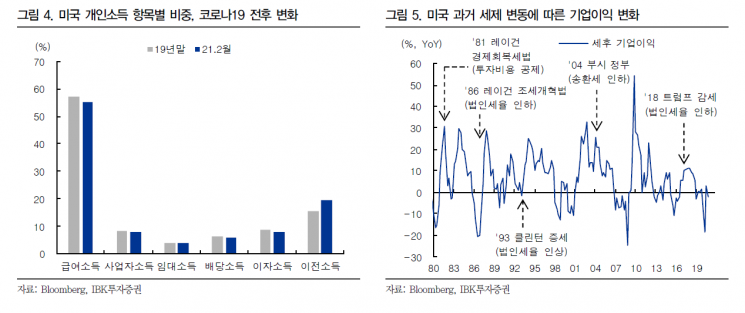
While there is no need to abandon a favorable view of the U.S. and domestic stock markets immediately, caution is necessary. Researcher Ahn explained, "Currently, the effects of crisis rescue policies, including cash payments, are dominant, and the extent of tax rate increases may be reduced during congressional negotiations. However, since the domestic market has already priced in expectations of a U.S. economic trickle-down effect, attention should be paid to the potential risks of changes in U.S. policies in the second half of the year."
© The Asia Business Daily(www.asiae.co.kr). All rights reserved.
![Clutching a Stolen Dior Bag, Saying "I Hate Being Poor but Real"... The Grotesque Con of a "Human Knockoff" [Slate]](https://cwcontent.asiae.co.kr/asiaresize/183/2026021902243444107_1771435474.jpg)


















