"Not effective and may only reduce administrative efficiency"
"Oppose ineffective laws... Need to unify laws related to public officials"
[Asia Economy Reporter Naju-seok] The Conflict of Interest Prevention Act, which had been shelved in the National Assembly for eight years, passed the plenary session on the 29th. It was passed under public pressure following the Korea Land and Housing Corporation (LH) scandal, but it was not approved unanimously. This was because a minority of lawmakers cast dissenting votes, arguing that the law was unrealistic and could only reduce administrative efficiency.
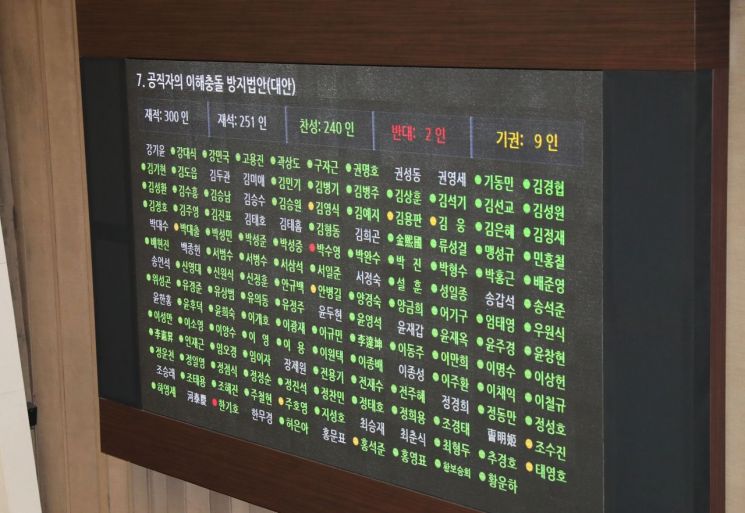
Park Soo-young, a member of the People Power Party who voted against the Conflict of Interest Prevention Act in the plenary session, said in a phone interview on the 30th, "I absolutely could not support it, so I voted against it." Park stated, "Some criticize it as anti-reform, but in fact, I am not opposed to the conflict of interest system itself," adding, "I judged that if a law is to be made, it should be done effectively and properly."
The Conflict of Interest Prevention Act, which passed the National Assembly with 240 votes in favor, 9 abstentions, and 2 against, prohibits public officials and others from pursuing private interests using undisclosed information obtained during the performance of their duties. It includes provisions requiring those involved in related duties to recuse themselves if they become aware of private interests. There have been claims that if this law had passed earlier, the LH speculation scandal could have been prevented, making it a hot topic in political circles. Politicians who want to put the LH incident behind them hoped that by passing this bill, they could achieve institutional improvements. Public outrage over the speculation by LH executives also strongly pressured the political sphere. This law was also discussed after the Sewol ferry disaster under the Act on the Prohibition of Improper Solicitation and Graft (Kim Young-ran Act), but due to controversies surrounding the bill, it was never passed. However, the LH incident created the conditions for the bill’s passage.
However, Park pointed out problems with the bill from the first public hearing on the statutory Conflict of Interest Prevention Act. He said, "Related laws such as the Public Officials Ethics Act, the Anti-Corruption Act, and the Improper Solicitation and Graft Act are somewhat mixed, so adding another law in this state?is that consistent with the legal system?" He expressed concern that "we will become the country with the most public official ethics or conflict of interest prevention laws in the world."
He also emphasized that making many laws is not necessarily a good thing. During the bill review process, Park pointed out, "Public officials have to look at the Public Officials Ethics Act for general principles, the Conflict of Interest Prevention Act for specific regulations, and the Code of Conduct for Public Officials for sanctions or disciplinary measures." To solve this problem, he also argued for the need to integrate the scattered public official ethics-related laws under the Anti-Corruption and Civil Rights Commission and the Ministry of Personnel Management into one. It should be made easy to understand so that public officials and citizens can "know at a glance." In fact, among advanced countries, none have as many anti-corruption-related laws as Korea. According to Park, excluding Korea, the country with the most is the United States with three laws, while Korea has six, including the Conflict of Interest Prevention Act.
He also pointed out problems with the law itself. There are issues of feasibility in managing 1.89 million public officials and their direct relatives, and problems with the approach of treating them as potential criminals. He criticized, "There are already five related laws, and if it increases to six with this new one, administrative efficiency will plummet as public officials have to check which law applies." This could lead to the paradoxical situation where public officials have to constantly check for conflicts of interest while working. During the bill review process, Park said, "A female public official bought land from her in-laws again. There will be parts where we have to ask if she has assets," adding, "The intention is good, but realistically, it could disrupt family peace."
These concerns were actually shared within the Political Affairs Committee, but under public pressure, the bill was processed at a rapid pace.

Park also expressed concern about the rushed preparation of the bill following the LH incident. He criticized, "Is there a case where a statutory law is made within a month?" and said, "There should have been a careful review and deliberation process, but the legislative review procedure was absurdly fast," adding, "It is a law without effectiveness or realism, and it was just a show to sweep away the LH incident."
However, Park’s call for unifying public official ethics-related regulations at the government-wide level was partially reflected in the Conflict of Interest Prevention Act amendment. The supplementary opinion on the amendment includes provisions that the Anti-Corruption Commission will report to the Political Affairs Committee within six months on plans to integrate related anti-corruption laws and will strive toward this goal. This is a promise that the government will now take a legislative direction toward integrating the fragmented public official ethics-related regulations.
© The Asia Business Daily(www.asiae.co.kr). All rights reserved.
![Clutching a Stolen Dior Bag, Saying "I Hate Being Poor but Real"... The Grotesque Con of a "Human Knockoff" [Slate]](https://cwcontent.asiae.co.kr/asiaresize/183/2026021902243444107_1771435474.jpg)

















