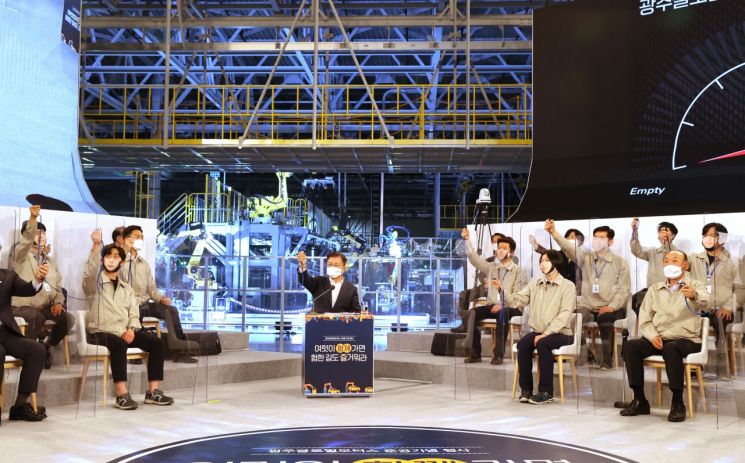
[Asia Economy Reporter Lee Ji-eun] President Moon Jae-in visited Gwangju Global Motors (GGM), which will be completed on the 29th, and stated, "The Gwangju-type job is a challenge to find a new balance in our economy," adding, "We will nurture it as another successful strategy for our economy." He emphasized that even if wages are low, if the level of 'social wages' such as housing, transportation, welfare, and cultural services is high, it can be a good job, and that the government and local governments must cooperate to raise social wages.
At the GGM factory completion ceremony in Gwangju that day, President Moon said, "(The Gwangju-type job) is an attempt to create new jobs through respect for the value of people and labor and labor-management cooperation, and to build an economy where workers and companies grow together."
GGM is the nation's first 'win-win regional job' company, bearing fruit just two years and three months after signing an agreement through a labor-management-civil-government consensus in January 2019.
President Moon emphasized, "It is the future of Gwangju and the future of the Republic of Korea, born from a social grand compromise among Gwangju citizens, local governments, and labor," adding, "Now, the city of democracy, Bitgoeul Gwangju, has added the name of coexistence."
He also highlighted the effect of creating youth jobs. President Moon stressed that this GGM factory is the first complete car factory established in Korea in 23 years, stating, "By each side making small concessions and joining forces, we have proven that it is possible to keep companies that were heading overseas and create good jobs."
He added, "Among the 385 employees hired so far, more than 70% are young people in their 20s and 30s from Gwangju and Jeonnam, and all are stable regular jobs," adding, "When companies maintain appropriate wage levels based on social agreements, they will provide more opportunities and hope to the youth."
He also foresaw it as a new leap forward for the regional economy. President Moon said, "More than 20,000 parts go into one complete car, and if production increases to 70,000 units annually, it will lead to the growth of various local companies," adding, "In addition to 900 direct jobs, 11,000 indirect jobs will be created, increasing the income of local residents and revitalizing neighborhood businesses."
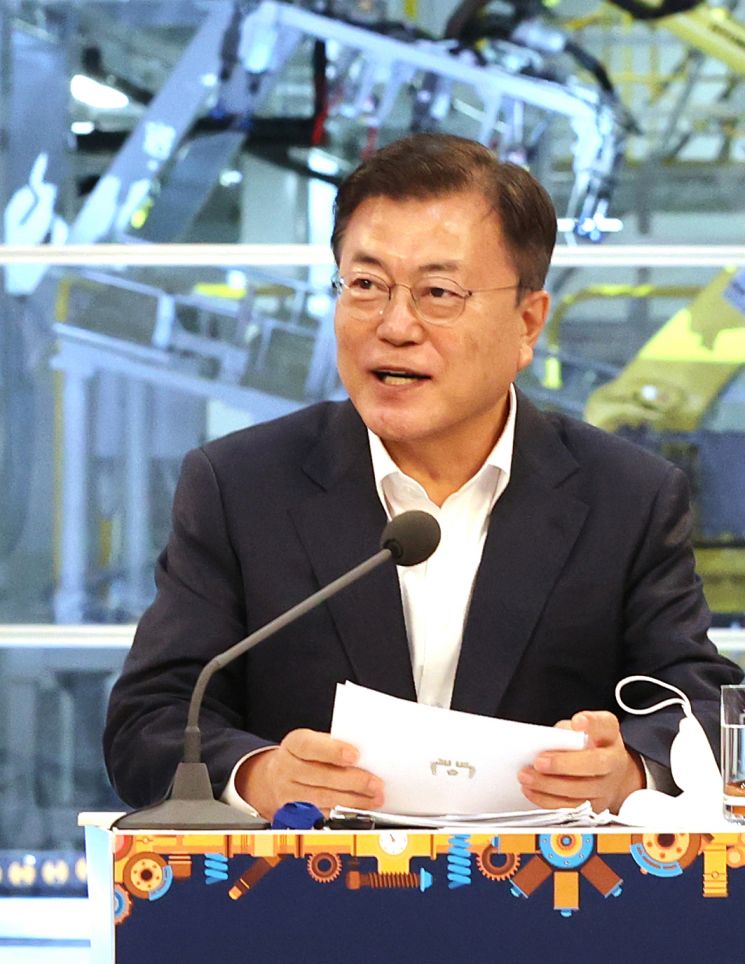
He also expressed the intention to expand win-win jobs nationwide, not just in Gwangju. President Moon said, "Win-win jobs have spread to Miryang, Daegu, Gumi, Hoengseong, Gunsan, and Sinan, with a total investment of 61 trillion won and the creation of 130,000 jobs planned," adding, "Efforts to find new win-win regional job models are ongoing across the country even at this moment, and some places aim to sign agreements within this year."
He also mentioned the connection with the regional balanced New Deal. President Moon said, "Various attempts are being explored, from sharing benefits with regions and residents to ultra-wide cooperation beyond administrative boundaries," adding, "Now, Korea will move forward as an inclusive innovation nation that leaps higher together with the confidence gained from the success of the Gwangju-type job."
President Moon said, "We will nurture win-win jobs as another successful strategy for our economy through various supports," adding, "Especially if regions propose creative job projects through social agreements, the government will actively seek customized support measures."
After the event, President Moon also emphasized the necessity of 'social wages' in his closing remarks. He said, "Until now, we have recognized that good jobs are determined by wages received from companies," adding, "However, if housing, transportation, welfare, and cultural services that can be socially provided are offered at a high level, combined with wages from companies, it can create good jobs."
He continued, "Earlier, the mayor of Gwangju gave a very good expression called 'social wages.' While wage conditions received from companies are decided between labor and management, social wages are determined by the civil and government sectors of labor, management, civil, and government," adding, "If the central government and local governments cooperate to raise social wages, even if the wage level paid by companies is not the highest, good jobs can still be created."
© The Asia Business Daily(www.asiae.co.kr). All rights reserved.
![Clutching a Stolen Dior Bag, Saying "I Hate Being Poor but Real"... The Grotesque Con of a "Human Knockoff" [Slate]](https://cwcontent.asiae.co.kr/asiaresize/183/2026021902243444107_1771435474.jpg)

















