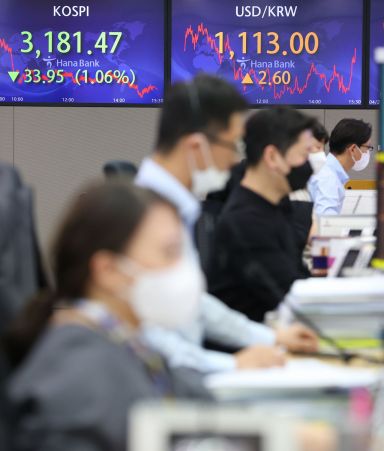
[Asia Economy Reporter Lee Seon-ae] Ahead of the resumption of short selling on May 3, domestic stock markets closed lower amid weakened investor sentiment. Selling pressure from foreigners and institutions prevented the index from turning upward, and profit-taking due to price burdens also fueled the decline.
On the 29th, the KOSPI index closed at 3,174.07, down 7.40 points (0.23%) from the previous day. As the index recently climbed back above the 3,200 level, price pressure increased. After reaching an all-time closing high of 3,217.53 on the 26th, the index fell for three consecutive trading days. However, during these three days, it repeatedly fluctuated above and below the 3,200 mark intraday. Profit-taking selling surged at these high prices.
The upcoming resumption of short selling next month also weighed on the market. On May 3, short selling will resume for KOSPI 200 and KOSDAQ 150 stocks. Short selling is an investment technique where investors borrow shares they do not own and sell them to gain profits. While it has the positive effect of curbing stock price bubbles, it can also act as a factor that drives prices down.
Lee Won, a researcher at Bukook Securities, explained, "As the market recently recorded the 3,200 level again, the price burden has increased. Along with this, anxiety over the resumption of short selling is spreading, causing increased market volatility."
Foreigners and institutions both engaged in net selling, with foreigners and institutions selling a net 13.5 billion KRW and 15.1 billion KRW respectively. In contrast, individual investors bought a net 33.7 billion KRW.
Among the top market capitalization stocks, LG Chem (6.85%), Samsung Biologics (1.14%), and Samsung SDI (0.75%) closed higher. Meanwhile, Samsung Electronics (-0.49%), NAVER (-1.87%), Kakao (-2.09%), and Hyundai Motor (-1.81%) declined. SK Hynix ended the day unchanged.
The KOSDAQ index also closed lower. It fell 7.58 points (0.76%) to 990.69. After dropping below the 1,000 mark the previous day, the decline widened. Like the KOSPI, it has been weak for three consecutive trading days. Individuals and foreigners were net buyers of 96.4 billion KRW and 11.0 billion KRW respectively, while institutions were the sole net sellers with 97.2 billion KRW.
Top market capitalization stocks also declined. Celltrion Healthcare fell 0.09%, Celltrion Pharm 1.59%, Kakao Games 1.62%, and EcoPro BM 2.37%.
The won-dollar exchange rate fell (won strengthened). In the Seoul foreign exchange market, the won-dollar rate closed at 1,108.2 won, down 4.8 won from the previous day.
Jeong In-ji, a researcher at Yuanta Securities, said, "After the KOSPI attempted to break through the 3,200 level on the 20th and went through a short-term correction before rising again, the advance was limited around 3,220. The January high range of 3,200 to 3,260 is expected to be a very strong resistance zone, so failing to surpass this resistance is a natural phenomenon."
He added, "The market is likely to continue a directionless trend for the time being. However, if a correction phase proceeds, levels around 3,150 or 3,100 will serve as important short-term support. Ultimately, if the index falls below the 60-day moving average and this moving average confirms resistance, it can be considered that the market has entered a mid- to long-term correction phase."
© The Asia Business Daily(www.asiae.co.kr). All rights reserved.
![Clutching a Stolen Dior Bag, Saying "I Hate Being Poor but Real"... The Grotesque Con of a "Human Knockoff" [Slate]](https://cwcontent.asiae.co.kr/asiaresize/183/2026021902243444107_1771435474.jpg)











