Yang 1st Vice Minister, Press Corps Meeting on the 29th
One Month Since Immediate Separation System for Child Abuse Implemented,
Expansion of Shelters and Psychological Treatment Centers for Victimized Children
Regarding National Pension Reform, "Social Discussions Must Continue"
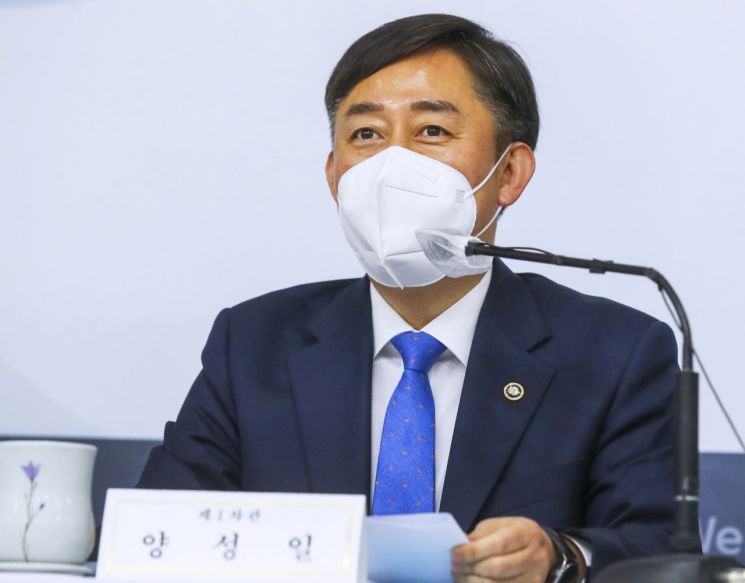 Yang Seong-il, the 1st Vice Minister of Health and Welfare, is answering questions at a press briefing held at the Government Sejong Complex on the morning of the 29th. (Photo by Ministry of Health and Welfare)
[Asia Economy Reporter Kim Ji-hee] Yang Seong-il, the First Vice Minister of the Ministry of Health and Welfare, expressed his commitment to strengthening support for the protection of child abuse victims separated from their families in relation to the Immediate Separation System for Child Abuse, which has been in effect since the end of last month.
At a press briefing held at the government Sejong Complex on the 29th, Vice Minister Yang said, “The Immediate Separation System, which mandates the unconditional separation of the family and child if the conditions for child abuse are met, has been implemented since the end of March. Although separation measures have increased compared to last year, support for how to safely protect children after separation and quickly restore the family is even more important.”
Earlier, the Ministry of Health and Welfare implemented the Immediate Separation System from the 30th of last month, which allows children who have been reported as suspected abuse victims more than twice a year to be immediately separated from the abuser and protected. As of midnight on that day, a total of 141 separation measures due to child abuse were recorded. Among these, 108 were emergency measures and 33 were immediate separations. Compared to 91 cases during the same period last year when only emergency measures were possible, the number of separation measures itself has increased, and immediate separations are also being carried out.
Recently, the Ministry of Health and Welfare has been focusing more on child protection after separation. As part of these efforts, shelters for child abuse victims, which are expected to see increased demand due to the implementation of the Immediate Separation System, are also being expanded. The number of child shelters is being increased from 76 last year to 105 this year. Additionally, temporary protection facilities, currently operated in 11 locations across 7 cities and provinces, are also being expanded. Vice Minister Yang stated, “Psychological counseling is now available through psychological treatment centers established at child protection specialized agencies in all 17 cities and provinces, and the number of designated medical institutions specializing in abused children has increased to 48 as of the 15th.”
Furthermore, a new home protection project for crisis children under the age of two is being launched. By the end of this year, 200 families will be selected to protect the children and, if necessary, return them to their original families. Vice Minister Yang explained, “Along with investigations by child abuse investigation officers, child protection specialist committees jointly assess and decide how to protect the victimized children and whether to return them to their original families. Afterward, the specialist committee manages the case for a certain period, but after six months, continuous management is carried out by the child protection specialized agency.”
Currently, 453 child abuse investigation officers (as of March 15), who investigate and separate cases immediately after abuse occurs, are deployed in the field. The Ministry plans to deploy a total of 624 officers by the end of this year.
Regarding the slow progress in discussions on national pension reform, Vice Minister Yang took a fundamental stance, saying, “It is an issue that requires intergenerational consideration and continuous social discussion.” Previously, the Ministry of Health and Welfare announced the 4th Comprehensive National Pension Plan at the end of 2018, submitting four options to the National Assembly: maintaining the current system, raising the basic pension to 400,000 won, increasing the contribution rate to 12% with a 45% income replacement rate, and increasing the contribution rate to 13% with a 50% income replacement rate.
He said, “Even in European history, pension reform has been such a difficult issue that successful reform often led to a change in government. Although the current administration submitted a pension reform plan to the National Assembly, I hope there will be serious social discussions on alternatives and opportunities for the Ministry of Health and Welfare to support them.” He added, “The direction of reform should be achieved through social consensus and completed by legislation in the National Assembly.”
© The Asia Business Daily(www.asiae.co.kr). All rights reserved.

















