Government's Gap with 'Official Unemployment Rate'
Widens Significantly Due to COVID
Concerns Over Blind Spots in Employment Policy
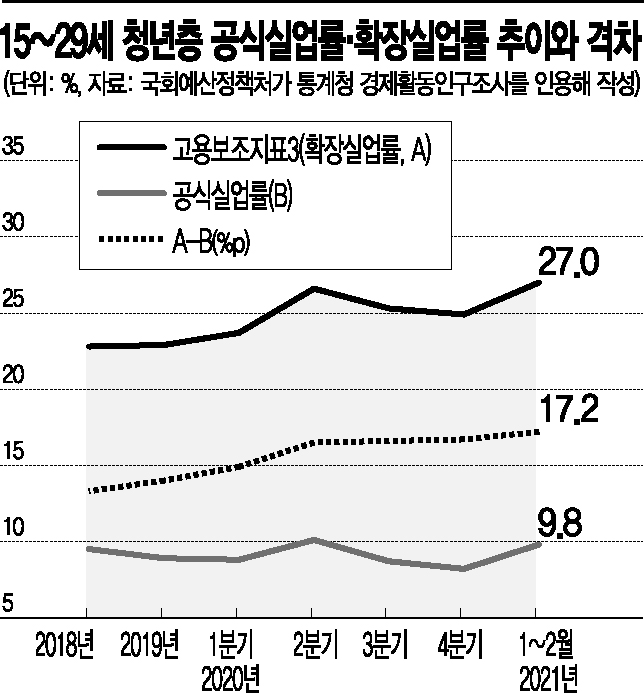
[Sejong=Asia Economy Reporter Moon Chaeseok] The gap between the government's official unemployment rate and the 'perceived unemployment rate,' which includes employed persons who cannot work as much as they want, has significantly widened due to COVID-19. This means that the number of 'unemployed persons not classified as official unemployed' has increased due to changes in job types. There are concerns that if the government continues to base employment policies solely on the official unemployment rate, those experiencing perceived unemployment may be left in a blind spot.
According to the report "Employment Situation of Youth Aged 15-29 After COVID-19 Examined Through Employment Supplementary Indicators" published on the 29th in the April issue of Economic and Industrial Trends & Issues by the National Assembly Budget Office, the gap between the youth expanded unemployment rate and Statistics Korea's official unemployment rate widened from 13.3 percentage points in 2018 to 17.2 percentage points in January-February this year. In particular, the gap rapidly increased from 14.9 percentage points in the first quarter of last year to 16.5 percentage points in the second quarter, when the impact of COVID-19 became more pronounced. The gap remained in the 16 percentage point range until the fourth quarter of last year and expanded to the 17 percentage point range this year.
This indicates a difference between the government's official unemployment statistics and the perceived unemployment rate. Statistics Korea classifies "persons who did not work during the survey week but have sought work in the past four weeks and are available to work as soon as a job is offered" as official unemployed. However, the increase in the potential labor force, which includes those who have the conditions or willingness to work more beyond the unemployed, is growing faster. According to Statistics Korea, the number of persons available for additional employment related to working hours increased from 102,000 in 2019 to 155,000 in January-February this year, while the number of official unemployed increased only slightly from 386,000 to 398,000 during the same period. Statistics Korea's expanded unemployment rate rose from 22.9% in 2019 to 27.0% in January-February, an increase of more than 4 percentage points.
The Budget Office emphasized in the report that government employment measures should be more based on the expanded unemployment rate. Yoo Geunsik, an economic analyst at the Budget Office, said, "The unemployment rate perceived by youth is rising rapidly after COVID-19," and urged, "The government should analyze in detail the causes of the widening gap between the official youth unemployment rate and the expanded unemployment rate after COVID-19."
The government has also expressed concerns about a recovery without employment. At a forum held yesterday by the Presidential Committee on Income-Led Growth, Kim Yonggi, Vice Chairman of the Jobs Committee, and Hwang Seonwoong, professor at Pukyong National University, diagnosed that "the possibility of a recovery without employment is increasing after the COVID-19 crisis."
© The Asia Business Daily(www.asiae.co.kr). All rights reserved.

















