Despite Peak of Famous Brands
Sales Decline and Operating Losses to Closure for Small and B2B Sales Companies
Housing Market Slump and COVID Impact
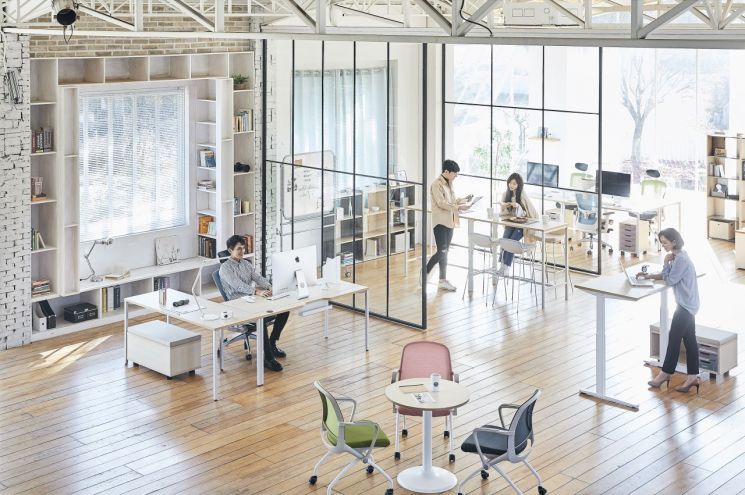 Coas, which gained global fame in 2010 as the official chair for the Seoul G20 Summit, is currently a solid company ranking second in the domestic office furniture market with a 23% market share (as of 2019). However, it has not been able to overcome the limitations of COVID-19 and B2B sales. The photo shows a Coas store.
 [Photo by Asia Economy DB]
[Asia Economy Reporter Kim Jong-hwa] The phenomenon of "the rich getting richer and the poor getting poorer" is intensifying in the furniture industry. While well-known brands such as Hanssem and Hyundai Livart are enjoying their heyday, small and medium-sized companies with weak brand power are either going out of business or struggling, especially those with a high proportion of B2B (business-to-business) sales.
According to the Financial Supervisory Service's electronic disclosure system and industry sources on the 3rd, Hanssem, the number one company in the furniture industry, posted sales of 553.1 billion KRW and an operating profit of 25.2 billion KRW in the first quarter, marking a 12.3% increase in sales and a 46.8% increase in operating profit compared to the same period last year, continuing its upward trend this year.
Hyundai Livart recorded sales of 350.4 billion KRW and an operating profit of 12.5 billion KRW in the first quarter, a 15.88% decrease compared to the same period last year. However, this decline was temporarily reflected in the first quarter due to the burden of smart factory investments and new store expansions, and the upward trend remains clear.
However, companies like Enex and Neps, which focus on built-in furniture (special sales furniture) and have a high proportion of B2B transactions with construction companies, are going through difficult times. The downturn in the housing market and market changes caused by COVID-19 are the main reasons. The proportion of special sales furniture in sales is 70% for Enex and 90% for Neps. In contrast, Hanssem is at 8% and Hyundai Livart at 20%, indicating a significantly higher proportion of special sales furniture for these companies.
The number of apartment units supplied, which was 530,000 in 2017, was halved to 180,000 in 2018, causing a sharp drop in special sales furniture sales. Since special sales furniture sales occur only after apartments are supplied and residents move in, the poor performance in 2018 was reflected last year and continues to affect this year.
An industry insider said, "B2C companies with a high proportion of direct sales to consumers recorded good performance due to strong retail sales, but companies with a high proportion of special sales all tasted bitterness. It will be difficult until this year. B2B companies are deeply considering their future direction."
Enex posted sales of 233.6 billion KRW and an operating loss of 8.5 billion KRW last year, while Neps recorded sales of 89.3 billion KRW and an operating loss of 1.4 billion KRW. However, the atmosphere has somewhat improved since the first quarter of this year. An Enex official expressed optimism, saying, "Orders for special sales furniture are increasing, and B2C retail sales are stabilizing, so we expect good performance this year."
Coas, which gained global fame by supplying chairs for the 2010 Seoul G20 Summit, recorded sales of 98.2 billion KRW and an operating loss of 2.1 billion KRW last year and is still facing difficulties this year. Coas is a solid company ranked second in the domestic office furniture market with a 23% market share (as of 2019), but it was hit hard by COVID-19 due to its B2B sales. A Coas official said, "Companies have reduced demand for office furniture or postponed replacement periods due to remote work, making things difficult. It seems the aftereffects are still lingering."
Among small-scale companies, some have gone out of business entirely. Innocent Furniture, located in Namdong Industrial Complex in Incheon, recently submitted a closure report to Incheon City. However, the brand and online sales rights have been transferred to another company, and online sales continue. The factory and office in Namdong Industrial Complex are closed.
An industry insider said, "In the past, small and micro companies exerted influence in the market based on price competitiveness and local accessibility, but after COVID-19, quality, design, and after-sales service have become important factors in product purchases. The concentration toward large companies with brand power, differentiated product development, aggressive marketing, and diverse distribution channels will intensify further."
© The Asia Business Daily(www.asiae.co.kr). All rights reserved.

















