Decision to Maintain Zero Interest Rate and Asset Purchase Pace
Emphasis on Active Response if Inflation Exceeds 2%
"Do Not Doubt Fed's Commitment Fulfillment" Emphasized
"Some Asset Bubbles... Due to Economic Sanctions and Vaccinations, Not Monetary Policy"
[Asia Economy New York=Correspondent Baek Jong-min] Jerome Powell, Chairman of the U.S. Federal Reserve (Fed), explained in detail that concerns about rising inflation are temporary. Despite growing worries about price increases in the U.S., he emphasized that there should be no doubt about the Fed's ability to manage inflation.
This reaffirmed the Fed's stance that it has no plans to change its accommodative monetary policy for the time being despite rising prices.
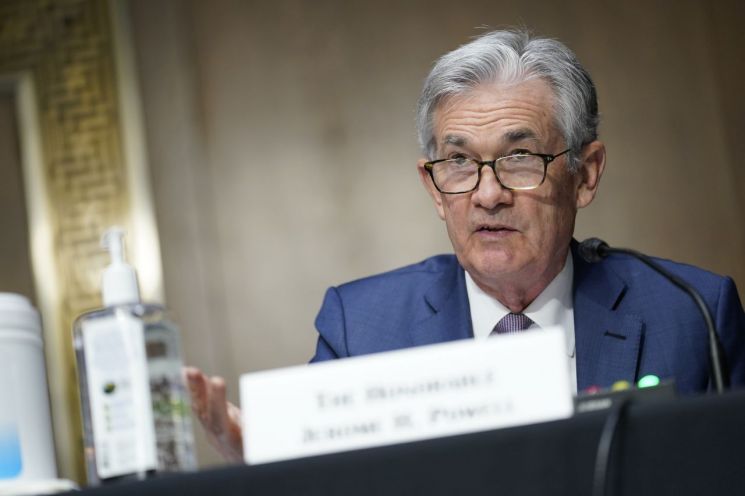
At a press conference following the announcement on the 28th (local time) to keep the benchmark interest rate unchanged and maintain asset purchases, Chairman Powell addressed concerns about hyperinflation similar to that of the 1970s by stating, "We have sufficient tools to handle inflation above 2% for a prolonged period."
He argued that having management tools is what differentiates the current inflation from the hyperinflation of the early 1970s. In March, the U.S. inflation rate was 2.6%, significantly exceeding the Fed's target of 2%.
Chairman Powell presented two reasons why the inflation occurring during the recent economic recovery is unlikely to persist.
First is the base effect. Powell explained that inflation appeared higher this year because inflation had sharply fallen due to the rapid spread of COVID-19 since March last year. He interpreted that about 1 percentage point of March's inflation and 70% of April and May's inflation were due to the base effect.
Powell predicted that inflation would stabilize as the base effect disappears.
He also identified global supply chain bottlenecks caused by the resumption of worldwide economic activity as another factor contributing to inflation.
He emphasized, "The bottlenecks are temporary and will soon disappear, so they do not affect changes in monetary policy." However, he noted it is difficult to predict how long it will take to resolve the bottlenecks and how much inflation they will influence in the meantime.
Powell particularly stressed, "The Fed has focused on a 2% inflation target for years. If inflation significantly exceeds 2%, we will bring it back to 2%. No one should doubt that we will do so. We will do our job."
Powell assessed that "some assets are priced high." He said, "We can see some bubbles in the capital markets. That is true," and explained, "I would not say that this is unrelated to monetary policy. However, it is tremendously correlated with vaccinations and economic reopening."
Following the Federal Open Market Committee (FOMC) regular meeting that day, the Fed announced it would keep the benchmark interest rate unchanged at 0.00?0.25% and maintain monthly asset purchases of $120 billion.
The Fed stated in its announcement that it would maintain the federal funds rate target range at 0.00?0.25% and that it is appropriate to keep the current monetary policy until maximum employment is achieved and inflation moderately exceeds 2%. It also reiterated its stance that there would be no changes in monetary policy until clear signals emerge.
The Fed gave a somewhat positive assessment of the economic situation. It said, "Economic activity and employment indicators have strengthened amid progress in vaccinations and strong policy support," adding, "Sectors most adversely affected by the pandemic remain weak but are showing improvement."
However, it cautioned, "The economic path will be greatly influenced by the course of the pandemic, including vaccinations," and warned, "The ongoing public health crisis continues to weigh on the economy, and risks to the economic outlook remain."
Bloomberg News reported that while the Fed previously described the economy as facing "considerable risks," this time it softened the language to simply "risks."
© The Asia Business Daily(www.asiae.co.kr). All rights reserved.
![Clutching a Stolen Dior Bag, Saying "I Hate Being Poor but Real"... The Grotesque Con of a "Human Knockoff" [Slate]](https://cwcontent.asiae.co.kr/asiaresize/183/2026021902243444107_1771435474.jpg)
















