"Not a Decline in Export Competitiveness, but a Result of Domestic Demand Recovery"
[Asia Economy Reporter Kim Eunbyeol] As exports and investments continue to show steady momentum and consumption beyond durable goods improves, it is analyzed that imports will maintain a high growth trend going forward. Accordingly, despite the increase in exports this year, the current account surplus is likely to decrease compared to last year, mainly due to the rise in imports centered on the goods balance.
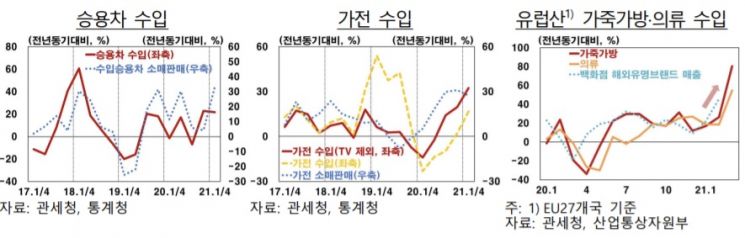
On the 29th, the Bank of Korea stated in the 'BOK Issue Note - Recent Import Trends and Evaluation' that "Imports, which showed a sharp decline in the 2nd and 3rd quarters of last year, turned to double-digit growth in the first quarter of this year, exceeding pre-COVID-19 levels." During the first quarter, imports reached an all-time high on a daily average basis considering business days, and last month's imports also recorded the highest monthly amount ever.
The Bank of Korea cited the following reasons for the recent increase in imports: ▲Recovery of exports and investments with high import dependence ▲Expansion of durable goods consumption ▲Rebound in raw material prices.
First, exports and investments in key industries such as semiconductors, automobiles, and chemicals showed a steady recovery, leading to a significant increase in imports of related materials, parts, and equipment. According to the Bank of Korea's analysis, imports in the 4th quarter of last year increased by 2.1% quarter-on-quarter, with exports (goods exports) and investments (gross fixed capital formation) contributing 3.2 percentage points and 1.2 percentage points respectively. On the other hand, private consumption acted as a factor reducing imports by 0.7 percentage points.
Joo Wook, head of the International Trade Team at the Bank of Korea's Research Department, explained, "Due to the impact of COVID-19, export volatility increased, and in the second half of last year, the contribution of exports to the import growth rate became very significant," adding, "When limited to the analysis period since 2018, it increased to the highest level."
The reason why exports and investments contribute greatly to the increase in imports is largely due to the higher import dependence of exports and investments compared to other expenditure items in our economy. In the case of South Korea, the scale of exports and investments relative to GDP was 63.8% on a nominal basis last year, which is higher than other countries such as the United States (28.1%), Japan (37.9%), and China (60.4%).
As durable goods consumption increased, imports of intermediate goods for domestic products also rose. Since the 4th quarter of last year, passenger car imports have shown a clear upward trend, and imports of home appliances have also increased significantly due to the rise in telecommuting and indoor activities. As revenge consumption sentiment and income among high-income groups improved, demand for luxury goods surged, leading to a sharp increase in imports of European leather bags and clothing.
Additionally, the rebound in prices of crude oil, steel, and metals also contributed to the increase in raw material imports, which in turn raised overall imports.
Joo said, "With exports and investments maintaining steady momentum, consumption beyond durable goods is expected to gradually improve due to COVID-19 vaccinations and other factors," forecasting that imports will continue to grow at a high rate. In particular, he noted, "If the consumption recovery becomes more pronounced, the demand for inventory replenishment by importers will also add to the factors expanding the import growth rate," and "The current account surplus this year is likely to decrease compared to last year, mainly due to the goods balance, despite the increase in exports."
However, he did not interpret this decrease in the current account surplus negatively. He explained, "Even if the current account surplus shrinks this year, it is mainly due to increased imports from domestic demand recovery rather than a decline in export competitiveness," adding, "This can be interpreted as reflecting the recovery trend of our economy, and the increase in capital goods imports driven by investment demand is expected to have positive effects on expanding our economy's production capacity and improving productivity in the future."
© The Asia Business Daily(www.asiae.co.kr). All rights reserved.
![Clutching a Stolen Dior Bag, Saying "I Hate Being Poor but Real"... The Grotesque Con of a "Human Knockoff" [Slate]](https://cwcontent.asiae.co.kr/asiaresize/183/2026021902243444107_1771435474.jpg)
















