Rice Imports Up 54.5% in Jan-Feb
Record High Domestic Prices Impact
Sharp Increase in Dried Red Pepper and Garlic Imports
Consumer Anxiety Grows
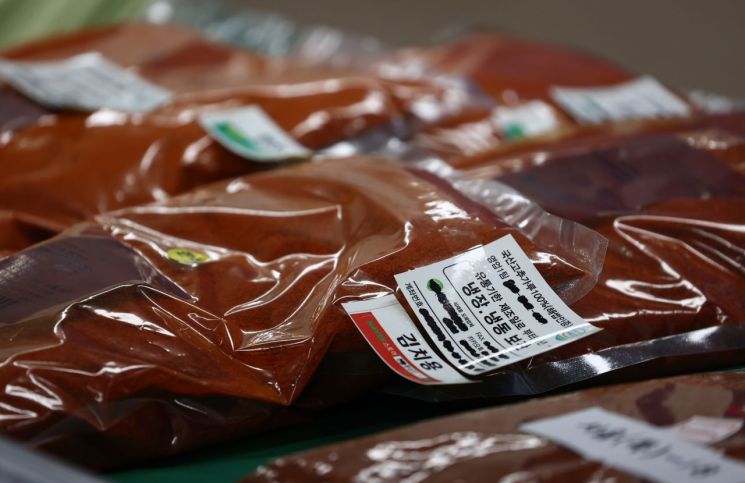 The photo shows red pepper powder with false origin labeling seized by the Seoul Metropolitan Government's Civil Affairs Judicial Police Unit.
 [Image source=Yonhap News]
[Asia Economy Reporter Seungjin Lee] As the prices of food ingredients continue to soar, imports of Chinese food ingredients are significantly increasing.
According to the Korea Agro-Fisheries & Food Trade Corporation (aT) on the 30th, the import volume of Chinese rice from January to February this year was 56,667 tons, a 54.5% increase compared to the previous year. Last year, the total import volume of Chinese rice was 228,440 tons, a 33.4% increase from the previous year, showing a trend of increasing imports of Chinese rice year after year. On the other hand, the annual per capita rice consumption of Koreans last year was 57.7 kg, the lowest ever recorded since statistics began. It has halved in 30 years from 119.6 kg in 1990.
The reason why imports of Chinese rice have increased despite the annual decrease in rice consumption is that the price of domestic rice is at an all-time high. The retail price of 20 kg of rice is 59,654 won, 15% more expensive than the previous year. Chinese rice has mainly been consumed in processed foods such as rice cakes and by catering companies serving unspecified large groups like funeral halls. Recently, as delivery demand has increased due to COVID-19, it is known that delivery specialty stores are considering using Chinese rice, taking advantage of consumers' tendency not to carefully check the origin of delivery food.
In addition to rice, imports of dried red peppers, garlic, and onions have also increased. Last month, 12,706 tons of dried red peppers were imported, a 15% increase compared to the previous year. Onion imports were recorded at 17,329 tons, a 108% increase from the previous year. Although the total import volume of garlic last month slightly decreased by 3.5% compared to the previous year, imports of fresh garlic increased sharply by 493%.
As imports of Chinese agricultural products surge like this, consumer anxiety is also growing. On YouTube, a controversy arose over a video showing a Chinese man mixing grains with his bare black feet. In a video drying red pepper powder, a swarm of rats appears. The government plans to strengthen origin labeling inspections. The National Agricultural Products Quality Management Service detected 1,081 cases of origin labeling violations at 949 companies through inspections of agricultural food origin labeling from January to March this year.
Of the 1,081 detected cases, 569 cases (53%) were from five items: 208 cases (19%) of napa cabbage kimchi, 144 cases (13%) of pork, 118 cases (11%) of beef, 54 cases (5%) of soybeans, and 45 cases (4%) of rice. The remaining 47% were from 99 other items including chicken. The number of detected cases increased by 18 cases (1.7%) compared to the same period last year.
© The Asia Business Daily(www.asiae.co.kr). All rights reserved.
![Clutching a Stolen Dior Bag, Saying "I Hate Being Poor but Real"... The Grotesque Con of a "Human Knockoff" [Slate]](https://cwcontent.asiae.co.kr/asiaresize/183/2026021902243444107_1771435474.jpg)
















