Sharp Decline in Newborns in Major Cities Including Beijing, China's Population Likely to Fall Below 1.4 Billion
Declining Birth and Marriage Rates, Rising Divorce Rate, Entry into Aging Society... China-India Population Shift Expected Sooner

[Asia Economy Beijing=Special Correspondent Jo Young-shin] The number of newborns in Beijing, the capital of China, has hit its lowest point in 10 years, signaling the reality of China's population cliff problem. Major foreign media outlets estimate that China's population declined last year for the first time since 1949. Given that China's growth engine is its 1.4 billion population, discussions about abolishing the birth control policy are expected to become more prominent.
China's state-run Global Times reported on the 28th that the number of newborns in Beijing last year was only 100,368, a decrease of 32,000 from the previous year. This is the lowest figure since 2011. The number of newborns in Beijing peaked at 171,305 in 2017, right after the introduction of the "two-child policy" in 2016, and has been declining every year since.
On the other hand, the number of deaths in Beijing last year was 97,649, nearly matching the number of newborns. The Global Times cited Chinese demographers expressing concern that the population of Beijing is likely to naturally decrease starting from 2022.
◇ Countdown to China-India Population Reversal = Major foreign media outlets reported that China's population may fall below 1.4 billion last year, and India, estimated at 1.39 billion, could take the position as the most populous country. Regarding this, the Global Times noted that a 2017 United Nations (UN) report projected India’s population would surpass China around 2024, but this timeline may be accelerated.
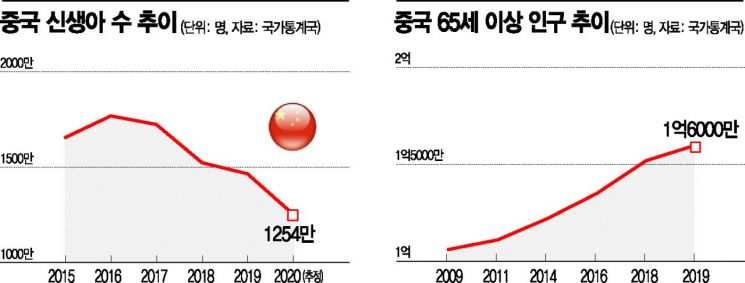
The population decline in China, the most populous country, is closely related to the decrease in the number of marriages leading to fewer newborns, an increase in deaths, and population aging. In fact, the number of newborns in China peaked at 17.86 million in 2016 and has decreased every year since, reaching 14.65 million in 2019?the lowest in 70 years. Last year's birth rate in China is estimated to be even lower.
Low birth rates are also linked to marriage rates. The number of marriages, which reached 13.47 million in 2013, sharply dropped to 8.13 million last year. Meanwhile, divorces surged from 580,000 in 1987 to 3.73 million last year.
The speed of aging in China is even faster. The population aged 65 and older, which was 106 million in 2009, surged to 111 million in 2011, 122 million in 2014, 135 million in 2016, 152 million in 2018, and 160 million in 2019. In just 10 years, the elderly population increased by 54 million, more than the entire population of South Korea.
Hwang Won-jung, senior researcher at the China Globalization Center, said, "The speed and scale of population decline are faster and larger than we (China) had imagined," expressing concern that "population decline could have devastating effects on China."
◇ Population Decline Is a Disaster, Public Discussion on Birth Liberalization = The competitiveness of G2 (the two major countries) China lies in its 1.4 billion population. Population decline means a decline in competitiveness. If population decline continues, it could cause serious economic and social shocks to China and potentially have adverse effects on the global economy.
Detecting such risks, the People's Bank of China, the central bank, estimated China's birth rate to be below 1.5 in a report released on the 14th, warning that the demographic changes in China could pose greater risks than expected.
Chinese economic media Caixin expressed concern that low birth rates and population aging will seriously impact China's national finances.
Caixin cited population experts suggesting that various solutions are needed, including housing, employment, and education. They argued that national policies such as stabilizing real estate prices, guaranteeing employment rights for women after childbirth, providing various childcare service supports including childcare allowances, and extending compulsory education from 9 to 12 years are urgently needed.
Along with this, Caixin also mentioned the previously unspoken issue of birth liberalization. It stated that the "two-child policy" alone cannot solve the population problem and that reproductive rights should be granted to individuals.
China's population issue was also mentioned at the 5th Plenary Session of the 19th Central Committee of the Communist Party of China in October last year, but at that time, the Chinese leadership did not prioritize this issue.
© The Asia Business Daily(www.asiae.co.kr). All rights reserved.
![Clutching a Stolen Dior Bag, Saying "I Hate Being Poor but Real"... The Grotesque Con of a "Human Knockoff" [Slate]](https://cwcontent.asiae.co.kr/asiaresize/183/2026021902243444107_1771435474.jpg)

















