4th Basic Plan for Healthy Families Confirmed... Family Scope Regulation to be Deleted
Universal 'Birth Registration System' Promoted for Birth Reports at Medical Institutions
Survey and Research on Non-Marital Childbirth Launched... Inter-Ministerial Consultation on Egg and Sperm Donation
Parental Leave Expanded to All Workers... Parental Leave Pay Increased to 1.5 Million Won
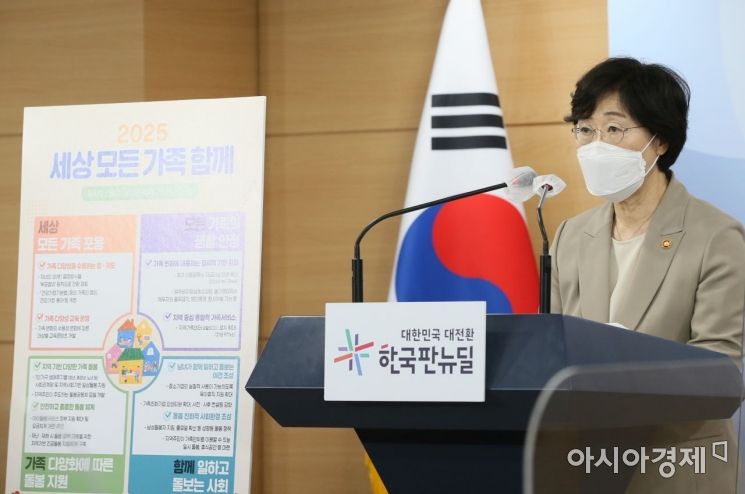 Jeong Young-ae, Minister of Gender Equality and Family, is announcing the '4th Basic Plan for Healthy Families' at the Government Seoul Office on the 27th.
[Asia Economy Reporter Han Jinju] The government is pushing for institutional improvements that remove regulations on the scope of family and allow unmarried cohabiting couples to be protected as family. The principle will be changed to abolish 'patrilineal preference' and allow the child's surname to be decided through parental agreement. In the long term, the introduction of a 'universal birth registration system,' where medical institutions register all children's birth information with the state, is also being considered. Public opinion on unmarried childbirth will be collected, and inter-ministerial discussions on legal and ethical issues will be initiated.
On the 27th, the Ministry of Gender Equality and Family finalized and announced the '4th Basic Plan for Healthy Families,' to be implemented from this year through 2025, after deliberation at the Cabinet meeting. According to Statistics Korea, as of 2019, single-person households accounted for 30.2% of all households, and households with two or fewer people accounted for 58.0%. The proportion of households traditionally recognized as typical families, consisting of married couples and unmarried children, decreased to 29.8%.
Due to late marriages and decreases in marriage and childbirth, the number of people moving between single-person households and households with two or more people throughout their lives has increased. Although various family types have emerged beyond traditional families, discrimination based on family form still exists, and there have been continuous calls for institutional improvements. A survey also found that seven out of ten people consider those who share livelihood or residence as 'family,' even if they are not married or related by blood.
Accordingly, the government is promoting institutional improvements to reduce discrimination based on family type. Article 781, Paragraph 1 of the Civil Act will be amended to allow the child's surname to be decided by parental agreement. The legal provisions distinguishing between children born within and outside marriage will also be reviewed. Instead of terms like 'children born within marriage' or 'children born out of wedlock,' the term 'child' will be used collectively. Families that are not connected by blood or marriage but are practical families, such as cohabiting or common-law couples, elderly cohabiting couples sharing care and livelihood, or foster families, will also be protected by law by revising the scope or regulations of family. The government is considering deleting the definition of 'family' in the Healthy Families Basic Act and the Civil Act to include 'unmarried cohabitation' in the concept of family beyond marriage, blood relation, and adoption.
Minister of Gender Equality and Family Jeong Young-ae said, "The Healthy Families Basic Act defines the scope of family as marriage, blood relation, and adoption, so although services are provided, there has been no legal basis, creating policy blind spots or concerns about reinforcing discriminatory perceptions. Even if the regulations on the scope of family are deleted, other laws or systems will not be affected, and it is expected to bring positive changes to discriminatory perceptions and the like."
The government will also initiate social discussions and research on unmarried single childbirth, such as that of Sayuri, who gave birth by receiving donated sperm. A public survey on bioethics and unmarried childbirth procedures, including surrogacy and sperm/egg donation, will be conducted in the first half of the year, and the need for research and institutional improvements regarding the status of sperm donors and children's right to know will be reviewed. Discussions on how far the government will allow egg/sperm donation and surrogacy are expected to accelerate.
Regarding this, Minister Jeong explained, "Currently, unmarried childbirth is not included within the concept of unmarried families, so we are trying to enable support. Sayuri also belongs to single parents, and regardless of unmarried childbirth or assisted reproductive technology childbirth, child support or housing support is provided if income is below a certain level."
She added, "There is no law prohibiting assisted reproductive technology for unmarried persons, but discussions are needed on practical restrictions such as exclusion from infertility treatment support. Since unmarried childbirth involves various legal, ethical, and cultural issues, we expect to prepare specific implementation plans through active inter-ministerial discussions."
The government will introduce a 'birth notification system,' where medical institutions notify public agencies of births. To prevent blind spots such as avoidance of childbirth at medical institutions, the introduction of a universal birth registration system will be considered in the long term. The universal birth registration system is a system where medical institutions, not parents, register all children's birth information with the state, and the United Nations Convention on the Rights of the Child has recommended its introduction in South Korea.
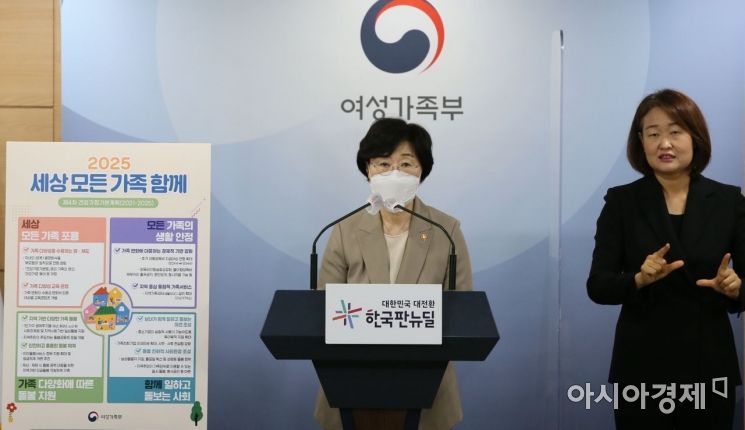 Jeong Young-ae, Minister of Gender Equality and Family, is announcing the '4th Basic Plan for Healthy Families' at the Government Seoul Office on the 27th.
Along with this, when an unmarried father files a birth report, if the mother's whereabouts are unknown or she does not cooperate, the birth report can be made with confirmation from the family court. The government will also review the system by requesting police or dedicated officials to accompany responses to child abuse or domestic violence and by inspecting the actual situation. The government is considering revising the spouse definition to allow punishment of violence in unmarried cohabiting families under the Domestic Violence Punishment Act and abolishing the crime of domestic violence that requires the victim's withdrawal of complaint.
Minister Jeong said, "There is no provision for punishing violence in intimate relationships such as unmarried cohabitation, and there is much controversy about how to include these relationships in the law. However, the Special Act on Punishment of Domestic Violence Crimes, which includes violence between dating partners within the definition of family violence limited to family members, has been proposed, and we plan to improve this part within the basic plan period to legally clarify and support it."
Support measures necessary to guarantee child-rearing life will also be expanded. Freelancers and special employment workers will gradually be included in the scope of parental leave. The government is conducting research on the phased expansion of parental leave eligibility and plans to prepare detailed schedules and budgets. In addition, since 2022, parental leave pay has been increased by 300,000 KRW to a maximum of 1.5 million KRW per month. If both parents with children under the age of one take parental leave, they will each receive up to 3 million KRW per month for three months. From this year, medical expenses for pregnancy and childbirth will be supported for teenage parents up to age 19 and will be gradually expanded up to age 24.
If child support obligations are not fulfilled after divorce, the burden of proof will be shifted from the creditor to the debtor, and even partial fulfillment will allow detention orders. From July, travel bans, public disclosure of names, and criminal penalties will also be possible. The introduction of the so-called 'Goo Hara Law,' which excludes those who fail to fulfill child-rearing obligations from inheritance, is also being considered.
To prevent isolation of single-person households, a 'social network project by life cycle' will be implemented. Young adults will receive education on preparing for independent living, middle-aged and older adults will receive psychological counseling and education to prepare for entering the later stages of life, and the elderly will be provided with education on daily care skills such as housekeeping and home management. An analysis and evaluation of welfare benefit unit standards reflecting the increasing trend of single-person households will also be pursued.
© The Asia Business Daily(www.asiae.co.kr). All rights reserved.
![Clutching a Stolen Dior Bag, Saying "I Hate Being Poor but Real"... The Grotesque Con of a "Human Knockoff" [Slate]](https://cwcontent.asiae.co.kr/asiaresize/183/2026021902243444107_1771435474.jpg)

















