Toyota, BMW, Hyundai Announce Pilot Production Plans for All-Solid-State Batteries
Fire Risk Eliminated and Capacity Dramatically Increased... Noted as a 'Game Changer'
[Asia Economy Reporter Hwang Yoon-joo] German automaker BMW has announced plans to launch electric vehicles equipped with solid-state batteries by 2030, drawing significant attention to the development of solid-state batteries. Opinions on the commercialization of solid-state batteries are sharply divided. Nevertheless, the reason why automakers and battery industries are fervently pursuing solid-state battery development is that it could be a 'game changer' capable of dramatically increasing battery capacity.
According to industry sources on the 25th, German automaker BMW revealed its intention to introduce electric vehicles equipped with solid-state batteries by 2030. The company with the most advanced technology related to solid-state batteries is Japan's Toyota, which holds about 1,000 patents. Toyota aims to apply its self-developed solid-state batteries to electric vehicles by 2028 and plans to unveil an electric vehicle equipped with a solid-state battery on a trial basis this year.
For electric vehicles to become a definitive trend, they must achieve a driving range comparable to that of current internal combustion engine vehicles. To this end, increasing the capacity of the core component?the battery for electric vehicles?is of utmost importance. There are two main ways to increase battery capacity. The first is to increase the number of batteries. However, this is difficult to realize because it raises battery costs and reduces space efficiency.
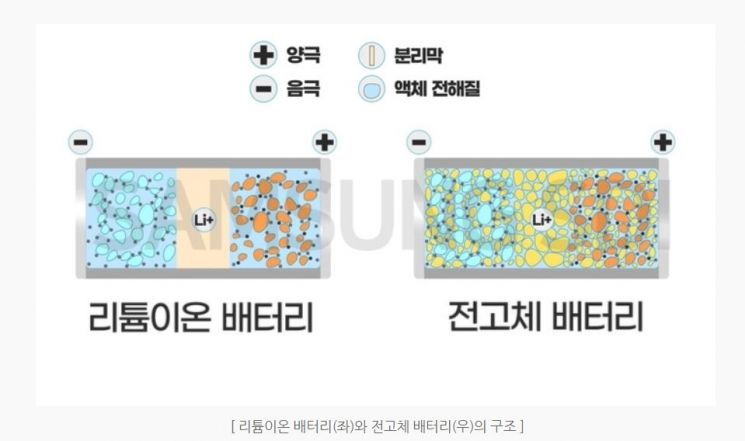
The alternative battery attracting attention is the 'solid-state battery.' Compared to conventional lithium-ion batteries, solid-state batteries have higher energy density and a significantly lower risk of explosion or fire. This allows for a reduction in safety-related components and the replacement of that space with active materials that increase battery capacity. When electric vehicle battery modules and packs are configured with solid-state batteries, the reduction in the number of components can increase energy density per volume, making it ideal for electric vehicle batteries that require increased capacity, according to the battery industry.
The key issue is the technology to make the electrolyte, a core material of electric vehicle batteries, solid. An industry insider said, "If solid electrolytes can be made, it could be a 'game changer' that changes the game in the electric vehicle market, but it is not an easy problem," adding, "Simply put, the process of developing solid electrolytes goes against chemical laws, so commercialization may take longer than expected."
Among domestic companies, Samsung SDI is the most actively pursuing solid-state battery development. In addition to its own development projects, Samsung SDI is jointly developing solid-state battery technology in cooperation with Samsung Electronics’ Advanced Institute of Technology and its research institute in Japan. In March last year, Samsung Electronics’ Advanced Institute of Technology disclosed research results on solid-state batteries capable of a driving range of 800 km on a single charge and more than 1,000 charge-discharge cycles. This research, which contains core technology that can increase the lifespan and safety of solid-state batteries while halving their size, was published in the world-renowned academic journal 'Nature Energy.'
Samsung SDI stated, "For electric vehicles to travel farther and more safely, the development of solid-state batteries is essential," and added, "Currently, we are in the stage of developing elemental technologies and are focusing on development for commercialization."
© The Asia Business Daily(www.asiae.co.kr). All rights reserved.
![Clutching a Stolen Dior Bag, Saying "I Hate Being Poor but Real"... The Grotesque Con of a "Human Knockoff" [Slate]](https://cwcontent.asiae.co.kr/asiaresize/183/2026021902243444107_1771435474.jpg)
















