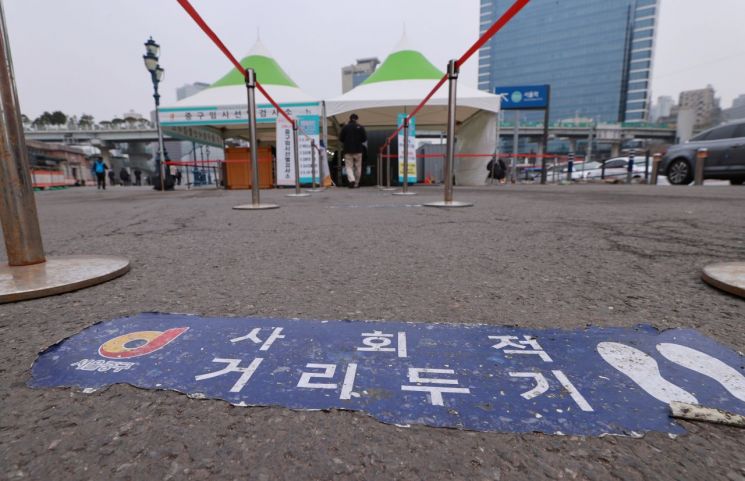
 Social distancing stickers are attached at the entrance of the temporary screening clinic for COVID-19 set up at Seoul Station Plaza.
 [Image source=Yonhap News]
[Asia Economy Reporter Lee Chun-hee] A new social distancing reform plan will be pilot-applied in 12 counties in Gyeongsangbuk-do with populations under 100,000, where the risk of infection is low. Accordingly, the current 'ban on private gatherings of five or more people' is expected to change to 'private gatherings allowed up to eight people' from the 26th of this month to the 2nd of next month.
Yoon Tae-ho, head of the Central Disaster and Safety Countermeasures Headquarters' quarantine team, announced at the regular briefing of the Central Disaster and Safety Countermeasures Headquarters on the 23rd, "From next Monday (the 26th), a new distancing system will be pilot-operated in 12 counties including Gunwi, Uiseong, Cheongsong, and Ulleung in Gyeongsangbuk-do." On the same day, the Central Disaster and Safety Countermeasures Headquarters meeting continued discussions along with a report on Gyeongbuk Province's 'Social Distancing Reform (Plan) Pilot Application Measures.'
Yoon explained, "These areas have a stable epidemic situation with fewer than one patient per day on average, so there have been opinions that it is necessary to adjust social distancing." According to the Central Disaster and Safety Countermeasures Headquarters, these 12 counties (Gunwi, Uiseong, Cheongsong, Yeongyang, Yeongdeok, Cheongdo, Goryeong, Seongju, Yecheon, Bonghwa, Uljin, and Ulleung) recorded a total of 14 domestic confirmed cases this month, averaging less than one case per day, indicating stability. Furthermore, although the area of these 12 counties is 15 times that of Seoul, their population accounts for only 4.3%, and population density is about 0.3%, so the risk of infection spread is considered relatively low. On the other hand, Gyeongbuk's economic situation has been evaluated as needing revitalization of the private economy due to difficulties in the livelihood economy and overall regional economic stagnation caused by COVID-19 since February last year.
Accordingly, the Central Disaster and Safety Countermeasures Headquarters and Gyeongbuk Province decided to pilot-apply the new social distancing reform plan Stage 1 in these 12 counties from the 26th of this month to the 2nd of next month. The pilot application period will be implemented for one week and is planned to be extended later.
In the new social distancing reform plan Stage 1, there are no restrictions on private gatherings, so the current nationwide 'ban on private gatherings of five or more people' and other private gathering restrictions will be lifted. However, the Central Disaster and Safety Countermeasures Headquarters and Gyeongbuk Province, concerned about excessive relaxation of quarantine measures, will allow the application of the Stage 2 measure of 'private gatherings allowed up to eight people' under the new reform plan.
Residents registered outside the pilot application areas are also allowed to hold gatherings of five or more people in those areas. Son Young-rae, head of the Social Strategy Team at the Central Disaster and Safety Countermeasures Headquarters, explained, "The basis of administration is centered on the region," adding, "It is considered by region, not by place of origin, so in the pilot project areas, gatherings of up to eight people will be allowed."
Under the new reform plan, Stage 1 has no ban on private gatherings, Stage 2 allows gatherings of up to eight people, and Stage 3 allows gatherings of up to four people. If raised to Stage 4, only two people can gather after 6 p.m.
Even while the new social distancing reform plan Stage 1 is pilot-applied in this way, local governments will strengthen quarantine measures separately for private gatherings and religious activities, considering regional risk levels. Also, considering the possibility of infection spread due to religious activities by the elderly and gatherings or religious events involving residents from other regions, measures such as restrictions on religious facility meetings, meals, and lodging may be implemented.
Gyeongbuk Province plans to strengthen special quarantine management reflecting regional characteristics following the pilot application of the distancing reform plan. The aging rate in the relevant areas is 35.3%, more than twice the national average (16.6%), so quarantine management for the elderly will be strengthened. Continuous quarantine inspections will be conducted at 140 elderly facilities, including nursing homes and daytime care centers, and measures for detecting symptomatic cases will be enhanced through twice-daily temperature checks of users. Proactive testing of facility workers will also be expanded.
Additionally, since infection spread in elderly-dense areas increases risk factors, response to severe patients will be strengthened. Moderate patients will be treated at infectious disease-dedicated hospitals in the province, and a cooperative system for transporting severe patients will be established.
Quarantine will also be strengthened at tourist sites. Ulleung County will enhance detection of symptomatic individuals through temperature checks before and after island entry, and increase on-site quarantine personnel at major tourist spots and bus terminals.
© The Asia Business Daily(www.asiae.co.kr). All rights reserved.
!["The Woman Who Threw Herself into the Water Clutching a Stolen Dior Bag"...A Grotesque Success Story That Shakes the Korean Psyche [Slate]](https://cwcontent.asiae.co.kr/asiaresize/183/2026021902243444107_1771435474.jpg)
















