Renewable Energy and Coal Phase-Out Are Premature...The Role of Nuclear Power Emerges
[Sejong=Asia Economy Reporter Kwon Haeyoung] Despite the Moon Jae-in administration's policy of phasing out nuclear power, the nuclear power plant operation rate has approached 80% this year. South Korea is bound to increase its reliance on renewable energy as President Moon reaffirmed the coal phase-out policy at the recent climate summit following his declaration to phase out nuclear power. This has led to concerns that nuclear power policy will face a dilemma. Renewable energy sources such as solar and wind must fill the gap left by nuclear power and cheap coal power, but their efficiency remains low, and supply-demand mismatches occur due to variations in sunlight and wind speed.
According to data submitted by Korea Hydro & Nuclear Power (KHNP) to Rep. Kwon Myung-ho of the People Power Party on the 23rd, KHNP's power generation in 2016 was 159,377,405 MWh, recording 79.6% of the maximum possible generation capacity (202,928,000 MWh). In particular, KHNP's nuclear power utilization rate dropped from around 80% in 2016 to 71.1% in 2017, the year the Moon administration took office, and further to 65.8% in 2018, before rising again to 70.5% in 2019 and 75.3% in 2020. The cumulative utilization rate for January and February this year was 78%.
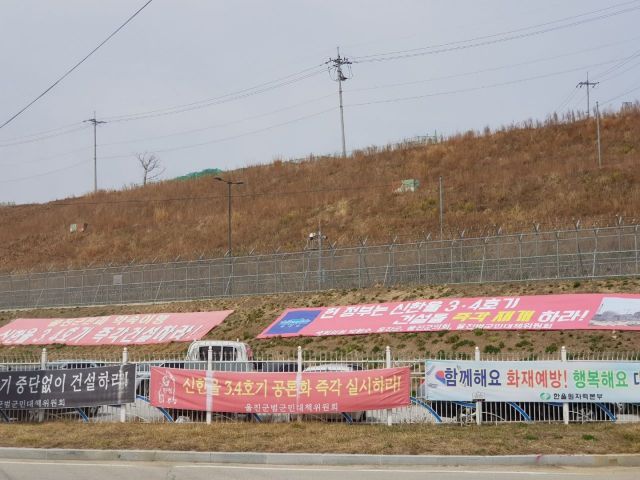
The increase in nuclear power utilization rate is largely due to the completion of maintenance work. The Korea Power Exchange operates power plants sequentially from the lowest generation cost, so it cannot arbitrarily adjust nuclear power utilization rates. Although the current government has accelerated its nuclear phase-out policy by early shutting down aging reactors such as Wolseong Unit 1 and halting construction of Shin Hanul Units 3 and 4, the nuclear power utilization rate paradoxically increased.
Some expect that the nuclear power utilization rate may rise further as the government speeds up its coal phase-out policies, including banning new coal power plants and implementing a cap on coal power generation. It is difficult for renewable energy, which has lower cost and efficiency competitiveness, to fully fill the gap left by the reduced share of coal power, the largest power source.
Countries such as the United States and the European Union (EU) are focusing on nuclear power as an alternative for carbon neutrality. The U.S. has classified Small Modular Reactors (SMRs) as clean energy in its carbon neutrality roadmap, and the EU is likely to include nuclear power in its green industry taxonomy. The South Korean government, which declared a nuclear phase-out, also belatedly announced last year its policy to develop and invest in the next-generation Korean-style small modular reactor, 'i-SMR.' This is interpreted as recognition that expanding reliance on nuclear power, which emits zero greenhouse gases, is inevitable to achieve carbon neutrality.
© The Asia Business Daily(www.asiae.co.kr). All rights reserved.
![Clutching a Stolen Dior Bag, Saying "I Hate Being Poor but Real"... The Grotesque Con of a "Human Knockoff" [Slate]](https://cwcontent.asiae.co.kr/asiaresize/183/2026021902243444107_1771435474.jpg)
















