President Moon's Climate Summit Declaration
Coal Power Industry Faces Inevitable Impact... Government Supports Coal Industry Business Transition
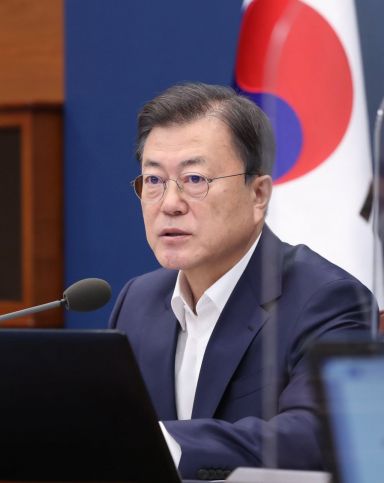
[Sejong=Asia Economy Reporter Kwon Haeyoung] On the 22nd, President Moon Jae-in declared the suspension of public financial support for new overseas coal power projects at the Climate Summit. This declaration strengthens the government's coal phase-out policy, raising concerns that the coal industry will face increased difficulties and that the burden of eco-friendly costs, such as electricity rate hikes, may increase. The government plans to support coal power companies in transitioning their businesses to renewable energy sectors such as new and renewable energy and gas turbines.
According to related government ministries on the day, the government will further raise the '2030 National Greenhouse Gas Reduction Target (NDC)' and suspend public financial support for newly initiated overseas coal power projects. However, public financial support will proceed as planned for ongoing projects such as Indonesia's Java Units 9 and 10 and Vietnam's Vung Ang 2 project.
Accordingly, policy financial institutions such as the Export-Import Bank of Korea, Korea Trade Insurance Corporation, and Korea Development Bank will no longer provide low-interest loans for new overseas coal power projects. The government also intends to create conditions to encourage the private financial sector to follow suit in suspending support for overseas coal power projects.
President Moon's declaration aligns with the global trend of halting investments in coal power for carbon neutrality. Eleven countries, including the United Kingdom, the United States, Germany, France, and Canada, have declared the suspension of public financial support for overseas coal power projects. International financial institutions such as the World Bank, European Investment Bank, and Asian Development Bank have also announced the cessation of investments in coal power. Domestically, financial groups like KB Financial Group and Hanwha Financial Group have declared the suspension of investments in coal power.
The government will also continue its domestic coal phase-out policies without disruption. It will, in principle, ban permits for new coal power plants and shut down 28 out of the current 58 coal power units by 2034, which is about half. A coal power generation cap system will be fully implemented starting next year.
The issue is that the suspension of export financing for coal power projects inevitably leads to a contraction of overseas business for EPC (Engineering, Procurement, and Construction) companies and their partners that have participated in overseas coal power projects. Domestically, there are concerns that the accelerated coal phase-out policy may shrink the ecosystem and rapidly increase eco-friendly costs.
In this regard, the government has set a policy to actively support the business transition of the coal industry. It plans to expand tax credits for research and development (R&D) of core technologies for carbon neutrality and establish a new climate response fund to support vulnerable industries and workers.
An official from the Ministry of Trade, Industry and Energy stated, "As new orders for coal-fired power plants worldwide are decreasing, we will support domestic companies to respond to the global energy transition trend by fostering ecosystems for new and renewable energy and gas turbines, and also expand support for renewable energy technology development."
© The Asia Business Daily(www.asiae.co.kr). All rights reserved.
![Clutching a Stolen Dior Bag, Saying "I Hate Being Poor but Real"... The Grotesque Con of a "Human Knockoff" [Slate]](https://cwcontent.asiae.co.kr/asiaresize/183/2026021902243444107_1771435474.jpg)
















