[Asia Economy Reporter Byunghee Park] Since last year, China has imposed trade sanctions on Australia by banning imports of Australian barley, beef, and other products. This was because Australian Prime Minister Scott Morrison called for an international investigation in April last year, blaming China for the COVID-19 outbreak, which irritated China.
However, the Wall Street Journal reported on the 21st (local time) that China's trade retaliation measures have not been effective due to soaring iron ore prices. Australia is the world's largest iron ore exporter, and paradoxically, thanks to China's economic recovery, iron ore prices have surged, allowing Australia to generate a large trade surplus from iron ore exports.
Australia accounts for more than 50% of the world's iron ore exports. The Australian government recently stated in a report that iron ore export revenue for this fiscal year (July 2020 to June 2021) is expected to break records again. Last fiscal year, iron ore export revenue reached a record high of 104 billion Australian dollars, and it is expected to reach 136 billion Australian dollars this fiscal year.
China's rapid economic growth is driving up iron ore prices. China's economic growth rate in the first quarter of this year (year-on-year) was 18.3%. Premier Li Keqiang of China presented an economic growth forecast of over 6% at last month's National People's Congress, but the IMF expects China's economic growth rate this year to reach 8.4%, the highest since 2011 (9.4%).
According to S&P Global Platts, on the 20th, iron ore prices reached $187.75 per ton, the highest since February 2011. Iron ore prices have risen 17% in just the past month. In 2011, China’s high economic growth also caused an iron ore supply shortage. Iron ore prices surged to $193 per ton in February of that year, prompting Australia and Brazil to increase iron ore production.
This year is no different. China's crude steel production in February was 83 million tons, an 11% increase compared to the same month last year. Crude steel is the raw material for steel.
While China has taken trade retaliation measures, it has not imposed sanctions on iron ore. Port Hedland in northern Australia is the world's largest iron ore exporting port. Last month, more than 80% of the iron ore exported from here was shipped to China, totaling 38.1 million tons. Although this was less than 40.4 million tons in March last year, it was an increase compared to 30.7 million tons in February this year.
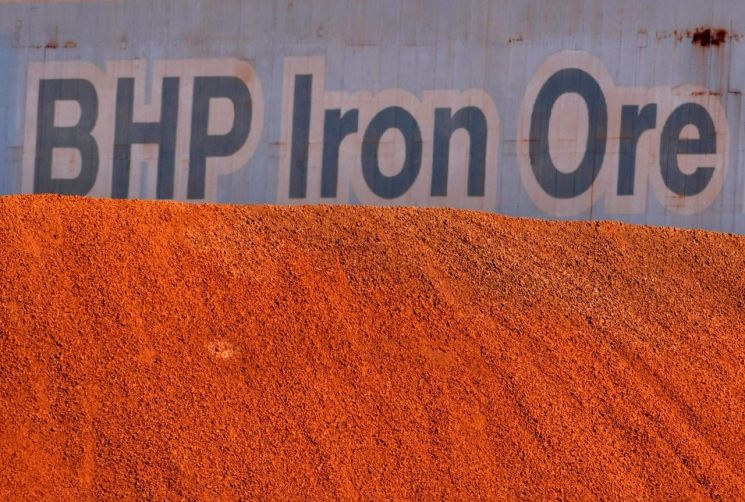
Australian mining company BHP Billiton announced on the 21st that iron ore production for this fiscal year (July 2020 to June 2021) is expected to reach the upper end of the previously forecast range of 245 million to 255 million tons. Production up to the third quarter of this fiscal year was 188.3 million tons, a 4% increase compared to the same period last year.
However, there are forecasts that iron ore prices will decline in the second half of this year. Goldman Sachs expects that as Brazil increases its export volume, an oversupply of iron ore will occur starting in the second half of this year. Iron ore prices are expected to fall to $110 per ton in the fourth quarter of this year and drop below $100 next year.
© The Asia Business Daily(www.asiae.co.kr). All rights reserved.
![Clutching a Stolen Dior Bag, Saying "I Hate Being Poor but Real"... The Grotesque Con of a "Human Knockoff" [Slate]](https://cwcontent.asiae.co.kr/asiaresize/183/2026021902243444107_1771435474.jpg)
















