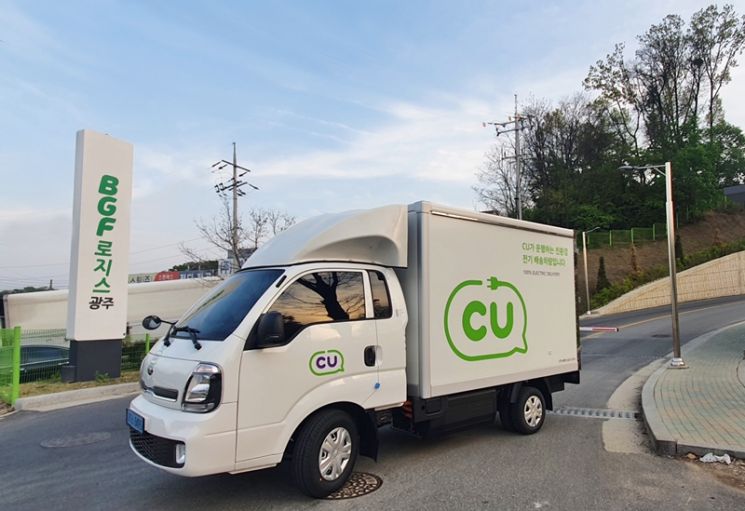
 On the 22nd, CU announced that it has introduced electric vehicles for delivery trucks supplying products to stores, becoming the first convenience store chain in the industry to do so. The Kia Motors Bongo EV model introduced by CU.
Responsible for Ambient Product Delivery at Medium to Large Stores in Gangnam, Seoul
Pilot Operation Until the Second Half of This Year, Gradual Expansion Decision Pending
Annual Carbon Emission Reduction of 2 Tons per Electric Vehicle
[Asia Economy Reporter Yuri Kim] CU announced on the 22nd that it will introduce electric vehicles for delivery trucks supplying products to stores for the first time in the convenience store industry, starting a transition to eco-friendly green logistics.
The electric vehicle introduced by CU is the Kia Motors Bongo EV model, operated by BGF Logis Gwangju in Gwangju, Gyeonggi Province. This vehicle will be exclusively responsible for delivering ambient products to medium and large stores in the Gangnam area of Seoul. BGF Logis Gwangju plans to install separate electric vehicle charging facilities within the logistics center to support full-scale electric vehicle operations.
CU’s electric vehicle delivery will undergo a pilot operation until the second half of this year, during which logistics efficiency and environmental benefits will be thoroughly reviewed to decide whether to expand to other logistics centers in the future.
Electric vehicles do not use fossil fuels while driving, thus emitting no air pollutants such as fine dust, carbon dioxide, or nitrogen oxides. It is known that one electric vehicle reduces carbon emissions by about 2 tons annually compared to internal combustion engine vehicles.
Electric motor operation offers economic driving costs and low maintenance expenses. Additionally, government and local subsidies are available, and discounts on public parking fees and highway tolls can be received, making it advantageous for nationwide delivery.
CU operates over 15,000 stores nationwide, with an average of three deliveries per store per day. There are a total of 33 logistics centers nationwide, operating approximately 2,000 delivery vehicles.
Since 2013, BGF Retail has equipped all delivery vehicles with vehicle control systems and air spoilers and applied energy saver paint. They have also conducted eco-driving training and fuel efficiency competitions with logistics partners to improve energy efficiency and reduce carbon emissions. Through these efforts, they have obtained green logistics company certification. Last year, they became the first in the industry to complete a solar power plant at the Chungbuk Jincheon Central Distribution Center (CDC). This large-scale power facility produces electricity and generates revenue, producing up to 1,200 megawatt-hours (MWh) annually.
BGF Retail explained that this initiative will enhance management performance by efficiently using company resources while participating in the government’s eco-friendly policies, thereby achieving social and economic benefits simultaneously.
Song Jaeguk, Head of SCM at BGF Retail, said, "By introducing electric vehicles to delivery trucks connecting CU’s nationwide network like capillaries, we have further strengthened the eco-friendly logistics system," adding, "We will continue to pursue sincere ESG (Environmental, Social, and Governance) management not only for products directly meeting consumers but also throughout the delivery process."
© The Asia Business Daily(www.asiae.co.kr). All rights reserved.
![Clutching a Stolen Dior Bag, Saying "I Hate Being Poor but Real"... The Grotesque Con of a "Human Knockoff" [Slate]](https://cwcontent.asiae.co.kr/asiaresize/183/2026021902243444107_1771435474.jpg)
















