[Asia Economy Reporter Kwon Jae-hee] On the 21st, regarding the dismissal decision in the second ruling of the damages claim lawsuit filed by comfort women victims against the Japanese government in a Korean court, which did not recognize the Japanese government's liability for damages, the Japanese government refrained from direct comments but could not hide its satisfaction.
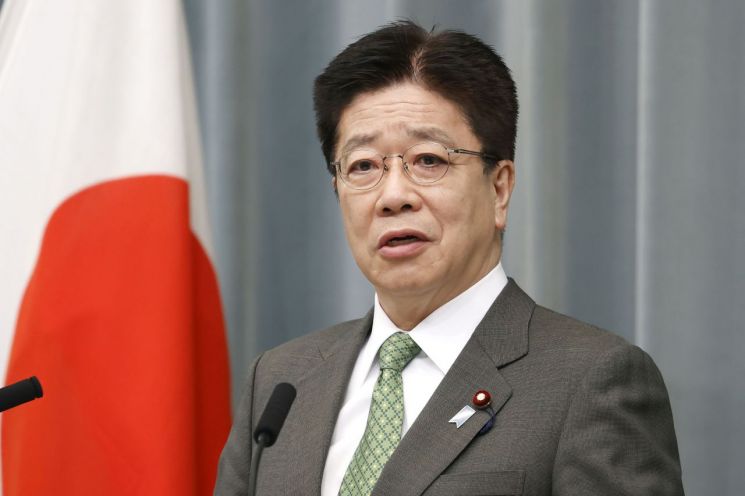
Kato Katsunobu, Chief Cabinet Secretary and spokesperson for the Japanese government, said at the regular press conference that morning, "This time, the ruling came out differently from the January 8 ruling this year," and added, "Since it is necessary to analyze the content in detail, the government will refrain from commenting at this point."
Regarding the Korean media reports from the previous day that the plaintiffs who won the lawsuit in January this year sought to seize Japanese government assets in Korea to secure litigation costs, which raised concerns about violations of international law according to the presiding court's decision, Kato avoided direct comments, citing it as a "procedure within Korea."
However, he said, "The January ruling (by another court) clearly violated international law and the agreements between Korea and Japan," and added, "The Japanese government cannot accept it and has continuously demanded that the Korean government take responsibility and devise appropriate measures to correct the 'international law violation situation.'"
Regarding the impact of this decision, which recognized sovereign immunity, on Korea-Japan relations, Kato reiterated, "It is difficult to comment without thoroughly analyzing the ruling."
He added, "We will continue to strongly demand that Korea take appropriate measures at the national level to correct the violation of international law."
Kato's remarks are notable as they reaffirm the Japanese government's stance that the comfort women compensation issue was completely resolved through the 2015 Korea-Japan agreement between foreign ministers.
The Japanese Ministry of Foreign Affairs strongly protested immediately after the January 8 ruling, which recognized the Japanese government's liability in another lawsuit filed by comfort women victims, by summoning Nam Gwan-pyo, the South Korean ambassador to Japan at the time.
The Japanese government, which considered the lawsuit itself unjust and did not respond at all during the litigation process, announced a statement under the name of Foreign Minister Motegi Toshimitsu on January 23, after the first ruling was finalized due to the withdrawal of the appeal.
In the statement, Foreign Minister Motegi said, "(This ruling) clearly contradicts international law and is very regrettable," and asserted, "It is absolutely unacceptable."
The Japanese government argues that the first ruling, which denied sovereign immunity, violates the 1965 Korea-Japan Claims Agreement and the 2015 Korea-Japan foreign ministers' 'comfort women agreement,' and is therefore contrary to international law.
The Japanese government invoked the principle of sovereign immunity under customary international law, which states that a sovereign state does not appear in another country's court, and refused to participate in the trial, claiming dismissal in this lawsuit as well as in the lawsuit handled by the Seoul Central District Court Civil Division 34 (then presiding judge Kim Jeong-gon) that issued the January ruling.
Meanwhile, major Japanese media outlets such as Kyodo News and NHK showed extraordinary interest by promptly reporting the news that the Seoul Central District Court Civil Division 15 (presiding judge Min Seong-cheol) issued a dismissal decision on the damages lawsuit filed by 20 comfort women victims and their families, including the late Kwak Ye-nam, Kim Bok-dong, and Lee Yong-soo, against the Japanese government.
© The Asia Business Daily(www.asiae.co.kr). All rights reserved.

















