The Government Says 'It's Due to Flight Schedules'... Concerns Over Thrombosis Remain
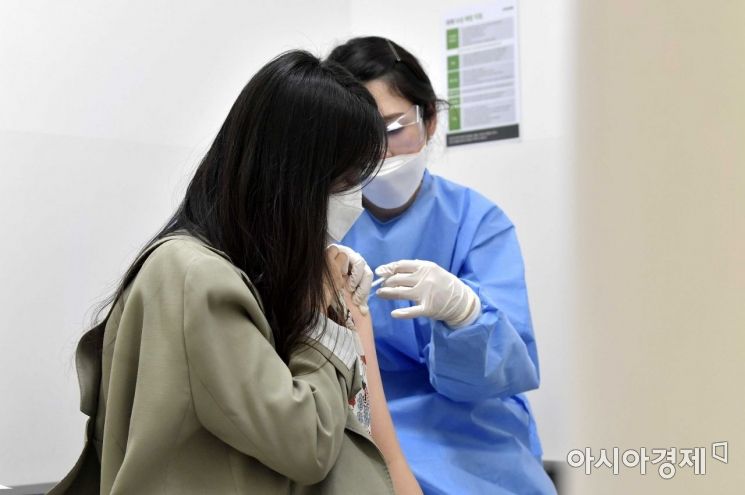 On the 19th, when COVID-19 vaccinations began for aviation industry workers, an airline flight crew member received the AstraZeneca vaccine at Bumin Hospital in Gangseo-gu, Seoul. Photo by Jinhyung Kang aymsdream@
[Asia Economy Reporter Seo So-jeong] "I am worried about side effects such as thrombosis if I get the COVID-19 vaccine, but if I don't, I am afraid I might be excluded from international flights."
Park, a 32-year-old working for an airline, has been struggling with this dilemma since reservations for vaccinations for flight attendants recently began. Due to the nature of the job, which involves providing services in a confined, crowded, and enclosed cabin space for long periods alongside incoming international passengers, vaccination is urgent. However, she has to receive the AstraZeneca vaccine, which has raised concerns about thrombosis among young people.
Park said, "Concerns about overseas variants are rapidly increasing, and I need to get vaccinated for both the passengers and myself. But since I am still in my early 30s and planning to get pregnant soon, I am hesitant about getting the vaccine."
According to the COVID-19 Vaccination Response Promotion Team on the 22nd, among about 16,200 flight attendants eligible for vaccination since the 19th, only 8,411 had made reservations, resulting in a reservation rate of just 51% as of the previous day. Considering that pre-reservations must be completed by the 23rd and vaccinations by the 24th, it is difficult to achieve the target vaccination rate.
Hong Jeong-ik, head of the Vaccination Planning Team at the Promotion Team, said at a briefing the day before, "The biggest problem with the low vaccination rate is that some requested not to be vaccinated this week due to flight schedules," adding, "We are considering extending the vaccination period for flight attendants so those who cannot get vaccinated due to schedules, such as traveling abroad, can receive vaccinations after returning to Korea."
Regarding concerns that thrombosis fears among young women have affected the vaccination rate, Hong explained, "Women under 30 have already been excluded from the vaccination target," and added, "There is an understanding that some cannot get vaccinated this week due to schedules, which is quite reasonable."
According to the airline industry, the reservation rate is lower than initially expected. Previously, the Ministry of Land, Infrastructure and Transport surveyed domestic airlines about flight attendants' consent to COVID-19 vaccination. In the case of Korean Air, nearly 90% of about 9,000 eligible personnel, including flight crew, cabin crew, and maintenance staff, agreed to vaccination.
The survey at that time did not specify a particular vaccine but only sought consent for vaccination. Recently, concerns about thrombosis with the AstraZeneca vaccine have emerged, and since a significant portion of flight attendants are women in their 30s and 40s, there are worries that the vaccination rate may be lower than expected.
A flight attendant said, "Due to the impact of COVID-19, international flights currently operate at only 30% compared to 2019, so there is no disadvantage yet for those unvaccinated. However, if flights expand in the future, there is a concern about being excluded from flight schedules, so many are getting vaccinated," adding, "The recent case of a woman in her 40s who experienced limb paralysis after vaccination as a nursing assistant does not feel like a distant issue."
© The Asia Business Daily(www.asiae.co.kr). All rights reserved.

![Clutching a Stolen Dior Bag, Saying "I Hate Being Poor but Real"... The Grotesque Con of a "Human Knockoff" [Slate]](https://cwcontent.asiae.co.kr/asiaresize/183/2026021902243444107_1771435474.jpg)















