Top 5 Card Companies
Last Year's Card Loan Balance Up 9.58% YoY
Delinquent Amount Also Up 2.08%
[Asia Economy Reporter Ki Ha-young] Last year, the outstanding balance of long-term credit card loans (card loans) reached an all-time high due to financial difficulties caused by COVID-19 and the boom in real estate and stock investments, while the delinquent amount of card loans also slightly increased. In particular, considering that the overall credit card debt delinquency rate had decreased due to financial support measures such as loan maturity extensions and interest payment deferrals related to COVID-19, concerns are emerging that card loan defaults may materialize when the financial support ends this coming September.
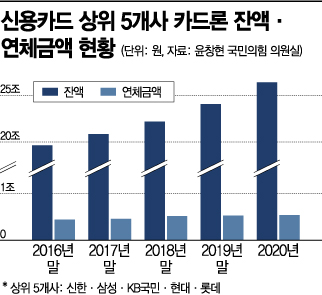
According to data submitted by the Financial Supervisory Service to Rep. Yoon Chang-hyun of the People Power Party on the 21st, the outstanding balance of card loans from the top five credit card companies (Shinhan, Samsung, KB Kookmin, Hyundai, and Lotte Card) last year was 26.367 trillion KRW, an increase of 2.305 trillion KRW (9.58%) compared to the previous year. This is the largest increase in the past five years.
The card loan balance has increased by 6.71 trillion KRW over the past five years. It was 19.657 trillion KRW at the end of 2016, 20.837 trillion KRW at the end of 2017, 22.179 trillion KRW at the end of 2018, 24.062 trillion KRW at the end of 2019, and 26.367 trillion KRW at the end of 2020, showing an increasing trend every year.
The delinquent amount of card loans (over 1 month overdue, excluding refinancing loans) also rose by 11 billion KRW (2.08%) from the previous year to 54 billion KRW. The delinquent amount has increased from 44.4 billion KRW at the end of 2016, 46 billion KRW at the end of 2017, 51.7 billion KRW at the end of 2018, 52.9 billion KRW at the end of 2019, to 54 billion KRW at the end of 2020.
However, compared to the sharp increase in card loan balances last year, the growth rate of delinquent amounts is relatively low. In particular, Hyundai Card has refrained from selling delinquent loans itself following the 'Strengthened Support Measures for Vulnerable Re-debtors' implemented in April last year to prevent repetitive sales of personal delinquent loans and excessive collection, which differs from other card companies where delinquent amounts increased. Considering this, delinquent amounts have been decreasing since the first quarter of last year.
The market interprets this as an optical illusion caused by COVID-19. The financial support measures such as loan principal repayment maturity extensions and interest payment deferrals have postponed defaults. Meanwhile, the slight increase in card loan delinquent amounts indicates that the number of borrowers struggling to repay has increased. This is why there are concerns that suppressed defaults could erupt all at once when the COVID-19 financial support measures, extended until September, end.
An industry insider expressed concern, saying, "If the economic downturn prolongs and interest rates rise, card loan users, who are mainly low-credit borrowers, could be the first to experience loan defaults," adding, "Starting with card loan users, household loan defaults could cascade sequentially."
© The Asia Business Daily(www.asiae.co.kr). All rights reserved.

















