KERI "Independent Development of Technology Owned Only by Germany and Japan."
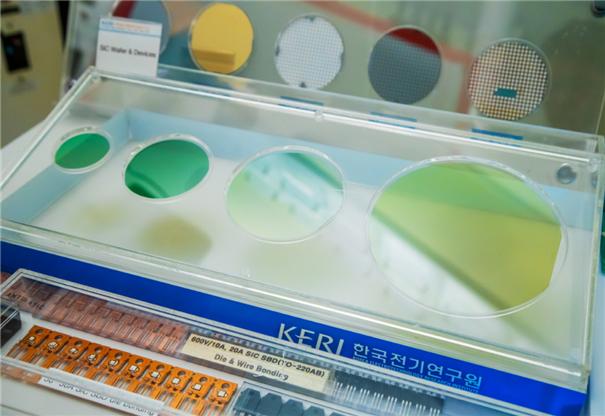
[Asia Economy Reporter Kim Bong-su] A technology that significantly enhances the performance and price competitiveness of SiC (Silicon Carbide) power semiconductors, whose demand is rapidly increasing for electric vehicles, while also enabling increased chip supply, has been developed domestically and is expected to be commercialized soon, attracting attention.
The Korea Electrotechnology Research Institute (KERI) announced on the 21st that it has developed the cutting-edge SiC power semiconductor device technology called ‘Trench Structure MOSFET’ and signed a technology transfer contract worth 2 billion KRW with a specialized manufacturer.
Power semiconductors (or power devices) are semiconductors that control electricity and are essential in all electrical and electronic products, including home appliances and lighting. A representative example is the power semiconductor, a core component of the inverter that converts the direct current electricity of an electric vehicle battery into alternating current electricity to supply the motor. Although demand for power semiconductors has surged recently due to electric vehicles, renewable energy generation, and energy storage systems, production has lagged, causing a 'semiconductor crisis' where global automakers have halted production lines.
When making electric vehicle inverters with SiC power semiconductors, energy efficiency improves by up to 10% compared to using silicon (Si) semiconductor inverters, and the inverter’s size and weight can be reduced, making it optimal for e-mobility. For this reason, demand for SiC power semiconductors for electric vehicles has surged, leading to a supply shortage for over a year. Additionally, SiC semiconductor materials are included in the U.S. export restrictions to China, making them a subject of the U.S.-China technology war.
The performance of SiC power semiconductors is far superior to silicon semiconductors. This stems from differences in material properties: SiC power semiconductors can withstand voltages ten times higher than silicon semiconductors, operate at high temperatures of several hundred degrees Celsius, and consume less power, thereby improving energy efficiency.
The success of domestic researchers in developing the SiC trench MOSFET signifies that Korea, a latecomer in the first division of SiC technology, has joined the ranks. The SiC trench structure has many challenges to overcome, such as ensuring stable operation and long-term durability, and only Germany and Japan have succeeded in mass production worldwide, indicating a high technological barrier. Bang Wook, head of KERI’s Power Semiconductor Research Center, said, “The trench MOSFET technology is the culmination of SiC material and device technologies that our institute has steadily accumulated over the past 20 years,” and evaluated, “The localization of trench MOSFET, which will become the main player in the SiC market within a few years, is the most significant achievement.”
The SiC trench MOSFET technology involves creating narrow and deep grooves (trenches) on the SiC wafer and arranging the current-carrying channels vertically along the walls of these grooves, differentiating it from the previously horizontally arranged channel structures. By standing the horizontally arranged channels vertically, the area occupied by the channels can be saved, reducing the power device area by up to several tens of percent.
Since the supply of SiC power semiconductors is monopolized by a few advanced countries, causing a global supply shortage, attention is focused on whether the trench technology developed by Korean researchers can increase production volume and alleviate the supply shortage of SiC power semiconductors.
Dr. Moon Jeong-hyun of KERI explained, “Applying this most challenging technology in SiC power devices allows more chips to be produced per wafer, increasing supply and lowering device prices accordingly.”
In particular, the ‘Trench Structure SiC Power Semiconductor MOSFET’ manufacturing core technology developed by KERI is already on the verge of commercialization. KERI recently transferred a comprehensive technology package, including various measurement and analysis technologies for product commercialization, to Yes Power Technics Co., Ltd., a specialized SiC power semiconductor company. The technology transfer amount, including the project contract, reached 2 billion KRW. The research team plans to actively support the localization and mass production of SiC power semiconductors, which have heavily relied on imports, by supporting the entire process from equipment purchase to mass production line establishment.
Meanwhile, according to European market research firm IHS Markit and others, the SiC power semiconductor market is expected to grow from about 700 million USD (approximately 780 billion KRW) last year to about 10 billion USD (approximately 11.14 trillion KRW) by 2030, showing an average annual growth rate of 32%.
© The Asia Business Daily(www.asiae.co.kr). All rights reserved.

















