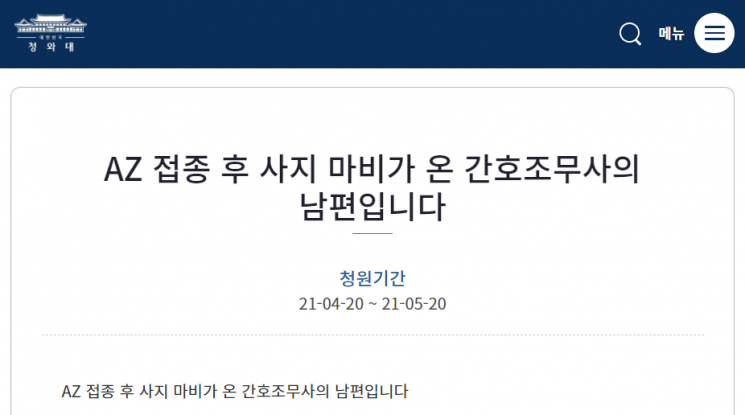
 A post uploaded by Mr. B, who identified himself as the husband of a nursing assistant who developed limb paralysis after receiving the AstraZeneca COVID-19 vaccine, captured from the Blue House National Petition website. [Image source=Blue House]
[Asia Economy Reporter Lee Chun-hee] The husband of nursing assistant A (45), who is currently hospitalized due to side effects such as limb paralysis after receiving the AstraZeneca (AZ) COVID-19 vaccine, posted a message on the Blue House National Petition Board stating that "it would have been better to catch COVID-19."
B, who identified himself as the husband of the nursing assistant who developed limb paralysis after receiving the AZ vaccine, posted a petition titled "I am the husband of a nursing assistant who developed limb paralysis after AZ vaccination" on the Blue House National Petition Board on the 20th.
He hesitated at first, thinking "this was just misfortune for our family," but posted the message "for those who have died or are suffering from severe aftereffects after vaccination, and for citizens who may suffer the same damage as me in the future," showing courage. B claimed that his wife A, as a healthcare worker, "was a priority vaccination target and therefore had no right to refuse the vaccine or choose which vaccine to receive."
According to the petition, A experienced adverse reactions after vaccination but continued working while taking painkillers, thinking she would soon recover. However, 19 days after vaccination, on the 31st of last month, she was hospitalized with symptoms of limb paralysis. B lamented, "Looking back now, there were prodromal symptoms 3 to 4 days before hospitalization, but due to the government's insufficient guidance on side effects, we did not recognize them."
A was later diagnosed with acute disseminated encephalomyelitis. According to B, the attending physician informed them that A would require treatment and rehabilitation for about six months to a year and that disabilities might occur.
Through the petition, B expressed the heavy burden of medical and caregiving expenses. He complained that A's treatment and caregiving costs amount to 4 million won per week, an unaffordable level for ordinary citizens. B said the public health center told them to "submit all treatment and caregiving expenses after treatment is complete," but the review process takes 120 days, and the Disease Control Agency only conducted investigations with no further updates.
He also expressed frustration over the government's stance that "although there are overseas cases, causality has not been recognized," saying, "How can ordinary citizens without medical knowledge prove causality for phenomena that even medical experts cannot explain?"
B revealed that after visiting the Korea Workers' Compensation and Welfare Service to apply for industrial accident compensation instead of the lengthy national compensation process, he saw a poster guiding COVID-19 confirmed patients on industrial accident claims and thought, "It would have been wiser not to get vaccinated and just catch COVID-19." There, a senior official told him, "It's unfortunate, but industrial accident claims are not accepted for vaccine side effects," and added, "Who would acknowledge causality in these times?" which deeply angered him.
B concluded his post by saying, "I believed the president's words that 'it is safe' and 'the government will take responsibility for side effects,'" and expressed a strong sense of betrayal, questioning, "Is there really a state?"
As of 4:20 PM on the same day, B's petition had surpassed the preliminary agreement threshold of 100 people, garnering 3,900 supporters and awaiting formal registration as an official petition.
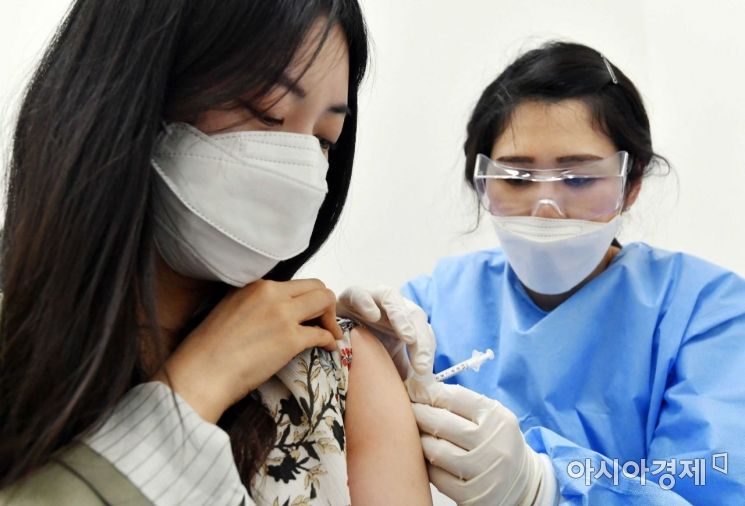 On the 19th, an airline crew member is receiving the AstraZeneca vaccine at Bumin Hospital in Gangseo-gu, Seoul. Photo by Jinhyung Kang aymsdream@
Nursing assistant A, who works at a hospital in Gyeonggi Province, received the AZ vaccine on the 12th of last month. It is known that she was diagnosed as healthy with "no specific findings" and no underlying conditions during a health checkup for hospital employment in January.
After vaccination, A experienced headaches and took painkillers, but symptoms persisted for a week. Around the 24th of the same month, she developed binocular diplopia, where objects appeared doubled. After being hospitalized on the 31st, she showed symptoms of limb paralysis and was diagnosed with acute disseminated encephalomyelitis. She remains hospitalized and undergoing treatment.
© The Asia Business Daily(www.asiae.co.kr). All rights reserved.


















