Application to Elementary Students in 2024 and Middle and High School Students in 2025
General Overview to Be Announced in the Second Half of This Year... Nationwide Survey in May
Expansion of Descriptive and Essay-Type Assessments in Middle School, Development of Future-Oriented Textbooks
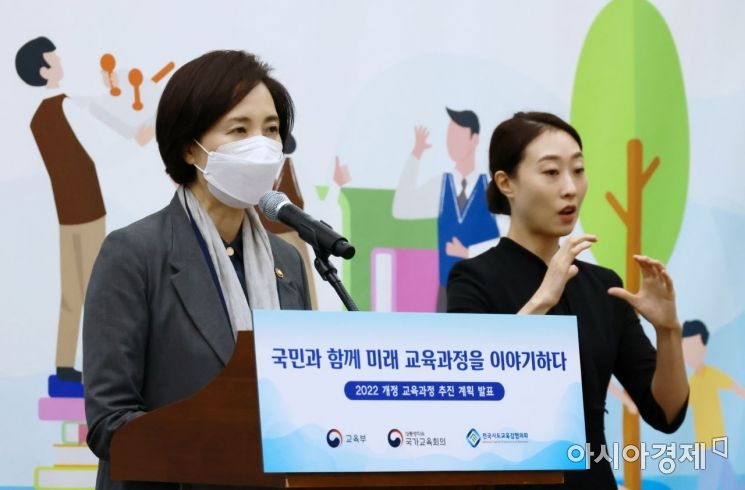
[Asia Economy Reporter Han Jinju] The Ministry of Education is starting the groundwork for the 2022 revised curriculum. The main focus is to expand competency education that enhances school autonomy in elementary and middle schools in line with the high school credit system, which will be fully implemented in 2025.
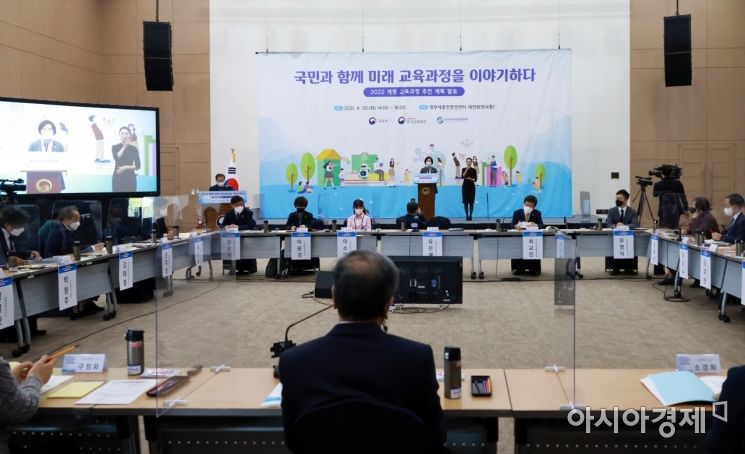
On the 20th, the Ministry of Education, the National Education Council, and the National Association of Metropolitan and Provincial Superintendents of Education announced the 2022 revised curriculum implementation plan at the Government Sejong Convention Center.
Deputy Prime Minister and Minister of Education Yoo Eun-hye stated, "The purpose of introducing the high school credit system is to establish a foundation that can be realized from the elementary and middle school curriculum stages," adding, "We will prepare a future-oriented teaching and learning foundation suitable for developing competencies, such as theme-based integrated classes, discussion classes, and written and essay-type assessments."
Minister Yoo explained, "We will improve the curriculum to be flexible by recognizing out-of-school learning experiences and various online classes and supporting diverse class operations," and added, "We will emphasize safe life and living, ecological transition education, democratic citizenship education, and strengthen artificial intelligence (AI) and digital literacy education."
Language, Numeracy, and Digital Literacy Also Considered 'Basic Literacy'
Elementary schools will implement play-linked learning appropriate to developmental levels, and middle schools will introduce essay and descriptive assessments. The 2022 curriculum includes language, numeracy, and digital literacy as basic literacy, beyond just reading, writing, and arithmetic. Ecological transition education, artificial intelligence (AI), digital literacy, and democratic citizenship education will also be strengthened to develop competencies that respond to social changes such as the climate crisis, COVID-19, and digital transformation.
The 2022 revised curriculum supports play-centered spatial innovation and learning linked to play, considering the developmental levels of elementary students. To expand curriculum diversity, the school autonomy time system will be improved to allow the establishment of new subjects linked to local communities and elective activities within the basic and foundational education of the common curriculum.
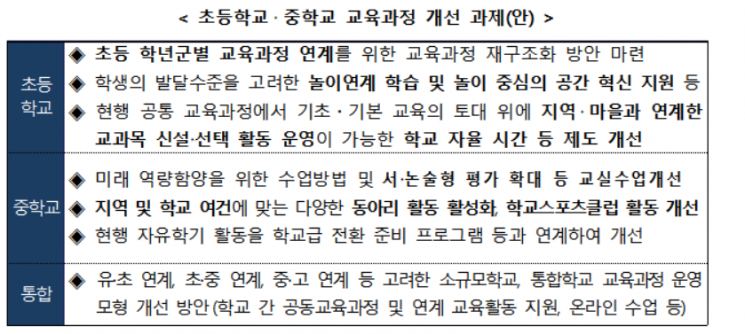
For middle schools, classroom instruction will be improved by expanding descriptive and essay-type assessments. Club activities suited to local and school conditions will be revitalized, and school sports club activities will also be improved. The current free semester activities will be modified to connect with programs necessary for school level transitions. Small-scale and integrated school curricula considering connections between kindergarten and elementary school, elementary and middle school, and middle and high school will also be operated.
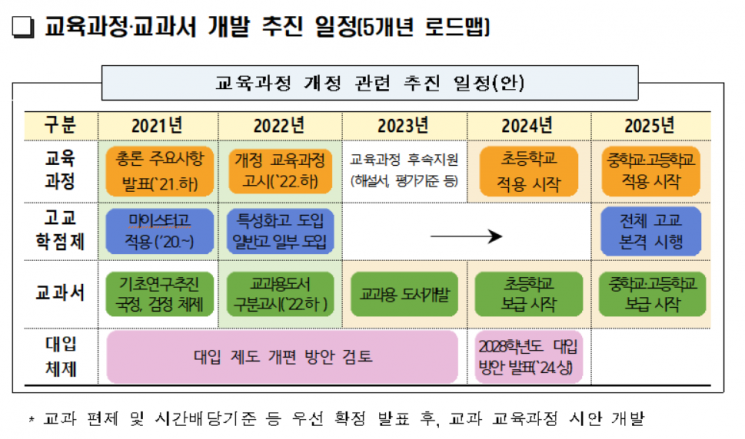
With the introduction of the high school credit system, reform of the college entrance examination system is inevitable. The Ministry of Education plans to disclose the college entrance examination reform plan applicable from the 2028 academic year in the first half of 2024. The Ministry will promote reforms in the school life record system and college entrance examination system to implement the revised curriculum. From the 2028 academic year, when students who have completed the new curriculum take the College Scholastic Ability Test (CSAT), the introduction of essay and descriptive exams is also under consideration.
Expansion of Remote Classes and Curriculum Autonomy... Development of Future-Oriented Textbooks
Moving away from textbooks and offline classes as the main focus, online-offline linked classes utilizing edutech will also be activated. The plan to recognize remote classes related to subject learning topics and learning experiences inside and outside school as class hours will also be reviewed. Efforts to expand the autonomy of schools and teachers will be carried out simultaneously. Autonomy in increasing or decreasing subject hours and reorganizing the curriculum will be expanded. Guidelines for the number of hours and operation methods will also be adjusted so that creative experiential activity curricula can be autonomously organized and operated.
Future-oriented textbooks linked to the revised curriculum will also be developed. To introduce future-oriented textbooks suitable for online-offline linked classes and the high school credit system, a plan for developing future-oriented textbooks and a notification plan distinguishing textbook types (state-authorized, certified, and recognized) will be prepared by the end of this year, with sequential development and distribution planned. State-authorized textbooks will be applied from 2024, and certified and recognized textbooks will be applied sequentially from March 2025. They will be applied in stages: early 2024 for grades 1 and 2, 2025 for grades 3 and 4 and middle school grade 1 and high school grade 1, 2026 for grades 5 and 6 and middle school grade 2 and high school grade 2, and 2027 for middle school grade 3 and high school grade 3.
The Ministry of Education decided to develop state-authorized textbooks for all subjects in lower elementary grades and Korean language and ethics subjects for grades 3 to 6. Certified textbooks will have their compilation standards revised and review documents simplified. Recognized textbooks, which are widely used as supplementary materials, will be developed through teacher research groups within or between schools. The introduction of a free textbook publication system, which delegates all rights of textbook compilation and publication to schools or teachers, will also be pursued.
Detailed Curriculum to be Finalized in the Second Half of This Year... Public Survey Starting in May
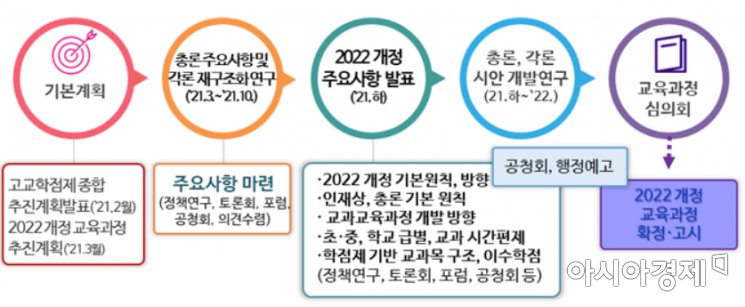
The Ministry of Education plans to announce the main points of the revised curriculum general theory in the second half of this year and finalize and notify the general theory and detailed curriculum in the second half of next year. Unlike previous curriculum revisions that were mainly expert-centered, this time the scope for collecting opinions from students, parents, and teachers has been expanded. The curriculum revision work will be promoted through cooperation among three committees: the Curriculum Revision Promotion Committee, the Policy Advisory Committee, and the Detailed Curriculum Adjustment Committee.
Kim Jin-kyung, Chairperson of the National Education Council, said, "From May, we will conduct a large-scale online public opinion survey for one month to listen to the public's views and deliberate with the public participation group and youth advisory group to reach a consensus," adding, "We will deliver the improvement plan to the Ministry of Education to reflect the opinions of students, parents, and teachers who have had difficulty participating practically in curriculum revisions so far."
Kim Hye-sook, Chairperson of the Policy Advisory Committee and Professor Emeritus at Ewha Womans University, explained, "The vision and consensus on future education talents and values cannot be obtained solely through public opinion surveys; concrete vision and agreement are necessary," adding, "Until now, education has focused on competition and created frameworks accordingly, but in the 2022 revised curriculum, how to create individuality and diversity is important."
© The Asia Business Daily(www.asiae.co.kr). All rights reserved.



















