Banks Take on Responsibility for Exchange Comprehensive Certification
Banking Association to Distribute 'Reference Materials' Within This Month
Strict Screening Expected for Real-Name Account Issuance

[Asia Economy Reporter Park Sun-mi] "From a bank's perspective, transactions with cryptocurrency exchanges carry more risks than benefits. This is because if they get entangled with money laundering, the problems can only escalate. This is why many banks are reluctant to engage with cryptocurrency exchanges." (Senior executive at Bank A)
Many domestic cryptocurrency exchanges are increasingly likely to shut down by the end of September, when the grace period for the amendment to the Act on Reporting and Using Specified Financial Transaction Information (the Specified Financial Transactions Act, or Specified Act) expires. This is because the government and financial authorities have failed to establish laws and regulations for the proliferating exchanges, and the banking sector, which has taken on the responsibility for comprehensive certification of exchanges, is signaling strict scrutiny in issuing real-name accounts. There is a growing sentiment that a conservative approach is inevitable, as there are concerns that if problems arise at exchanges?similar to the private equity fund scandal?banks might be held liable for investment losses, and that these issues could be linked to money laundering.
According to the financial sector on the 20th, the Korea Federation of Banks plans to distribute reference materials containing basic processes and evaluation factors for banks to consider when dealing with cryptocurrency exchanges within this month. The external consulting service for preparing these reference materials is in its final stages, aiming for distribution within this month. The related tasks are handled by the newly established Legal Support Department, created during the Korea Federation of Banks' organizational restructuring in March.
Banks that decide to engage with cryptocurrency exchanges will be able to create and apply detailed internal guidelines tailored to their circumstances based on the reference materials distributed by the Korea Federation of Banks. Although banks requested the financial authorities to develop guidelines necessary for transactions with cryptocurrency exchanges reflecting the amended Specified Act, which took effect on the 25th of last month, the authorities declined, stating that each bank must establish its own standards individually.
The amended Specified Act imposes anti-money laundering obligations on cryptocurrency exchanges and mandates that by September 24, when the grace period ends, they must obtain real-name deposit and withdrawal accounts from banks and complete the reporting procedures to operate legally. Essentially, the comprehensive evaluation of the risk, safety, and business models of cryptocurrency exchanges is entrusted to the banking sector, which decides whether to issue real-name deposit and withdrawal accounts.
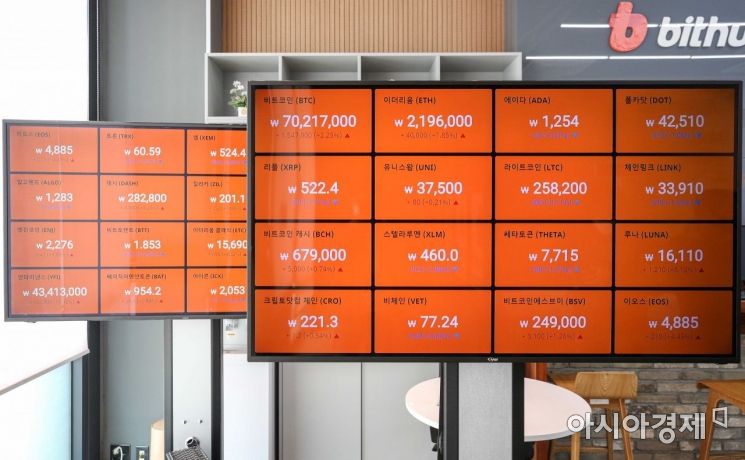
Banks Signal Strict Screening for Cryptocurrency Exchange Transactions... Conservative and Passive Responses
Banks are showing reluctance to partner with cryptocurrency exchanges. Currently, only four major exchanges?Bithumb, Upbit, Coinone, and Korbit?have real-name accounts with banks such as NH Nonghyup, Shinhan, and K Bank. More than 100 small and medium-sized exchanges are contacting banks to obtain real-name deposit and withdrawal accounts by the end of September but have yet to achieve significant results.
Commercial banks like KB Kookmin and Woori Bank, which do not currently transact with cryptocurrency exchanges, are hesitant to enter the market due to the risks associated with cryptocurrency transactions. Even banks already dealing with major exchanges are reluctant to increase the number of exchanges they work with, citing the burden.
Banks intend to apply stricter internal screening criteria to the major cryptocurrency exchanges they already transact with, evaluating them more conservatively. The reluctance of commercial banks to issue deposit and withdrawal accounts to cryptocurrency exchanges stems from their exposure to liability in case of incidents and the risks of money laundering.
Moreover, as cryptocurrency investment has recently overheated, the government has heightened vigilance by announcing a special government-wide crackdown to prevent illegal activities such as money laundering and fraud using cryptocurrencies. The Financial Services Commission plans to strengthen primary monitoring by financial companies during virtual asset withdrawals and enhance cooperation between the Financial Intelligence Unit (FIU), investigative agencies, and tax authorities to promptly notify them of suspicious illegal transactions. The Ministry of Economy and Finance will also strengthen inspections for violations of related laws, including the Foreign Exchange Transactions Act, in cooperation with the Financial Supervisory Service.
A bank official said, "If a financial accident occurs after issuing deposit and withdrawal accounts to cryptocurrency exchanges, it directly impacts the bank's compliance management," adding, "Since this issue could implicate executives one after another, banks generally perceive that it is better not to get involved at all."
Another bank official explained, "Several cryptocurrency exchanges have consulted with branches about issuing real-name accounts, but none have been approved yet," adding, "Due to internal control risks, even banks that have dealt with cryptocurrency exchanges must approach expanding their client base conservatively."
© The Asia Business Daily(www.asiae.co.kr). All rights reserved.


















