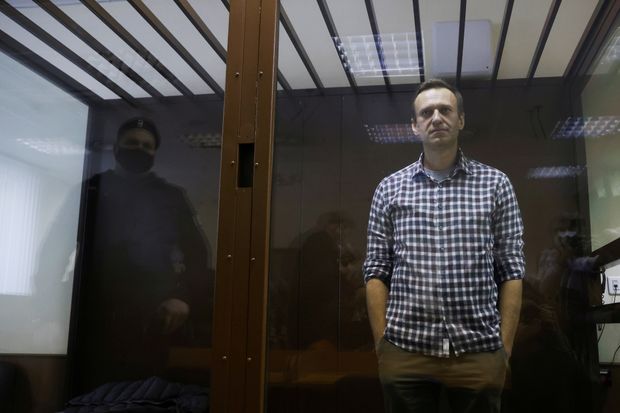
[Asia Economy Reporter Yujin Cho] Russian opposition activist Alexei Navalny, who raised concerns of death after a three-week hunger strike following his imprisonment, has been transferred to a hospital within the correctional facility and is receiving treatment. This move by the prison authorities came just one day after nationwide protests demanding medical care and his release were announced.
According to The Wall Street Journal (WSJ), on the 19th (local time), the prison authorities stated, "The Correctional Authority Medical Committee has decided to transfer Navalny to the inmate hospital located within the prison." The authorities added, "Navalny's current health condition is stable, and an internal medicine specialist examines him daily," and "With the patient's consent, vitamin therapy has been prescribed."
Since his imprisonment in February, Navalny had been conducting a hunger strike for three weeks from the end of last month until recently. On the 7th, he posted on his Instagram, "I am conducting a 100% strict prison hunger strike without any tricks like salt water, juice, or vitamins."
In other social media comments, Navalny wrote that prison guards forcibly tried to feed him after putting him in a restraint suit, and they also tried to lure him by secretly putting candy in his pocket or by spreading the smell of fried chicken.
Meanwhile, the international community has expressed deep concern over Navalny's deteriorating health and urged the Russian government to treat him humanely.
White House Press Secretary Jen Psaki urged the Russian government on the 19th (local time) to treat detained opposition activist Alexei Navalny humanely.
At a briefing that day, Psaki said that if Navalny dies, there will be consequences for the Russian government, adding, "Before that, our goal remains to continue urging his release and reaffirming our view that he must be treated humanely."
Earlier, Jake Sullivan, White House National Security Advisor, warned in an interview with CNN the previous day, "If Navalny dies, the Russian government will be held accountable."
The European Union (EU) also expressed deep concern over Navalny's worsening health and announced that the matter would be discussed at a foreign ministers' video conference.
Josep Borrell, the EU High Representative for Foreign Affairs and Security Policy, stated in a statement on the 18th, "The EU is deeply concerned by reports that Navalny's health has continued to deteriorate in prison," and "We demand that Russian authorities immediately allow Navalny to meet with trusted medical professionals."
Navalny, considered the biggest political rival to President Vladimir Putin, was treated in Germany last August for symptoms of poisoning and was arrested after returning to Russia in January this year.
After imprisonment, Navalny requested treatment from his personal doctor for back and leg pain, but when this was denied, he declared a hunger strike on the 31st of last month.
His personal doctors revealed on the 17th that his blood potassium levels were at a dangerous level and that he could die at any time from cardiac arrhythmia, but the prison authorities still do not allow external medical examinations.
© The Asia Business Daily(www.asiae.co.kr). All rights reserved.
![Clutching a Stolen Dior Bag, Saying "I Hate Being Poor but Real"... The Grotesque Con of a "Human Knockoff" [Slate]](https://cwcontent.asiae.co.kr/asiaresize/183/2026021902243444107_1771435474.jpg)
















