42.5% of Male Engineering Graduates, 10.1% of Female Graduates
Gender Gap in Engineering Employment Rate Also Higher at 5.5%p Compared to Overall
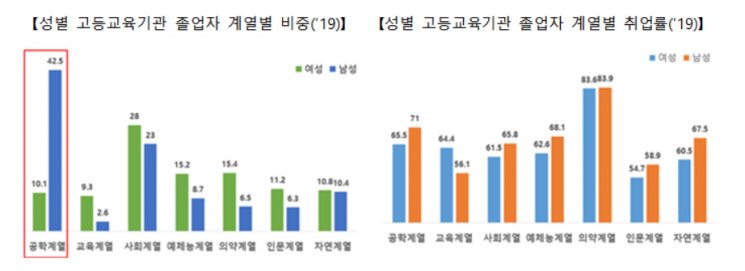 Proportion and Employment Rate by Field of Study for Graduates of Higher Education Institutions in 2019
[Asia Economy Reporter Han Jinju] Among university graduates, the major with the largest gender gap is engineering, and the gender gap in employment rates is also higher than average.
On the 19th, the Ministry of Gender Equality and Family announced on the 20th that it held the "4th Expert Meeting on Analysis of Women's Employment Status and Policy Task Discovery" at the Government Seoul Office, together with the Korean Women's Development Institute, Korea Center for Women in Science, Engineering and Technology (WISET), Korea Polytechnic University, and the IT Women Entrepreneurs Association.
Kim Nanju, Associate Research Fellow at the Korean Women's Development Institute, confirmed through the analysis of the "2019 Employment Statistics Survey of Graduates from Higher Education Institutions" that there are gender gaps by field and employment rate gaps among graduates from higher education institutions.
Among graduates from higher education institutions, the field with the largest gender gap between male graduates (42.5%) and female graduates (10.1%) was engineering. The employment rate gap in engineering was 65.5% for women and 71.0% for men, a 5.5 percentage point difference, which is larger than the overall gender gap in employment rates (3.8 percentage points).
Song Eunkyung, Business Strategy Team Leader at WISET, presented the progress of the women's science and technology growth support platform project, ‘W-Bridge’. W-Bridge provides integrated growth support services throughout the entire life cycle of women in science and technology, including career exploration, employment linkage, basic consulting for career planning, mentoring, and networking.
Professor Ha Jungmi of Korea Polytechnic University said, "The emergence of advanced information technology (IT) platforms, changes in the labor environment and corporate culture in new industrial ecosystems are expected to help improve women's employment rates, so it is necessary to reduce gender differences in field selection from the high school level."
Park Susanna, Head of Management Support at the IT Women Entrepreneurs Association, explained, "Although the number of female students applying for STEM fields and female researchers is increasing, there is a shortage of female leaders in the information and communication technology (ICT) sector. It is necessary to support career-disrupted women scientists and engineers with education and career planning, and to properly highlight the role of female leaders in the ICT field."
The Ministry of Gender Equality and Family plans to promote experiential and support policies so that interest in engineering fields can be fostered and entry encouraged from middle and high school years, such as operating engineering experience events for female students and supporting the "STEM Female Graduate Student Engineering Research Team System," where graduate student research leaders form teams with female university, middle, and high school students.
Kim Kyungseon, Vice Minister of the Ministry of Gender Equality and Family, said, "We must resolve the issue of gender-based occupational segregation, which is one of the biggest factors in the COVID-19 women's employment crisis. We will expand vocational training such as specialized technical courses in response to changes after COVID-19, and support the expansion of young women's entry into future promising jobs such as digital transformation and low-carbon economy."
© The Asia Business Daily(www.asiae.co.kr). All rights reserved.
![Clutching a Stolen Dior Bag, Saying "I Hate Being Poor but Real"... The Grotesque Con of a "Human Knockoff" [Slate]](https://cwcontent.asiae.co.kr/asiaresize/183/2026021902243444107_1771435474.jpg)
















