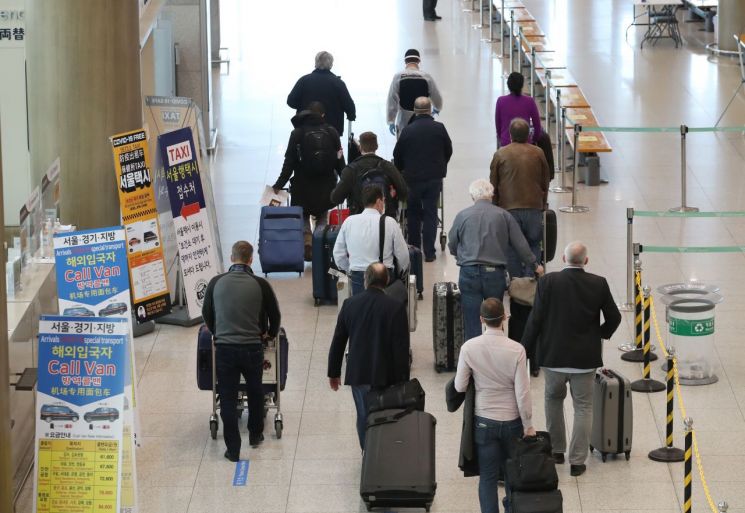
 As cases of infection with imported variant viruses known to be more transmissible than the original COVID-19 continue to rise steadily, authorities are on high alert as an infection with the Indian "double mutant" (B.1.617) has now been confirmed. The photo shows international arrivals at Terminal 1 of Incheon International Airport in Yeongjongdo on the 19th. [Image source=Yonhap News]
[Asia Economy Reporter Chunhee Lee] Amid growing concerns about the '4th wave' of COVID-19, cases of infection with variant viruses that have mutated to become more transmissible while potentially reducing the effectiveness of vaccines and treatments are continuously increasing.
The Central Disease Control Headquarters (CDCH) announced on the 19th that, based on genome analysis conducted since the 12th, 70 additional cases of infection with the 'three major variant viruses' from the UK, South Africa, and Brazil have been confirmed, bringing the total to 449 cases.
Among the newly confirmed 70 cases, 64 were infected with the UK variant, 5 with the South African variant, and 1 with the Brazilian variant.
Of these, 35 cases were imported from overseas and 35 were domestically transmitted. By nationality, 41 were Korean nationals and 29 were foreigners.
Among the 35 domestic cases, 27 were linked to cluster infections involving the variants, while 8 were individual confirmed cases not yet classified as cluster infections. Of the 35 imported cases, 13 were identified during quarantine upon entry, and the remaining 22 were diagnosed with variant infections during self-isolation after entry.
The CDCH has analyzed 7,215 variant virus genomes since October last year and has identified 449 major variant cases to date. Among these, 388 were the UK variant, 51 the South African variant, and 10 the Brazilian variant.
Additionally, 9 cases of the Indian variant have been confirmed so far. However, all these infected individuals directly entered from India, and there have been no further transmission cases.
Regarding the risk of variant viruses, Jung Eun-kyung, Commissioner of the Korea Disease Control and Prevention Agency, stated, "So far, there is no confirmed evidence from investigations or research on how variant viruses affect transmissibility, fatality rates, or the efficacy of vaccines and treatments," adding, "We expect additional investigation and research results to be released continuously, and we will keep monitoring and responding accordingly."
© The Asia Business Daily(www.asiae.co.kr). All rights reserved.
![Clutching a Stolen Dior Bag, Saying "I Hate Being Poor but Real"... The Grotesque Con of a "Human Knockoff" [Slate]](https://cwcontent.asiae.co.kr/asiaresize/183/2026021902243444107_1771435474.jpg)











