Government, Bank of Korea, and Others Assess Easing of Domestic Demand Slump
Clothing and Dining Expense Spending Outlook Sentiment Revives
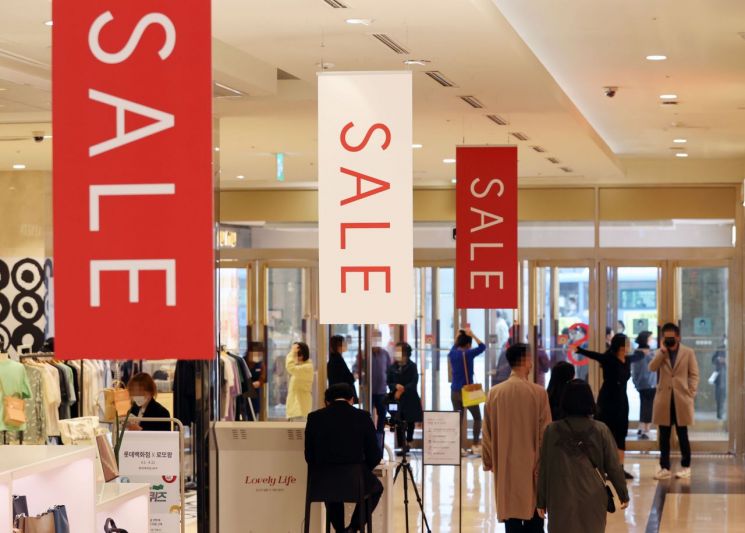
[Asia Economy Reporter Kim Eun-byeol] Although the number of new COVID-19 cases has remained in the 600s for four consecutive days, consumer sentiment is gradually recovering compared to last year. This is because the public, tired of quarantine rules, is not reducing outdoor activities as much as last year despite the increase in COVID-19 cases, and a sense of revenge consumption is also at play.
According to the government on the 18th, the Ministry of Economy and Finance diagnosed in the 'April Recent Economic Trends (Green Book)' published on the 16th that "the domestic demand slump is gradually easing." This reflects the phenomenon of pent-up desires due to COVID-19 being released as revenge consumption at department stores and other places. While the government cautiously stated last month that "the domestic demand slump continues," it used the expression "easing of domestic demand slump" for the first time since the COVID-19 outbreak last year. Last month, the phrase "real economy uncertainty" was also omitted for the first time in nine months.
The Bank of Korea also kept the base interest rate unchanged at the Monetary Policy Committee meeting but evaluated that the domestic economic recovery trend has somewhat expanded and the slump in private consumption has eased. Bank of Korea Governor Lee Ju-yeol said, "The domestic economy has somewhat expanded its recovery trend," adding, "Exports continued to perform well, facility investment maintained a steady recovery trend, and private consumption eased its slump," forecasting that the economic growth rate this year will reach the mid-3% range.
Actual consumption indicators also show a favorable trend. Department store sales in March surged 62.7% compared to the same month last year. This broke the record for the highest growth rate since monitoring began in 2005, surpassing the 39.5% increase in February by a large margin in just one month. Domestic card approval amounts and online sales also increased by 20.3% and 21.1%, respectively, compared to a year ago.
The Consumer Confidence Index (CCSI) compiled by the Bank of Korea also recorded 100.5 last month, surpassing 100 for the first time since January last year (104.8), just before the COVID-19 outbreak. The CCSI is a sentiment index calculated using six major indices from the Consumer Sentiment Index (CSI). A value above the baseline of 100 means that more people view the economic situation and outlook optimistically than pessimistically.
In particular, the consumption expenditure outlook survey among the CCSI categories shows high scores for clothing and dining expenses. The clothing expenditure outlook CSI rose to 94, approaching the level of December 2019 (98), just before the COVID-19 spread. The dining expenditure outlook CSI also reached 90, comparable to the pre-COVID-19 level (92).
LG Economic Research Institute stated, "Consumption experienced severe sluggishness until early this year due to the resurgence of COVID-19 at the end of last year, but has shown some recovery since February," adding, "Thanks to the expansion of durable goods demand, goods consumption is recovering rapidly, and among service consumption, sales at offline retail stores with short face-to-face time and sales of clothing and shoes for outdoor activities are increasing, showing some recovery in consumption."
Despite the ongoing spread of COVID-19, outdoor activities are increasing due to fatigue from prolonged isolation, which is reviving purchasing sentiment for clothing and other items. However, service consumption with high face-to-face interaction, such as food and accommodation, leisure and cultural services, and personal services, remained severely contracted at around 70% of pre-COVID levels even in January and February this year, indicating that there is still no room for complacency. LG Economic Research Institute forecasted, "Considering that it will be difficult for the number of confirmed cases to decrease significantly until the third quarter, it will be difficult for consumption recovery to fully take off, and the situation where consumer sentiment seems to revive due to the spread of COVID-19 but then declines again will likely repeat."
© The Asia Business Daily(www.asiae.co.kr). All rights reserved.

















