Ministry of Employment Announces Analysis of Asphyxiation Accidents Over the Past Decade
Frequent in Wastewater Treatment, Sewers & Manholes, Livestock Manure Processing
Focused Prevention Inspections at High-Risk Sites Until June
Technical Guidance for Local Government Projects in Public Sewage Treatment, Sewers & Manholes
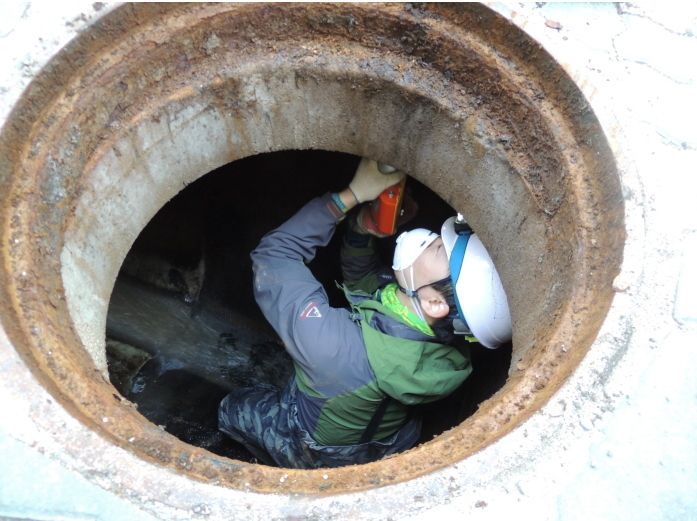
[Sejong=Asia Economy Reporter Moon Chaeseok] It has been revealed that 53.2% of those involved in accidents died from asphyxiation disasters, which occur most frequently in the spring. The government has issued an asphyxiation hazard warning.
The Ministry of Employment and Labor announced on the 18th the results of an analysis of asphyxiation disasters that occurred over the past 10 years since 2011. Asphyxiation disasters are fatal, with 53.2% of all victims dying. This is overwhelmingly higher than the 1.1% death rate in general accidental disasters.
According to the Ministry of Employment and Labor, there were 195 asphyxiation disasters over the 10 years, affecting 316 people. More than half of them, 168, died.
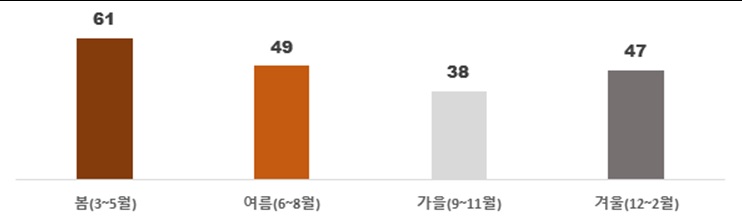 Number of seasonal suffocation accidents from 2011 to 2020. (Source: Ministry of Employment and Labor)
Notably, asphyxiation disasters occur most frequently in the spring. Spring accounted for 61 cases (31.3%), more than summer (49 cases, 25.1%), winter (47 cases, 24.1%), and autumn (38 cases, 19.5%).
As the weather warms, microorganisms actively proliferate and consume oxygen inside workspaces. High concentrations of hydrogen sulfide also occur. Because of this, asphyxiation disasters frequently happen in wastewater treatment and septic tanks, sewage and manholes, and livestock manure treatment facilities.
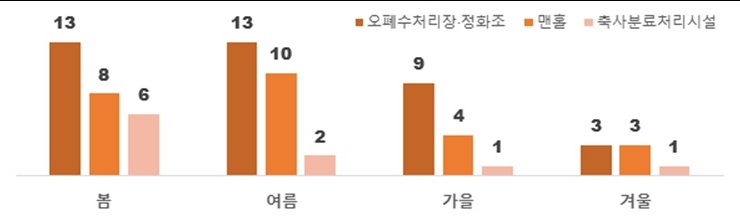 Status of asphyxiation accidents during seasonal wastewater treatment, manhole, and livestock manure treatment work from 2011 to 2020. (Data=Ministry of Employment and Labor)
The Ministry of Employment and Labor has decided to designate the period until June as the "Intensive Inspection Period for Asphyxiation Disaster Prevention." Priority inspections will be conducted on wastewater treatment facilities, septic tanks, sewage and manholes, and livestock manure treatment facilities. During inspections, they will focus on confirming ▲prohibition of entry into confined spaces and installation of warning signs ▲possession and use of disaster prevention equipment such as ventilators, toxic gas detectors, and supplied-air respirators ▲establishment and implementation of confined space work programs.
The Ministry will work with the Korea Occupational Safety and Health Agency, private disaster prevention organizations, and related groups to quickly disseminate the possibility of asphyxiation disasters at vulnerable workplaces. They plan to distribute a "Self-Inspection Checklist for Asphyxiation Disaster Prevention."
In particular, for sewage and manhole sites mainly commissioned by the public sector, safety management will be strengthened in cooperation with local governments. Through on-site inspections of specialized companies, they will verify compliance with safety and health measures and guide them to possess basic preventive equipment such as gas detectors.
Kim Gyuseok, Director of the Industrial Accident Prevention and Compensation Policy Bureau at the Ministry of Employment and Labor, urged, "In confined spaces, a single wrong breath can cause death by asphyxiation. It is essential to identify where confined spaces are in the workplace, check oxygen and toxic gas levels, and ensure ventilation during work."
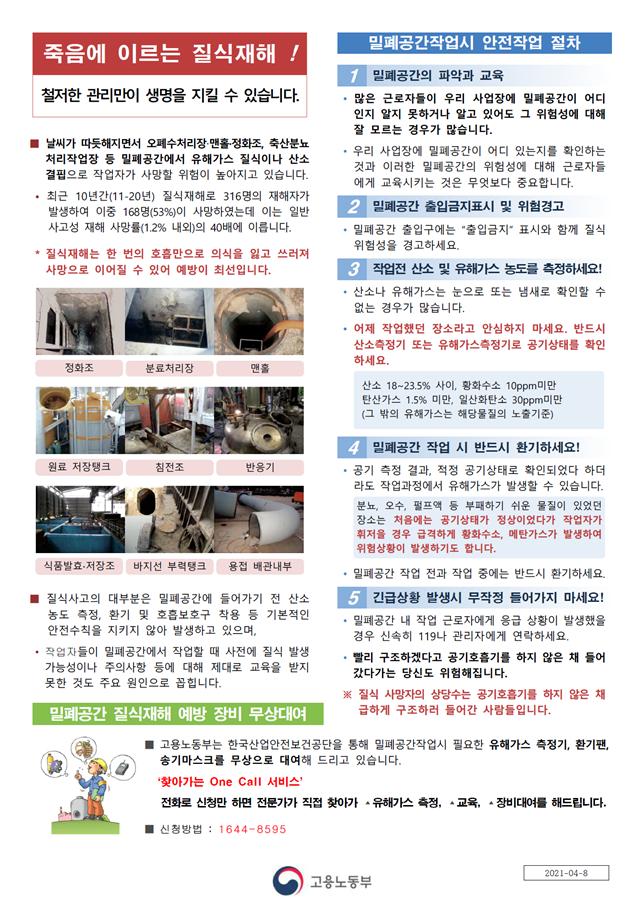 Safety Work Procedures for Preventing Suffocation Accidents. (Source: Ministry of Employment and Labor)
© The Asia Business Daily(www.asiae.co.kr). All rights reserved.



















