Government "This Year's Sales Target: 40 Trillion Won & Shipping Capacity: 1.05 Million TEU"
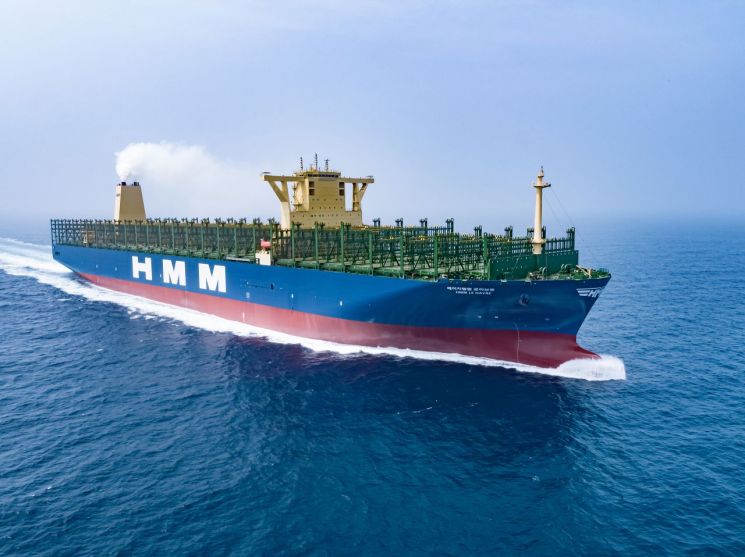
[Sejong=Asia Economy Reporter Moon Chaeseok] It has been diagnosed that South Korea's shipping industry is recovering to the level before the bankruptcy of Hanjin Shipping in 2016.
The Ministry of Oceans and Fisheries announced this, stating that it reported support measures for the shipping industry's leap forward at the expanded economic ministers' meeting chaired by President Moon Jae-in on the 15th.
According to the Ministry of Oceans and Fisheries, last year, South Korea's shipping industry recorded sales of about 36 trillion won, and the ocean-going container ship capacity was 800,000 TEU. Sales approached the pre-bankruptcy level of Hanjin Shipping, which was around 39 trillion won. The ship capacity is also heading toward 1.05 million TEU as of August 2016. This year's shipping industry target sales are 40 trillion won, and ocean-going container ship capacity is 1.05 million TEU.
To achieve these goals, liquidity support will not be spared. Support for small and medium-sized shipping companies will be increased, centered on the Korea Ocean Business Corporation (KOBC). Through KOBC's Korean-style shipowner business, new guarantees, and COVID-19 financial support, the industry safety net will be strengthened. KOBC plans to purchase up to 10 vessels this year and lease them at reasonable charter rates through the shipowner business. This helps shipping companies purchase vessels more cheaply.
The new guarantee business promotion system is expected to be completed within the first half of the year. In December last year, the KOBC Act was amended to provide a legislative basis for guarantees not only for asset acquisition but also for credit loans, contract bidding, and performance. The scale of the COVID-19 financial stability support project will be increased from 661.4 billion won last year to 681.9 billion won this year to support liquidity securing for small and medium-sized shipping companies.
Export logistics difficulties will be reduced. More than two temporary vessels of national shipping companies will be deployed monthly, and 50% of the loading space will be preferentially allocated to small and medium-sized shipping companies. This means prioritizing support for small and medium-sized shipping companies, which have relatively more capacity, over large shipping companies to secure logistics space. Through this, the plan is to actively resolve logistics difficulties for export companies.
A Ministry of Oceans and Fisheries official said, "The Ministry will continue to faithfully implement the 'Five-Year Shipping Reconstruction Plan' established in 2018 to enhance the global competitiveness of our shipping industry and do its best to support the rebound of the Korean economy through unwavering import and export logistics support."
© The Asia Business Daily(www.asiae.co.kr). All rights reserved.

















