US Economy Shows Strong Recovery but Interest Rates Fall Below 1.6% for First Time Since March
Inflow of Overseas Investors' Buying...Impact of US Treasury Sell Positions Liquidation
Eurozone Interest Rates Expected to Rise..."Buying Momentum May Not Last"
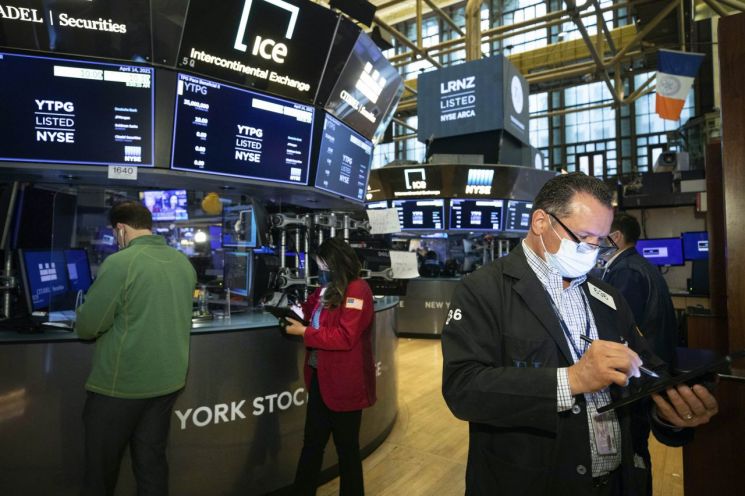 On the 14th (local time), securities traders are conducting their work on the trading floor of the New York Stock Exchange in the United States.
 [Image source=Yonhap News]
[Asia Economy Reporter Minwoo Lee] Despite the strong recovery of the U.S. economy, U.S. Treasury yields, especially in the medium- to long-term maturities, have fallen sharply. This is attributed to the inflow of buying demand from foreign investors, including major central banks, as well as the liquidation of previously accumulated short positions in Treasuries. As movement restrictions in the Eurozone (19 countries using the euro) gradually ease and Eurozone yields rise, it is expected that the large-scale buying of U.S. Treasuries by foreign investors will not continue.
On the 17th, KB Securities analyzed the trend of U.S. Treasury yields accordingly. On the 15th (local time), the 10-year U.S. Treasury yield dropped sharply by more than 10 basis points (1bp=0.01%) from 1.637% the previous day to 1.531%. It fell below 1.6% for the first time since March 11. The 30-year U.S. Treasury yield also fell below 2.3% for the first time since March 11. Yields declined despite unusually strong economic indicators.
In fact, the recently released U.S. economic data for March and April exceeded expectations and performed well. Retail sales in March increased by 9.8% month-on-month, significantly surpassing the market expectation of 5.9%. Retail sales excluding automobiles surged by 8.4% month-on-month, while the expected figure was 5.0%. Core retail sales, which reflect the underlying trend of consumption, rose by 6.9% month-on-month, also exceeding the expected 6.3%. This is attributed to the $1,400 cash payments per household member starting last month and the expansion of vaccinations, which have gradually revitalized economic activity.
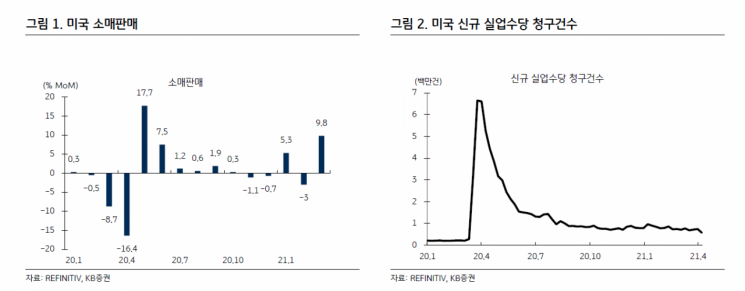
Weekly initial jobless claims also decreased by about 200,000 from the previous week to 576,000, the lowest since the COVID-19 pandemic began in March last year. Continuing jobless claims were 3.731 million, slightly above the expected 3.7 million but still the lowest since the pandemic. The April New York Federal Reserve manufacturing PMI, the first regional Fed PMI to be released, recorded 26.3, surpassing both the expected 19.5 and the previous month's 6.8.
Inflow of Foreign Investor Buying... Impact of U.S. Treasury Short Position Liquidation
Despite these conditions, yields fell, which is interpreted as the result of buying demand from foreign investors, including major central banks. Ilhyuk Kim, a researcher at KB Securities, explained, "Japanese investors net purchased about 1.7 trillion yen (approximately 17.4556 trillion KRW) of overseas bonds last week," adding, "This contrasts with the net weekly sales of about 2 trillion yen in mid to late February."

This is because U.S. Treasury yields remain attractive to foreign investors. The hedged yield on the 10-year U.S. Treasury for Japanese investors is 1.1014%, significantly higher than the 0.084% yield on the 10-year Japanese government bond. U.S. Treasuries are also attractive to Eurozone investors. The hedged yield on the 10-year U.S. Treasury is 0.757%, while the 10-year Italian government bond yield, which has a much lower credit rating than the U.S., is lower at 0.73%. The yield spread between U.S. and Italian Treasuries widened to 24 basis points in early April but has recently narrowed rapidly.
However, the sharp yield changes cannot be explained solely by medium- to long-term capital inflows. Researcher Kim assessed that the liquidation of previously accumulated short positions in Treasuries had a decisive impact on the sharp yield drop. He explained, "There were large short positions accumulated in the 'iShares 20+ Year Treasury Bond' ETF, which invests in U.S. Treasuries with maturities over 20 years," adding, "The average purchase yield of these short positions, accumulated by hedge funds employing CTA (Commodity Trading Advisor) strategies since January, was about 1.47% for the 10-year bond, and the massive liquidation of these positions caused the sharp yield drop." He further noted, "The reason for liquidating the short positions was reportedly to expand long positions in the Nasdaq," adding, "The sharp yield drop and the rise in growth stocks in the market support this."
Possibility of Further Decline but Upside Also Limited
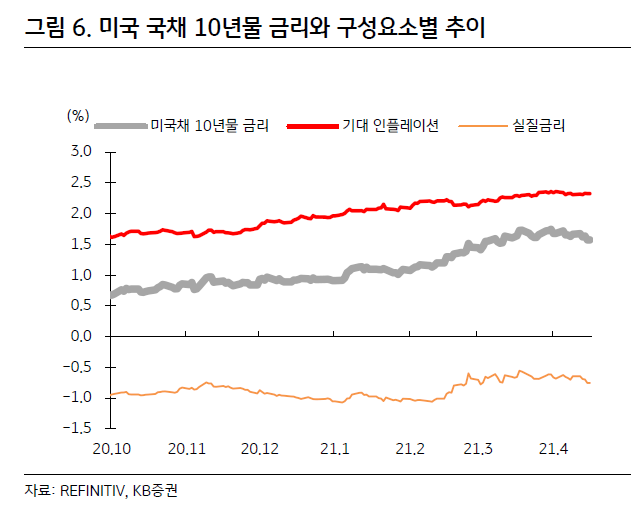
While the possibility of further yield declines is not low, factors limiting yield increases still remain. As the extended movement restrictions in the Eurozone gradually ease, Eurozone yields are expected to rise. Researcher Kim said, "Accordingly, the likelihood of sustained large-scale buying of U.S. Treasuries by foreign investors is low," adding, "The yields, which sharply dropped due to the liquidation of U.S. Treasury short positions, may have confirmed a short-term bottom." Inflation expectations have not weakened either. Despite the sharp yield drop, expected inflation remained almost unchanged.
From a medium- to long-term perspective, yields are expected to rise, but many factors constrain the increase. Researcher Kim predicted, "Statements by U.S. Treasury Secretary Janet Yellen regarding Treasury maturity and public sentiment favoring fiscal soundness over tax increases will limit the upward trend in yields," adding, "In a situation where earnings growth prospects are improving, a moderate rise in yields is positive for the stock market."
© The Asia Business Daily(www.asiae.co.kr). All rights reserved.



















