Annual Employee Growth Rate 2.1~3.2%p Higher
Wages Per Worker 9.1 Million KRW More... Annual Wage Increase Effect of 1.29 Million KRW
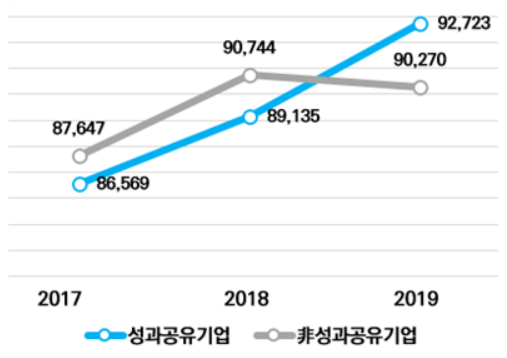 Operating profit trends of performance-sharing companies and non-performance-sharing companies.
 [Photo by Korea Small Business Institute]
[Asia Economy Reporter Junhyung Lee] The operating profit of small and medium-sized enterprises (SMEs) that share performance with their employees was found to be higher than that of companies that do not.
According to the report "Current Status and Development Tasks of SME-Employee Performance Sharing System" released by the Small and Medium Business Research Institute on the 18th, as of 2019, the operating profit of performance-sharing companies was 24.53 million KRW higher than that of non-performance-sharing companies.
The "SME-Employee Performance Sharing System" is a system that recognizes SMEs sharing performance with employees as performance-sharing companies and provides preferential treatment and support. It has been in effect since February 2018. Companies can be recognized as performance-sharing companies if they share performance through one or more legally defined types of performance sharing.
According to the report, up to last year, 51,275 SMEs participated in the system. Among performance-sharing companies, 53.1% were located in the Seoul metropolitan area. Manufacturing accounted for 55.7%, services 20.8%, with an average of 30.8 employees and an average business age of 12.4 years.
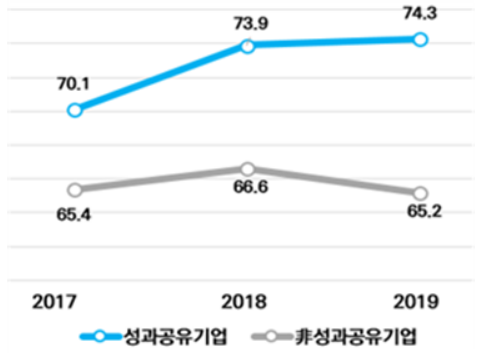 Labor cost trends of performance-sharing companies and non-performance-sharing companies.
 [Photo by Korea Small Business Institute]
Performance-sharing companies achieved superior results compared to non-performance-sharing companies in various aspects, including employment creation effects. The annual average employee growth rate of performance-sharing companies was 2.1 to 3.2 percentage points higher than that of non-performance-sharing companies.
Labor costs, including wages and performance bonuses, were approximately 9.1 million KRW higher per employee. Additionally, according to a survey conducted by the Small and Medium Business Research Institute targeting 2,021 performance-sharing companies, companies participating in the performance-sharing system experienced an average annual wage increase of 1.29 million KRW per employee.
Participating companies also reported high satisfaction. Choi Sungwook, CEO of fintech company Centbee, stated, "Performance sharing had a significant effect on fostering employees' sense of belonging and ownership, as well as encouraging long-term service." He added, "In particular, stock options helped address issues such as high developer salaries faced by SMEs in the information technology (IT) industry." Han Kiyoung, CEO of roofing panel company ABM, said, "By participating in the system and receiving tax benefits on performance bonuses, the funds for performance bonuses have become more abundant."
However, performance-sharing companies (51,275) still account for only 1.4% of all SMEs (approximately 3.6 million). This is why there are calls for strengthened government support to spread the culture of performance sharing.
Senior researcher Eunshil Lee of the Small and Medium Business Research Institute said, "It is necessary to quantitatively and qualitatively enhance the performance-sharing system by developing and distributing evaluation indicators so that companies can directly assess their level of performance sharing." She added, "Since government incentives serve as the main motivation for participation in the system for companies with short business histories or venture companies, changes and strengthening of existing support methods are also needed."
© The Asia Business Daily(www.asiae.co.kr). All rights reserved.
![Clutching a Stolen Dior Bag, Saying "I Hate Being Poor but Real"... The Grotesque Con of a "Human Knockoff" [Slate]](https://cwcontent.asiae.co.kr/asiaresize/183/2026021902243444107_1771435474.jpg)

















