Ministry of Science and ICT Selected Korea Atomic Energy Research Institute Consortium as Project Operator
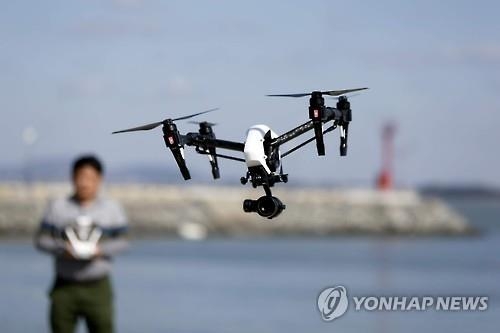
[Asia Economy Reporter Kim Bong-su] #. In 202* year, Mr. A, an employee of Korea Hydro & Nuclear Power working at a nuclear power plant, discovered a drone illegally filming by crossing the nuclear power plant fence. In the past, there was no way to respond, so he just watched helplessly, but the situation changed drastically after the recently developed integrated response system was introduced. The illegal drone intrusion was immediately detected by radar, and a patrolling DroneCop was dispatched. Instead of calling the dispatched DroneCop, Mr. A activated the jamming system to forcibly seize control of the drone and landed it to begin an investigation.
Although hypothetical, this is a situation that could happen soon. The government is investing a total of 42 billion KRW to establish an integrated response system that covers drone detection, neutralization, and incident investigation to improve the current reality where it has been unable to handle threats to various national critical facilities using commercial drones.
The Ministry of Science and ICT announced on the 18th that it has selected the Korea Atomic Energy Research Institute (KAERI) consortium as the lead organization for the Illegal Drone Intelligent Response Technology Development Project, jointly promoted with the Ministry of Trade, Industry and Energy and the National Police Agency.
This project will be carried out over five years from this year until 2025 with a national budget of 42 billion KRW. It aims to develop an integrated illegal drone response system in preparation for the possibility that illegal acts using commercial drones domestically and internationally, such as privacy invasion and aviation interference, could escalate into public facility terrorism and threats.
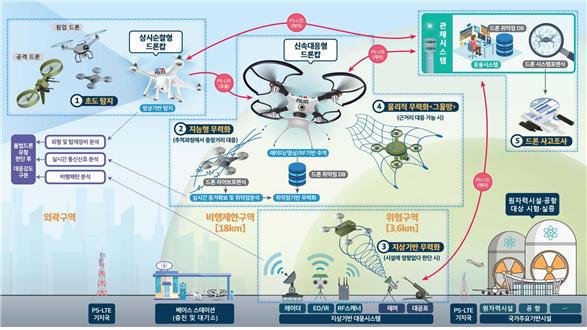
The selected consortium consists of a total of 23 organizations, including four public research institutes and universities such as KAERI and KARI, as well as 17 anti-drone related companies and demand companies including LIG Nex1. They plan to develop an integrated solution capable of responding comprehensively from detection, identification, analysis, neutralization, to incident investigation of illegal drones, and to build and demonstrate it at actual nuclear facilities and airports. They will also derive threat scenarios such as illegal drone infiltration and develop and demonstrate anti-drone core technologies and systems to respond accordingly. The project includes developing a ground-based system composed of detection sensors and neutralization equipment, and an aerial-based system including always-patrolling drones (monitoring perimeter and shadow areas) and rapid-response DroneCops (direct neutralization of illegal drones) that interoperate and complement the ground-based system.
Upon identifying an illegal drone, they plan to immediately analyze vulnerabilities and derive the optimal neutralization method such as GNSS and communication spoofing, communication jamming, control takeover, and physical neutralization through intelligent neutralization core technology, as well as secure forensic technology to identify perpetrators. The project also includes optimally deploying ground and aerial systems connected via the disaster safety communication network (PS-LTE) to critical facilities and establishing and demonstrating an integrated operation system applying intelligent neutralization core technology and forensic technology.
Although this project focuses on developing response technology against domestic and international commercial drones that infiltrate without special payloads, they plan to advance the technology in the future to respond to drones equipped with weapons and establish a domestic technology-based anti-drone integrated platform and response system.
Kim Bong-su, Director of Basic and Core Research Policy at the Ministry of Science and ICT, said, “It is important to prepare an integrated solution that can comprehensively respond to illegal drone activities, which have recently become an issue.” He added, “The KAERI consortium selected this time will secure core technologies for illegal drone response and prepare a domestic technology-based anti-drone integrated solution, thereby ensuring the safety of domestic critical facilities and playing a strong supporting role to lead the global market.”
© The Asia Business Daily(www.asiae.co.kr). All rights reserved.
![Clutching a Stolen Dior Bag, Saying "I Hate Being Poor but Real"... The Grotesque Con of a "Human Knockoff" [Slate]](https://cwcontent.asiae.co.kr/asiaresize/183/2026021902243444107_1771435474.jpg)

















