7th Anniversary Memorial Ceremony Nationwide Today
Truth Investigation and Compensation Still Incomplete
Ongoing Suffering of Bereaved Families and Survivors
Calls for Measures Against Repeated Disasters
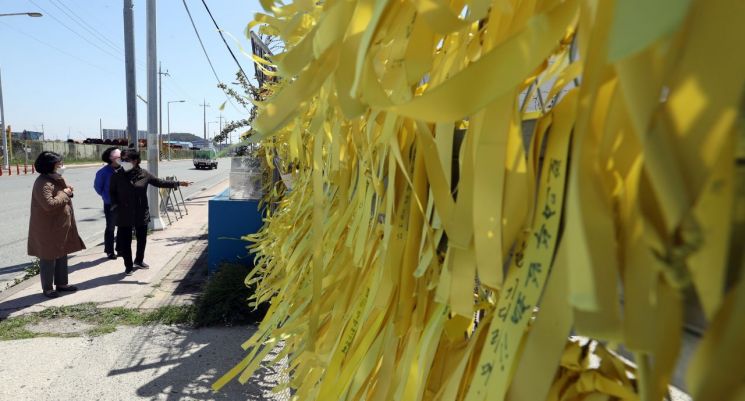
[Asia Economy Reporter Donghoon Jeong] On the 7th anniversary of the Sewol ferry disaster on the 16th, memorial events will be held across the country.
The 4·16 Sewol Ferry Disaster Families' Association and the 4·16 Solidarity will hold a 7th anniversary memorial ceremony for the Sewol ferry disaster at Hwarang Park in Ansan, Gyeonggi Province, where Danwon High School is located, starting at 3 p.m. that day. Fewer than 100 people, mainly bereaved families, are expected to attend the ceremony to honor the victims. The Sewol ferry disaster occurred on April 16, 2014, when the passenger ferry Sewol, en route from Incheon to Jeju, sank, resulting in the deaths of 299 of the 476 passengers, including Danwon High School students on a group school trip, and 5 missing.
Memorial events will also be held in Incheon, the departure point of the Sewol ferry, and Jeju, the destination. At the Sewol ferry civilian victims memorial hall in Incheon Family Park, memorial altars will be set up in Guri, Gyeonggi Province; Miryang, Gyeongnam Province; and Ulsan. Cultural festivals will be held in Uijeongbu, Gyeonggi Province, and Jeju. Related film screenings are scheduled in Wonju, Gangwon Province; Seosan, Chungnam Province; and Naju, Jeonnam Province.
Although memorial events are held in many places, the pain of survivors and bereaved families continues. On the 13th, disaster and accident victims and their families held a "Records and Testimonies Meeting of Disaster and Accident Victims and Bereaved Families" at the People's Solidarity for Participatory Democracy in Jongno-gu, Seoul. Yoon Kyung-hee, a bereaved family member of the Sewol ferry disaster, said, "Seven years after the disaster, I have spent more days on the streets than at home. The health of bereaved families has deteriorated, and social relationships have almost been severed," adding, "Proper truth-finding has not been achieved, but society only demands 'victimhood'." Yoo Kyung-geun, executive director of the 4.16 Sewol Ferry Disaster Families' Association, said, "Legal and institutional measures are needed to allow the parties and victims of social disasters to actively participate in truth-finding." Twenty-four Sewol ferry survivors residing in Jeju recently filed a compensation lawsuit against the state. They claim that due to the short application period under the 'Sewol Victim Support Act,' they did not receive proper compensation and that illnesses that appeared after receiving compensation were not remedied.
Civil society organizations are urging the establishment of legal and institutional measures in response to repeated disasters such as the Sewol ferry disaster, the humidifier disinfectant disaster, and the death of the late Kim Yong-gyun. A representative example is the 'Basic Act on Life Safety,' proposed in November last year. The Basic Act on Life Safety legally specifies the 'right to safety' to protect life, body, and property from safety accidents. It also codifies the state's responsibility to guarantee this right and includes principles for special protection of vulnerable groups and support for victims. Since there is no current law explicitly stating the right to safety, civil society is calling for the prompt passage of the Basic Act on Life Safety. The bill is still pending in the National Assembly. A representative from the office of Woo Won-sik, a Democratic Party lawmaker who sponsored the Basic Act on Life Safety, explained, "The Basic Act on Life Safety focuses on victims. It addresses how to protect and remedy victims' rights when disasters occur, as well as the investigation of causes and truth-finding and restoration of victims' rights, so the bill needs to be passed as soon as possible."
© The Asia Business Daily(www.asiae.co.kr). All rights reserved.

















