Coinbase Listing Success... "A Milestone Signaling Cryptocurrency's Entry into the Mainstream"
Abundant Liquidity Drives Cryptocurrency Investment Boom
Still Subject to Severe Price Volatility and Potential Use in Illegal Transactions
NYT: "Cryptocurrency Must Prove It Is More Than Just a Store of Value"
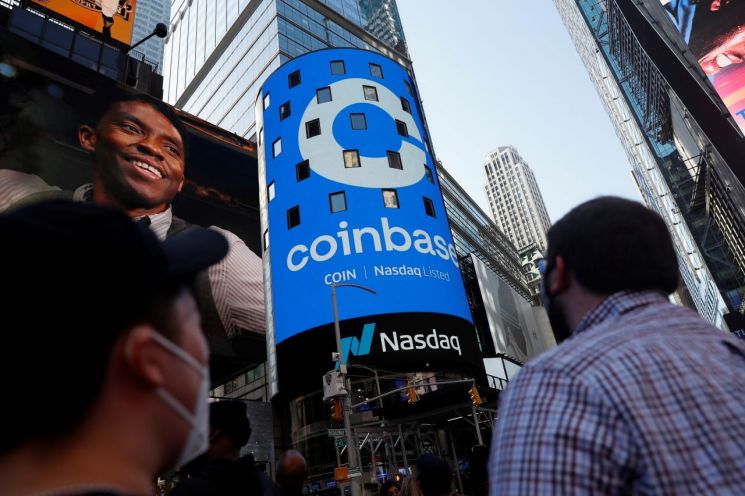
[Asia Economy Reporter Kim Suhwan] "Cryptocurrency, once called a speculative tool for criminals and investors, is now being incorporated into the mainstream market."
On the day Coinbase, the largest cryptocurrency exchange in the United States, was listed on the Nasdaq on the 14th (local time), The New York Times (NYT) evaluated the significance of Coinbase's listing in this way. Coinbase closed the day at $328 per share, recording a market capitalization of $85.8 billion (approximately 96 trillion KRW). This figure is more than 10 times higher than the last valuation of Coinbase in the over-the-counter market before its listing and surpasses the market capitalizations of Airbnb ($82 billion) and Facebook ($63 billion) at their respective IPOs.
Accordingly, cryptocurrency supporters are cheering, saying this moment reveals the potential of cryptocurrencies they have long advocated. Bradley Tusk, a venture capitalist at Tusk Ventures, said, "When asked if cryptocurrency has now entered the realm of reality, the answer is yes," adding, "Coinbase's listing is something that cannot be ignored."
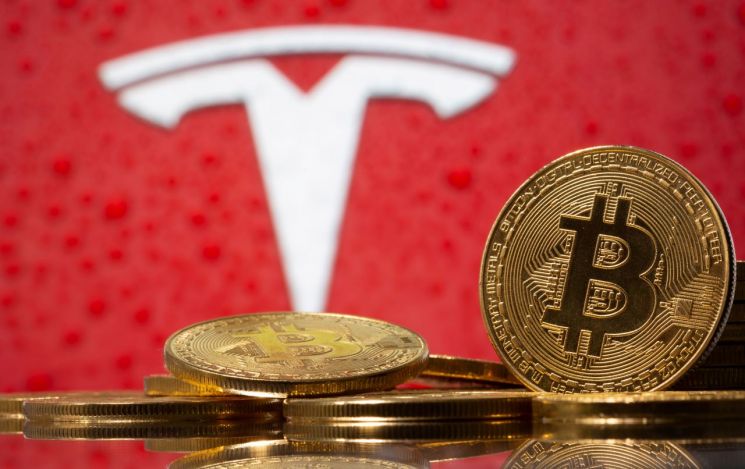
Additionally, investors expect that Coinbase's listing will help alleviate the concerns of investors who are cautious about directly investing in cryptocurrencies. Cryptocurrency investors argue that since Coinbase has received approval from the U.S. Securities and Exchange Commission (SEC) and will be subject to regulatory oversight, investment safety is guaranteed.
Zarak Jovanputra, founder of Future Perfect Ventures, analyzed the Coinbase listing as "a wake-up call to traditional tech and financial companies," stating, "People have started to take cryptocurrency seriously."
Efforts to Secure Credibility and Abundant Liquidity Drive Cryptocurrency Investment Boom
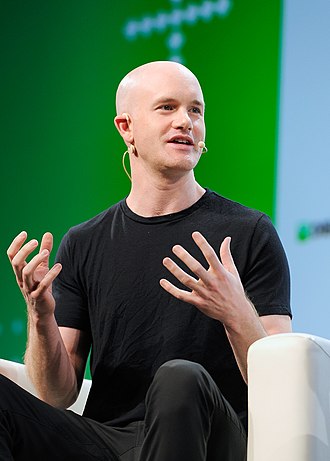
Since the launch of Bitcoin in 2009, the history of cryptocurrencies has been a continuous process of alleviating investors' concerns about trust in cryptocurrencies. The founders of Coinbase were aware of these concerns. Brian Armstrong, co-founder of Coinbase, recognized the inevitability of cryptocurrency regulation and grew the company by complying with it.
Coinbase initially focused on securing credibility. It participated in the venture acceleration program of Y Combinator, a leading U.S. venture capital firm, and attracted investment from Andreessen Horowitz Capital. Andreessen Horowitz Capital is a venture capital firm that mainly invests in growth stocks and has successfully led IPOs for Facebook, Pinterest, Instagram, Skype, and others. By successfully attracting investment from such a verified institution, Coinbase contributed to alleviating market distrust toward cryptocurrency exchanges.
Moreover, Coinbase actively supported the mainstream market's adoption of cryptocurrencies. Coinbase pursued cooperation with retailers to enable Bitcoin as a payment method. Nick Tomaino, who joined the company in its early days in 2013, emphasized, "When people could buy mattresses at the online furniture retailer Overstock using Bitcoin, they began to trust Bitcoin."
The launch of Ethereum, another cryptocurrency with expanded functions beyond Bitcoin, is also cited as a factor increasing investment in cryptocurrencies. First launched in 2015, Ethereum uses its own blockchain technology and is an open-source platform that allows users to create their own fundraising campaigns or build their own secure networks. With its expanded functions, various developers and users began to flock to Ethereum, and the number of fund products using Ethereum or companies utilizing Ethereum technology increased significantly.
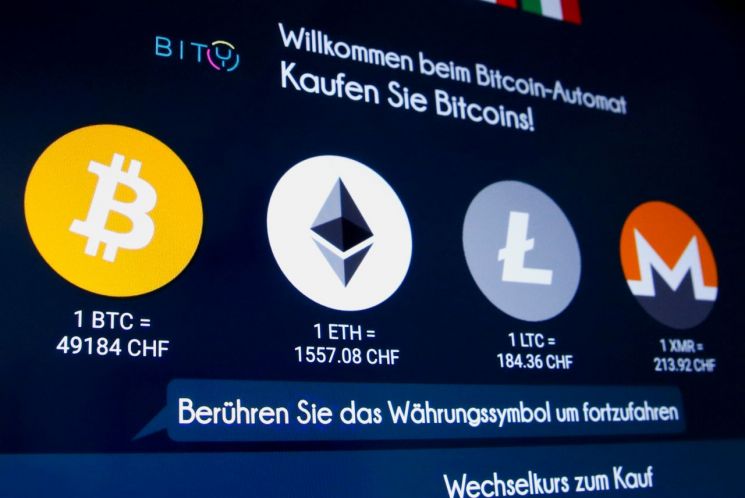 The logos of major cryptocurrencies. From the left: Bitcoin, Ethereum, Litecoin, Monero [Image source=Reuters Yonhap News]
Furthermore, the large-scale quantitative easing measures implemented by governments worldwide during the COVID-19 pandemic last year became a decisive trigger for the current cryptocurrency boom. As liquidity in the market surged due to government stimulus measures, investors seeking new investment avenues began to view cryptocurrencies as a new investment domain, and market funds flowed into cryptocurrencies.
Accordingly, from January last year to this month, Bitcoin prices surged by about 700%, and its market capitalization surpassed $1 trillion for the first time in history.
Earlier this year, Tesla, an electric vehicle company led by Elon Musk, and Square, a leading U.S. electronic payment company, purchased Bitcoin worth $1.5 billion and $170 million, respectively. In March, Morgan Stanley began selling Bitcoin funds to some of its clients. Additionally, Miami, the largest city in Florida, is considering allowing citizens to pay local taxes with Bitcoin and announced in February its intention to purchase Bitcoin directly.
Remaining Challenges? ... "Must Prove That Cryptocurrency Is More Than Just a Means of Storing Money"
Skeptical views on Bitcoin's growth potential still exist. This is because cryptocurrencies are not subject to oversight by central authorities, making Bitcoin susceptible to illegal transactions, and its price volatility remains high.
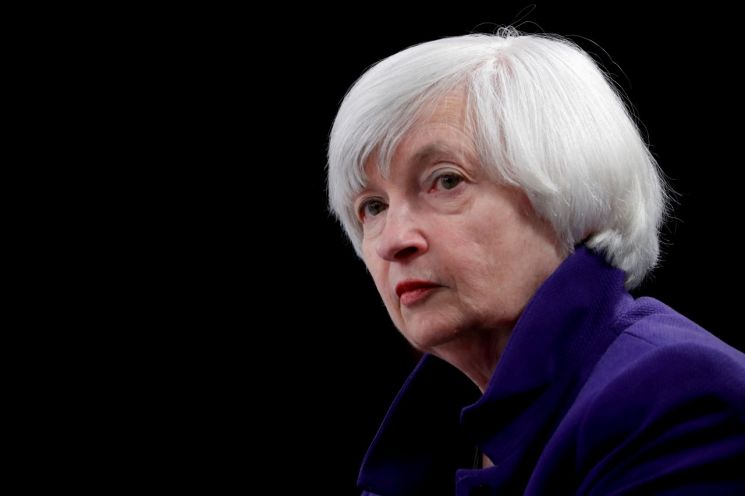
The U.S. government has also hinted at possible cryptocurrency regulations. Janet Yellen, U.S. Treasury Secretary, emphasized during her confirmation hearing in the Senate earlier this year, "Bitcoin appears to be used mostly for illegal transactions (such as weapons purchases and drug deals)," and stated, "We need to consider ways to curb such illegal activities."
In addition, inverse exchange-traded funds (ETFs) that track Bitcoin price crashes have appeared. In Canada, on the 15th, the 'BetaPro Inverse Bitcoin ETF' launched by Horizons ETF began trading on the Toronto Stock Exchange, marking the first appearance of a Bitcoin inverse ETF in North America.
The 2018 cryptocurrency crash also raised concerns about instability and bubbles, directly caused by investors' 'panic selling' (rapid selling driven by fear). Coinbase acknowledged, "It is true that cryptocurrency assets are unstable," and admitted, "There are many unpredictable factors."
The NYT analyzed that "price volatility is too severe for cryptocurrencies to be used as actual currency." Tusk, the venture capitalist, also predicted, "We still cannot be sure how high Bitcoin will rise."
Ultimately, it is analyzed that proving the potential of cryptocurrencies is crucial for their full incorporation into the institutional framework. The NYT stated, "The biggest challenge facing cryptocurrencies is to prove that cryptocurrency technology can achieve more than just a means of storing money."
Tomaino said, "It is true that the current cryptocurrency boom is ongoing," but added, "No one knows how the situation will change two years from now or even tomorrow."
© The Asia Business Daily(www.asiae.co.kr). All rights reserved.
![Clutching a Stolen Dior Bag, Saying "I Hate Being Poor but Real"... The Grotesque Con of a "Human Knockoff" [Slate]](https://cwcontent.asiae.co.kr/asiaresize/183/2026021902243444107_1771435474.jpg)


















