59,975 Apartments Scheduled for Occupancy Nationwide in Q2
49.7% Decrease in 수도권, 50.0% Decrease in Seoul Compared to Previous Year
Ministry of Land, Infrastructure and Transport: "Base Effect Due to Increased Supply Volume"
[Asia Economy Reporter Kangwook Cho] The supply of apartments in the metropolitan area and Seoul in the second quarter of this year is expected to decrease by half compared to the same period last year.
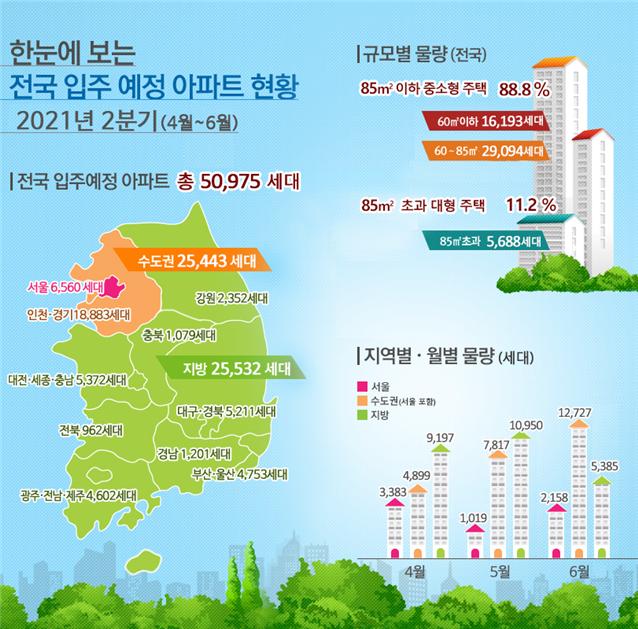
According to the Ministry of Land, Infrastructure and Transport on the 16th, the number of apartments scheduled for occupancy nationwide from this month through June is estimated at 50,975 units.
Among these, private and public apartments scheduled for occupancy in the metropolitan area and Seoul are counted at 25,443 units and 6,560 units respectively. This represents a shrinkage of 49.7% in the metropolitan area and 50.0% in Seoul compared to the same period last year.
Looking at the detailed occupancy volume, in the metropolitan area, 4,899 units will be occupied this month, including Magok in Seoul (512 units) and Oryu in Incheon (2,894 units). In May, 7,817 units including Daejang in Seongnam (1,964 units) and Gosan in Uijeongbu (1,331 units) will be occupied, and in June, 12,727 units including Geomdan in Incheon (1,168 units) and Masong in Gimpo (574 units) are scheduled for occupancy.
In the provinces, 9,197 units including Mandeok in Busan (1,969 units) and Gyelim in Gwangju (908 units) will be occupied in April, 10,950 units including Tangjeong in Asan (944 units) and Hayang in Gyeongsan (655 units) in May, and 5,385 units including Suseong in Daegu (844 units) and Sejong City (845 units) in June.
By housing size, units under 60㎡ amount to 16,193, units between 60 and 85㎡ are 29,094, and units over 85㎡ are 5,688, with small and medium-sized housing under 85㎡ accounting for 88.8% of the total, indicating a large volume of small and medium-sized housing occupancy.
By sector, private housing accounts for 37,844 units and public housing for 13,131 units.
The Ministry of Land explained that although the occupancy volume in the second quarter decreased compared to the same period last year, this is largely due to a base effect from the previous increase in occupancy volume. They also forecast that occupancy volume will recover from the third quarter, maintaining the overall occupancy volume for this year at the average level of previous years.
The Ministry projects that the apartment occupancy volume this year will reach 340,000 units nationwide, including 200,000 units in the metropolitan area, with 42,000 units in Seoul. Compared to last year, the metropolitan area will increase by 6,000 units, but nationwide it will decrease by 33,000 units.
In particular, through the 2·4 Supply Plan, more than 2 million new units nationwide and over 1.8 million units in the metropolitan area will be supplied in the future, and the Ministry expects that mid- to long-term supply and demand conditions will remain stable as the planned pre-sale volume will also increase after this year.
The Korea Research Institute for Human Settlements analyzed that due to government supply measures, the metropolitan area’s occupancy volume after this year will significantly expand from the past 10-year average of 234,000 units to 308,000 units, and Seoul’s from 73,000 units to over 113,000 units.
A Ministry of Land official stated, "The current government’s apartment occupancy volume is at an all-time high level, so it is difficult to simply compare occupancy volumes with the previous period," adding, "With the largest pre-sale volume ever planned this year, an increase in new occupancy volume is also expected after 2023."
© The Asia Business Daily(www.asiae.co.kr). All rights reserved.
![Clutching a Stolen Dior Bag, Saying "I Hate Being Poor but Real"... The Grotesque Con of a "Human Knockoff" [Slate]](https://cwcontent.asiae.co.kr/asiaresize/183/2026021902243444107_1771435474.jpg)
















