- Average Sale Price per 3.3㎡ in Population Growth Areas Also Rose Sharply in 2000, 2010, and 2020 Cycles
- Interest Expected in New Housing Complexes by Region as Population Growth Leads to Housing Price Increases
According to an analysis of data from the Korean Statistical Information Service (KOSIS) by the real estate research firm Realtoday, the region with the largest increase in registered resident population from 2000 to 2020 was Seoul.
From 2000 to 2020, at 10-year intervals, the areas with the greatest increase in registered resident population also showed notable rises in housing prices. This is believed to be due to population growth areas undergoing regional development and corporate attraction, which in turn spurred housing price increases driven by economic revitalization.
Seoul's registered resident population was 3,540,492 in 2000, rising to 4,224,181 in 2010, and 4,417,954 in 2020, marking a total increase of 877,746 compared to 2000.
Following Seoul, the top 10 regions with the largest increases in registered resident population were Incheon, Busan, Yongin, Daegu, Daejeon, Gwangju, Suwon, Cheongju, and Goyang. Notably, Yongin saw a population increase greater than that of metropolitan cities.
Yongin had a registered resident population of only 130,599 in 2000, but this grew significantly to 319,465 in 2010 and 420,519 in 2020, showing substantial growth every 10 years. Particularly, since 2000, the population has increased every year without a single decline.
The top 10 regions with the largest population increases compared to 2000 also experienced notable housing price rises. Analyzing the average sale price per 3.3㎡ at 10-year intervals in 2000, 2010, and 2020, Seoul showed the largest increase in sale prices.
In 2020, Seoul's average sale price per 3.3㎡ was 36.08 million KRW, up 29.2 million KRW from 6.88 million KRW in 2000. Suwon's price rose by 12.88 million KRW (from 3.59 million KRW to 16.47 million KRW), and Yongin's increased by 11.75 million KRW (from 3.59 million KRW to 16.47 million KRW). Additionally, the average sale prices per 3.3㎡ in Busan, Goyang, Daejeon, Daegu, Incheon, Gwangju, and Cheongju also increased.
This appears to be partly influenced by various favorable factors in each region. For example, in Suwon and Yongin, expansions of metropolitan transportation networks such as the GTX-A Line, Indeokwon-Dongtan double-track railway, the 2nd Gyeongbu Expressway (Anseong-Guri), and the 2nd Capital Region Outer Ring Expressway (Icheon-Osan (Dongtan)) are ongoing.
In the first half of this year, new apartments are planned to be supplied mainly in regions with clear population growth.
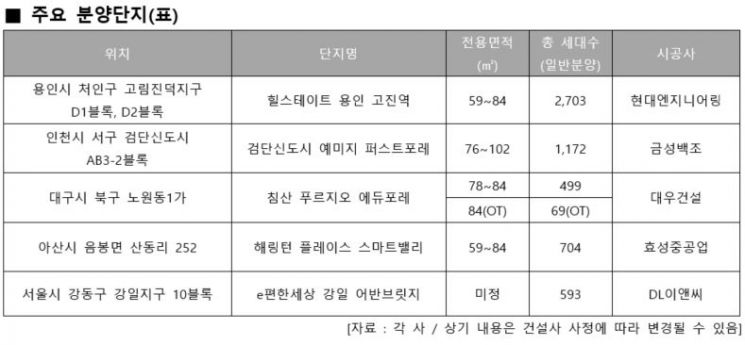
In Yongin, Gyeonggi Province, Hyundai Engineering plans to sell units in ‘Hillstate Yongin Gojin Station’. The complex will consist of 22 buildings, ranging from 4 basement floors (3 basement floors in D2 block) to 30 floors above ground, with 2,703 households and unit sizes from 59 to 84㎡. The number of households per block is △D1 block 1,345 households △D2 block 1,358 households. It adjoins the Gorim district, which includes planned sites for kindergarten, elementary, middle, and high schools. Residents can access Seoul and the metropolitan area via Everline Gojin Station and Yongin IC on the Yeongdong Expressway. Nearby are small parks and various convenience facilities such as E-Mart Yongin and Yongin Central Market.
In Incheon, Geumseong Baekjo will begin first-priority subscription applications on the 20th for ‘Geomdan New Town Yemiji First Foret’ located in Seo-gu. The complex will be built with 1,172 households, ranging from 2 basement floors to 25 floors above ground, with unit sizes from 76 to 102㎡. Transportation options include the Incheon Subway Line 1 Sinseol Station (scheduled for 2024) and Geomdan Gyeongmyeong-ro Road (scheduled for 2023).
In Daegu, Daewoo Construction plans to sell units in April for ‘Chimsan Prugio Eduforet’ in Buk-gu. The complex will have 27 floors above ground and 2 basement floors, consisting of 499 apartments sized 78 to 84㎡ and 69 officetel units sized 84㎡. Chimsan Park is located nearby, and residents can access major downtown areas via Daegu Subway Line 3 Wondae Station and Buk-gu Office Station.
In Asan, Hyosung Heavy Industries plans to sell units in ‘Herrington Place Smart Valley’. The complex will consist of 10 buildings from 1 basement floor to 20 floors above ground, with 704 households sized 59 to 84㎡. Convenient transportation includes KTX Cheonan-Asan Station, Seoul Metropolitan Subway Line 1 Dujeong Station, and Cheonan Express Bus Terminal. Various convenience facilities such as Costco Cheonan are within walking distance, and Cheonan City Hall, Galleria Department Store, and Cheonan Sports Complex are within a 10-minute drive.
In Seoul, DL E&C plans to sell units in June for ‘e-Pyeonhansesang Gangil Urban Bridge’ in Gangdong-gu. The complex will have 27 floors above ground with a total of 593 households. Nearby are parks and sites for elementary and middle schools, and with the opening of Gangil Station on Subway Line 5, residents can easily access downtown Seoul and Hanam Misa.
© The Asia Business Daily(www.asiae.co.kr). All rights reserved.
![Clutching a Stolen Dior Bag, Saying "I Hate Being Poor but Real"... The Grotesque Con of a "Human Knockoff" [Slate]](https://cwcontent.asiae.co.kr/asiaresize/183/2026021902243444107_1771435474.jpg)
















