Assemblyman Kim Byung-wook Proposes Amendment to Insurance Business Act
Legal Basis for Outsourcing Professional Intermediary Agencies and Prohibition of Medical Information Use
"Non-reimbursed Service Status Assessment" to Address Medical Community Opposition
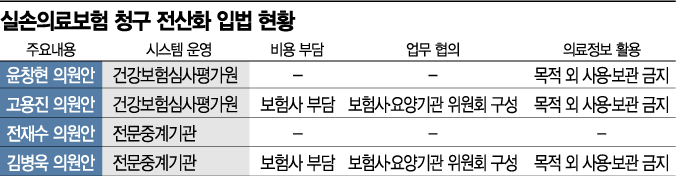
[Asia Economy Reporter Oh Hyung-gil] The insurance industry is expressing optimism as progress is expected in the revision of the Insurance Business Act related to the ‘computerization of claims for indemnity health insurance,’ which was stalled at the National Assembly last year.
With both the government and ruling and opposition parties showing a positive attitude toward the legal amendment, it is seen as a golden opportunity. However, how to persuade the still strong opposition from the medical community remains a variable.
According to the insurance industry on the 15th, Kim Byung-wook, the ruling party secretary of the Political Affairs Committee and a member of the Democratic Party of Korea, officially proposed the ‘Partial Amendment to the Insurance Business Act’ on the 12th. The core is to entrust medical institutions with the submission of supporting documents necessary for insurance claims such as medical bills to a specialized intermediary agency and transmit them electronically.
This is the fourth time in the 21st National Assembly following similar bills proposed last year by lawmakers Yoon Chang-hyun, Ko Yong-jin, and Jeon Jae-soo.
The key point of these bills is to replace the current method where indemnity insurance subscribers receive their receipts from medical institutions and send them to insurance companies, with a system where they request the medical institutions to transmit the data electronically to the insurance companies. The bill was deferred last December during discussions at the National Assembly’s Political Affairs Committee’s bill subcommittee due to opposition from some lawmakers.
The current amendment also includes a legal basis to entrust the tasks related to the establishment and operation of the computerized system to a specialized intermediary agency. This is a measure to alleviate concerns from the medical community that if the Health Insurance Review and Assessment Service were to operate the system, it could access medical information and identify the status of non-reimbursable medical services at medical institutions.
Additionally, the bill includes provisions to prohibit the specialized intermediary agency from using or storing information for purposes other than document transmission. A committee involving insurance companies and medical institutions will be formed to discuss matters related to the intermediary agency’s duties.
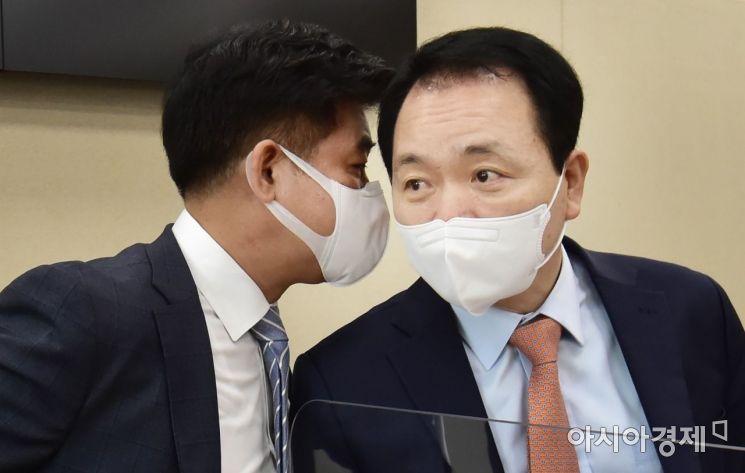 Sung Il-jong, Chairman of the Legislative Review Subcommittee of the Political Affairs Committee, and Kim Byung-wook, a member of the Democratic Party of Korea, are attending the second Legislative Review Subcommittee meeting of the Political Affairs Committee on the Prevention of Mutual Interference Act held at the National Assembly on the 13th, talking before the meeting begins. Photo by Yoon Dong-joo doso7@
Permission for Patient Medical Information Transmission Rights... Amendment to Medical Service Act Also Proposed
It is explained that the bill aims to reflect the medical community’s opposition or opinions as much as possible within the broader framework of introducing computerization. Lawmakers from both ruling and opposition parties who proposed the amendment plan to hold a forum next month involving the insurance and medical industries to seek consensus, which is expected to accelerate the bill’s passage.
An amendment to the Medical Service Act has also been proposed, allowing patients to request the transmission of their medical information to third parties if they wish.
Kim Mi-ae, a member of the People Power Party, recently proposed an amendment stipulating that if a patient has received or will receive treatment at a specific medical institution for a certain period, the patient can request transmission of the medical records to a third party designated by the patient through a medical record transmission support system.
The medical community has long pointed out that “if problems arise from transmitting patient information to third parties, medical institutions could become embroiled in legal disputes,” arguing that this conflicts with the Medical Service Act.
At a forum titled ‘What is the problem with mandatory claims by private (indemnity) insurance medical institutions’ hosted by Min Hyung-bae of the Democratic Party of Korea and organized by the Korean Medical Association on the 12th, lawyer Lee Jun-seok of the law firm Jiwoo argued, “Article 21 of the Medical Service Act generally prohibits anyone other than the patient from viewing or obtaining copies of patient records, and only enumerates exceptional cases where third-party access or exchange is allowed. Therefore, the provisions of the (Insurance Business Act) amendment conflict with the Medical Service Act provisions regulating medical institutions’ obligations.”
In response, the Ministry of Health and Welfare issued an authoritative interpretation in 2019 stating, “If the patient requests a copy of the medical record, they may request it be sent to a third party, and medical institutions must comply with the patient’s request unless there is a justifiable reason,” but the medical community has not changed its stance.
An insurance industry official said, “The proposed amendments contain similar but slightly different contents, but a consensus will be reached during the bill review process. The longer the bill’s passage is delayed, the more consumer inconvenience continues, so we hope the bill will be passed promptly.”
Meanwhile, claims for indemnity insurance have rapidly increased every year, with the number of claims rising from 49.5 million in 2016 to 105.32 million in 2019, more than doubling in three years. Indemnity insurance subscribers experience inconvenience as they must directly obtain related documents such as medical receipts from hospitals or pharmacies and submit them to insurance companies to receive insurance payments.
© The Asia Business Daily(www.asiae.co.kr). All rights reserved.
![Clutching a Stolen Dior Bag, Saying "I Hate Being Poor but Real"... The Grotesque Con of a "Human Knockoff" [Slate]](https://cwcontent.asiae.co.kr/asiaresize/183/2026021902243444107_1771435474.jpg)

















