Korea Real Estate Board April 2nd Week Apartment Price Trends
Seoul Increase Rate Expands from 0.05% to 0.07%
Sharp Rise in Reconstruction Complexes Since Oh Se-hoon’s Inauguration
Regulation Easing Expectations... Nowon Jumps 0.17%
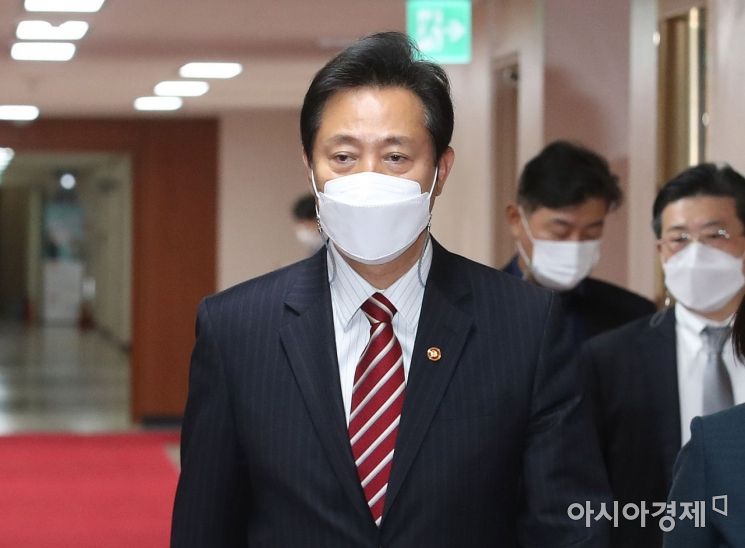 Seoul Mayor Oh Se-hoon is attending the Cabinet meeting held at the Government Seoul Office in Jongno-gu, Seoul, on the morning of the 13th. Photo by Hyunmin Kim kimhyun81@
[Asia Economy Reporter Moon Jiwon] After the announcement of the 2·4 measures, Seoul apartment prices, which had been stabilizing, increased their rate of rise again this week. This is due to the rise in prices of major reconstruction complexes in Seoul, driven by expectations of eased reconstruction regulations since the inauguration of Seoul Mayor Oh Se-hoon. In fact, Nowon-gu rose by 0.17% this week, nearly doubling the increase from the previous week (0.09%), and all three Gangnam districts also saw sharper upward trends.
According to the weekly apartment price trend for the second week of April announced by the Korea Real Estate Board on the 15th, the rate of increase in Seoul apartment prices expanded from 0.05% last week to 0.07% this week. After recording a 0.10% increase in February, the rate of increase gradually decreased to 0.05% last week but expanded again this week.
The Korea Real Estate Board explained, "Although there was generally a wait-and-see stance due to strengthened tax burdens and supply measures, apartment prices rose mainly in areas with recent expectations of regulatory easing such as Apgujeong and Jamsil in Gangnam, as well as Nowon and Yeongdeungpo, expanding the rate of increase."
In fact, Nowon-gu, where major reconstruction complexes are concentrated, rose by 0.17% this week, significantly expanding the increase compared to the previous week (0.09%). This is the highest rate of increase among Seoul's autonomous districts. The increase was mainly driven by mid- to low-priced areas in Sanggye-dong and reconstruction complexes in Wolgye-dong. Mapo-gu (0.05%) also saw continued buying demand mainly in Seongsan-dong reconstruction areas.
The four Gangnam districts also saw a jump in asking prices as listings were withdrawn mainly in major reconstruction complexes amid growing expectations of regulatory easing. Songpa-gu (0.12%) rose mainly in Jamsil and Garak-dong reconstruction areas, Gangnam-gu (0.10%) in Apgujeong-dong reconstruction areas, and Seocho-gu (0.10%) mainly in Seocho and Bangbae-dong, all expanding their rate of increase compared to the previous week.
Yangcheon-gu (0.08%) and Yeongdeungpo-gu (0.07%) also saw apartment prices rise mainly in reconstruction areas such as Mok-dong and Yeouido-dong. This is interpreted as an effect of the spread of expectations that reconstruction regulations may be eased following Mayor Oh's inauguration. During his candidacy, Mayor Oh promised to ease reconstruction regulations, specifically mentioning areas like Sanggye-dong and Mok-dong.
As Seoul apartment prices, which had been gradually stabilizing, showed signs of becoming unstable again, the Ministry of Land, Infrastructure and Transport is also on alert. Kim Soo-sang, Director of the Housing and Land Office at the Ministry, said at the 'Weekly Housing Supply Briefing' held at the Government Sejong Complex the day before, "There are concerns about price increases centered on some reconstruction complexes in Seoul due to expectations of regulatory easing around the recent by-elections," adding, "It is a time when careful responses from related agencies are necessary."
Although not directly mentioned, this statement is interpreted as targeting Mayor Oh, who campaigned on regulatory easing.
Unlike Seoul, Incheon and Gyeonggi-do saw a slight decrease in the rate of increase compared to the previous week. In Incheon, the apartment price increase rate dropped from 0.49% last week to 0.39% this week. Yeonsu-gu (0.49%), Seo-gu (0.42%), and Jung-gu (0.37%) all rose significantly mainly in major complexes with good residential conditions, but buying demand somewhat slowed due to recent fatigue from rapid price increases.
Gyeonggi-do rose by 0.32% this week, down from 0.34% the previous week. Siheung-si (0.82%), where the price increase has been steep since the designation of the 3rd new town, rose mainly in affordable older complexes, and Uiwang-si (0.78%), Ansan-si (0.70%), and Anyang Dongan-gu (0.70%) also continued their upward trend due to transportation development benefits.
The jeonse (long-term lease) market showed a similar pattern to last week. Seoul apartment jeonse prices rose by 0.03%, the same as the previous week. The Korea Real Estate Board explained, "The stabilization is expanding as the Gangnam 4 districts and Yangcheon-gu have shifted to a downward trend."
Nowon-gu (0.11%) saw an expanded increase compared to last week due to increased jeonse demand mainly in mid- to low-priced complexes in Wolgye and Junggye-dong, and Seongdong-gu (0.07%) mainly in station-area complexes. However, Mapo-gu (-0.01%) continued its downward trend due to the impact of new supply. Gangdong (-0.02%) and Gangnam-gu (-0.01%) also continued to decline as listings accumulated due to fatigue from rapid price increases. Songpa-gu (0.00%) remained flat.
Seocho-gu (0.01%) rose slightly mainly in older complexes in Seocho-dong, but the Gangnam 4 districts as a whole shifted to a downward trend for the first time in 96 weeks since the second week of June 2019. Yangcheon-gu (-0.01%) saw jeonse prices fall for the first time in 44 weeks since the second week of June last year due to accumulated listings.
© The Asia Business Daily(www.asiae.co.kr). All rights reserved.
![Clutching a Stolen Dior Bag, Saying "I Hate Being Poor but Real"... The Grotesque Con of a "Human Knockoff" [Slate]](https://cwcontent.asiae.co.kr/asiaresize/183/2026021902243444107_1771435474.jpg)
















