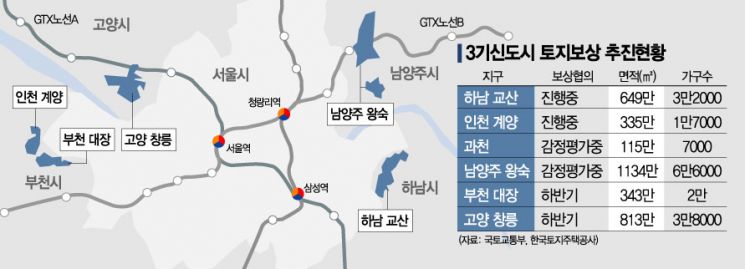
Since the announcement of the March 29 real estate measures to prevent speculation scandals involving employees of Korea Land and Housing Corporation (LH), landowners in the planned sites of the 3rd phase new towns have been increasingly concerned. As the government announced a significant reduction in profits from land transactions and strengthened tax burdens, some landowners have been rushing to proceed with compensation procedures before the legislation is finalized. This paradoxical situation has accelerated land compensation work, even as calls for the cancellation of the 3rd phase new towns arose due to speculation scandals.
According to LH and others on the 15th, the land compensation rates for Hanam Gyosan New Town (6.49 million ㎡) and Incheon Gyeyang (3.33 million ㎡), which began compensation procedures at the end of last year, are both reported to be close to 60%. Hanam Gyosan and Incheon Gyeyang were the first among the new town sites to start compensation, and recently, the land compensation work has been gaining momentum. As of the end of March, Hanam Gyosan's land compensation rate is 56%, the highest among the 3rd phase new towns. Incheon Gyeyang is also showing progress at 54%.
This is interpreted as a result of the combined effects of recent apartment price increases, the characteristics of the 3rd phase new towns, and the government's announcement of increased land transaction taxes. In the real estate speculation eradication and recurrence prevention measures announced on the 29th of last month, the government unveiled a reform plan for the capital gains tax on land. The aim is to reduce incentives for land speculation by reclaiming profits from land transactions through taxation. In particular, the increase in the capital gains tax rate on short-term held land effective from January 1 next year is having a significant impact on the market.
The exemption benefits from capital gains tax surcharges for land transfers due to public projects such as site development are being drastically reduced, and if non-business land is newly purchased after the enforcement of the law, capital gains tax reduction benefits will not be available. Previously, capital gains tax surcharges applied if non-business land was purchased within two years from the announcement date of related projects such as the 3rd phase new towns, but this period will be extended to five years. In other words, those who purchased land three years before the announcement date will have to pay more capital gains tax when disposing of the land. This creates an incentive to dispose of land as quickly as possible to avoid a capital gains tax bomb.
The special supply criteria for negotiated transfer housing have also put landowners in a dilemma. Recently, the Ministry of Land, Infrastructure and Transport announced a legislative notice for the amendment of the 'Public Housing Special Act Enforcement Rules.' According to the amendment, for negotiated transfer housing, even in the metropolitan area, those owning 400㎡ or more of land will be selected as eligible, relaxing the previous requirement of owning 1000㎡ or more.
Eligible individuals can receive special supply of apartments with a floor area of 85㎡ or less. Given the recent surge in apartment prices in the metropolitan area and the soaring value of occupancy rights, expectations for new apartments are considerable. The problem is that if the land compensation objection procedure is pursued, this eligibility disappears. A real estate industry official said, "The moment you enter the objection procedure to get more compensation, the 'lottery apartment' disappears," adding, "This inevitably leads to a dilemma between compensation money and new apartments."
The preference for land-for-land compensation due to soaring apartment prices and increased land demand is also accelerating the compensation process. Land-for-land compensation is a method where landowners offer their land but receive developed sites within the district as compensation. LH explained that the recent increase in compensation rates in Hanam Gyosan and Incheon Gyeyang is largely due to landowners opting for land-for-land compensation.
© The Asia Business Daily(www.asiae.co.kr). All rights reserved.
![From Bar Hostess to Organ Seller to High Society... The Grotesque Con of a "Human Counterfeit" [Slate]](https://cwcontent.asiae.co.kr/asiaresize/183/2026021902243444107_1771435474.jpg)
















